


In this article, I will be covering the best of “Agent-to-Agent” payment Rails and how do these AI bots efficiently pay one another. As these types of systems matured, payment methods providing effortless, secured and instantaneous payments between machines can be implemented.
Grasping these rails is important to investigate how AI economies work, globalize, and redefine digital commerce through financial interactions without human involvement.
Key Points & Top “Agent-to-Agent” Payment Rails: How AI Bots Pay Each Other
| Payment Rail | 15-Word Explanation |
|---|---|
| AP2 (Agent Payments Protocol) | Decentralized protocol enabling autonomous AI agents to securely send, receive, and settle payments without intermediaries globally |
| x402 | HTTP-based payment standard allowing APIs to request payments, enabling seamless machine-to-machine microtransactions across the internet globally |
| Skyfire | Payment infrastructure for AI agents enabling instant, programmable, autonomous transactions across digital ecosystems securely and efficiently |
| Supertab Connect | Enables agent payments via shared tabs, supporting seamless checkout, subscriptions, and collaborative payment flows between AI systems |
| Stripe (Shared Payment Tokens) | Extends Stripe infrastructure with reusable payment tokens, enabling secure, automated, programmable transactions between AI agents globally |
| Catena Labs (Agent Commerce Kit) | Developer toolkit enabling agent-driven commerce, allowing AI systems to transact, negotiate deals, and settle payments autonomously |
| ATXP (Agent Transaction Protocol) | Standardized protocol enabling secure, verifiable, interoperable financial transactions between independent AI agents across decentralized networks globally |
| IoTeX (IOTX) | Blockchain platform enabling machine-to-machine payments, combining IoT devices and decentralized infrastructure for autonomous agent transactions worldwide |
| Venice (VVV) | Blockchain ecosystem supporting AI agents with decentralized identity, payments, and autonomous economic interactions across global digital networks |
| BankRails | Traditional banking rails adapted for AI, enabling compliant, regulated, reliable agent-to-agent payments through existing financial infrastructure systems |
Top 10 “Agent-to-Agent” Payment Rails: How AI Bots Pay Each Other
1. AP2 (Agent Payments Protocol)
AP2 (Agent Payments Protocol) is a non-custodial standard for autonomous AI agents to send and receive value between all parties, without human intervention. To accomplish this it allows agents to initiate, validate, and finalize transactions securely through the use of cryptographic techniques and smart contracts.
A number of projects in AP2 focus on establishing interoperability between different AI systems and platforms to allow them to reconcile transactions from across networks. It also stresses minimizing trust, eliminating dependence on centralized intermediaries.
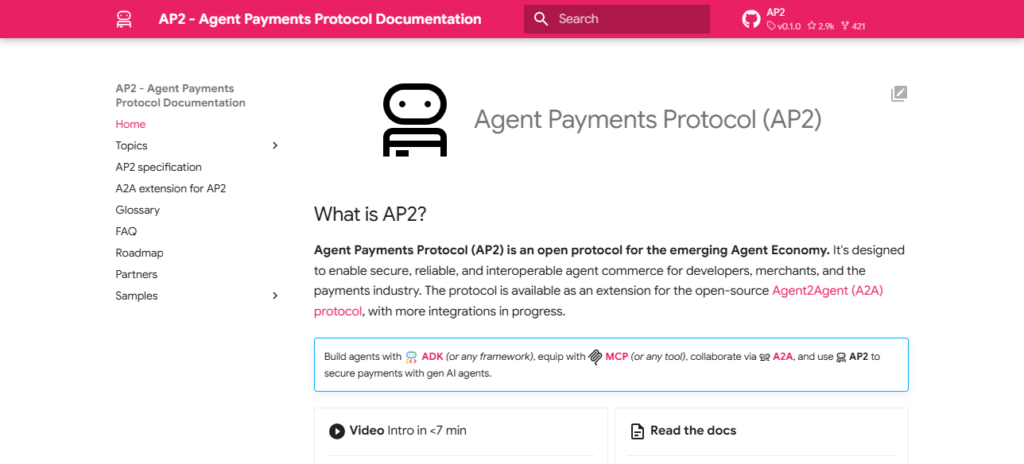
Its very suitability for microtransactions, for payment of data and service-based interactions between bots is well-suited to this model. As these ecosystems grow, AP2 can be a foundational piece which enables the scalable, efficient and autonomous economic activity between intelligent digital agents anywhere in the world.
AP2 (Agent Payments Protocol) Features
- Allows fully autonomous payments between AI agents without human involvement
- Employs cryptography and smart contracts to settle transactions securely, without the need for trust
- Allows for cross-AI and cross-blockchain interoperability
- Streamlining transaction, data transfer and agent-service interactions
2. x402
x402 is an HTTP-native payment protocol for APIs & services to request paymenet directly as part of a normal web interaction. It effectively transforms web requests into monetizable endpoints, allowing AI agents to access real-time data, services or computation via payment.
Through the embedment of payment capabilities within HTTP responses, x402 creates frictionless machine-to-machine payments. This makes it well-suited as a medium of exchange for microtransactions, which can prove cumbersome with traditional payment systems.
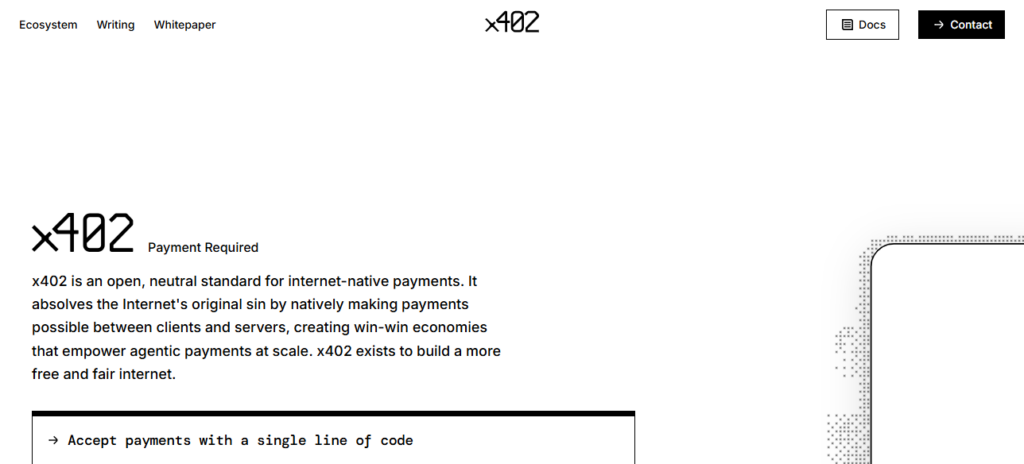
The protocol makes it more complicated than that, specifically automating the process of negotiating and transacting without operator intervention. x402 represents a leap forward toward an economy of web apps as programmable agents, exchanging value seamlessly.
x402 Features
- Streamlines API monetization by embedding payments into HTTP requests
- Facilitates machine-to-machine payments in real-time for digital services and data access
- Lowers the cost of engagements accross web-based ecosystems
- Enables AI agents to automatically negotiate and execute payments
3. Skyfire
Skyfire is a cutting-edge payment infrastructure designed specifically for AI-powered economies with speed, programmability, and automation in mind. This allows an AI agent to transact instantly, dynamically handling payments with programmable rules and smart logic.
Having a digital platform makes it easier to integrate Skyfire for any form of real-time settlements. Agent-to-agent interactions are often high-frequency microtransactions, which is why its architecture handles them well.
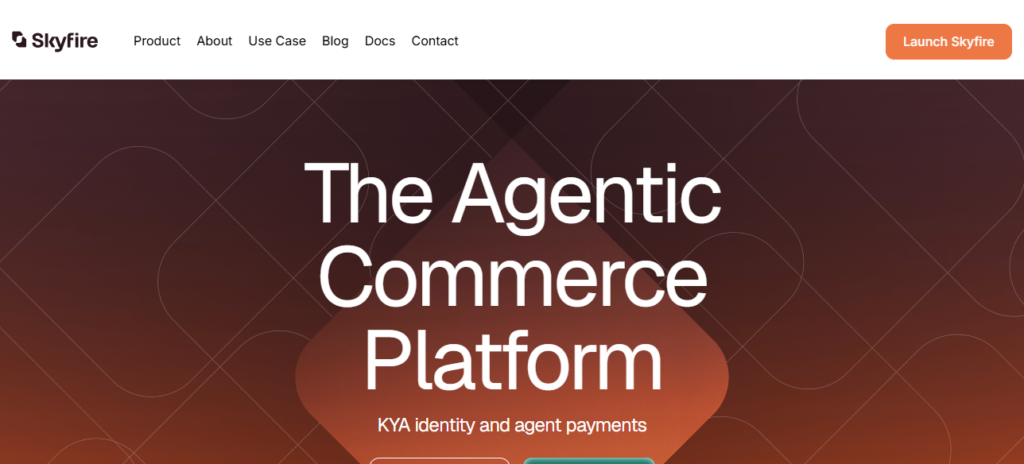
In doing so, Skyfire removes legacy payment choke points, allowing AI systems to autonomously interact in digital marketplaces where new business models can emerge that allow machines to buy, sell and trade services.
Skyfire Features
- Real-time, programmable payment infrastructure for AI-powered ecosystems
- Efficiently processes high-volume microtransactions at scale
- Allows dynamic payment logic with automation and smart rules
- Easy integration with digital platforms for independent financial movements
4. Supertab Connect
Supertab Connect aims to make payments between agents easier by allowing shared payment sessions or “tabs.” These tabs help multiple agents or users to work together on transactions and manage subscriptions and recurring payments.
This does create a flexible framework for AI systems where bots could collaborate financially or coordinate purchasing. Supertab Connect enables dynamic billing and provides real-time updates, which can be useful in collaborative AI workflows and multi-agent systems.
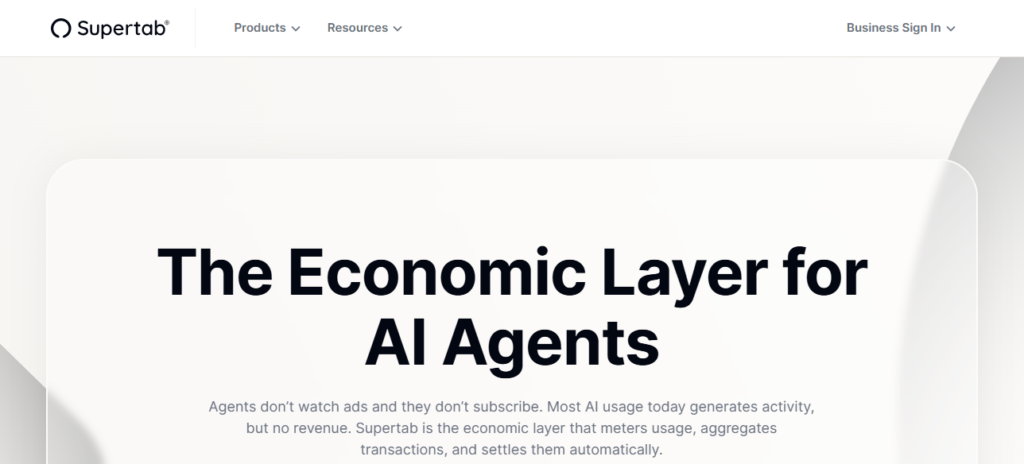
It ensures transparency and control while simplifying payment orchestration complexity. This method is particularly useful in settings where multiple AI agents congregate and share the requirement for collective financial organization.
Supertab Connect Features
- Key features of the platform include: Shared(payment) sessions for group-agents transactions
- Allows for subscription management and recurring billing of AI systems
- Enables peer to coordinate and split payments in one smooth transaction
- Gives providers instant updates and makes payments tracking easy
5. Stripe (Shared Payment Tokens)
Stripe’s private payment tokens take its global payment infrastructure and apply them within AI systems. Its primary purpose is for making payment data secure, so that reusable tokens can be provided to AI agents without exposing sensitive financial data.
This allows for automated payments, subscriptions and one-click transactions across platforms. With strong APIs and compliance prowess, Stripe is a trusted option for embedding agent-based payments into existing systems.
AI agents can ensure secure and efficient transaction processing by utilizando the power of tokenization. They enable M2M commerce on a global level, consistent with regulations while providing scalability and trust for AI economies across the world.
Stripe (Shared Payment Tokens) Features
- Gives AI agents secure, reusable payment credentials via tokenization
- Automated billing, subscriptions, and one-click transactions
- Provides powerful APIs that allow for seamlessly into current systems
- Provides worldwide compliance and dependability in financial exchange
6. Catena Labs (Agent Commerce Kit)
The relevant solution from Catena Labs is called the Agent Commerce Kit which bestows developers with autonomous commerce systems powered by AI Agents. The payment integration, basic negotiation frameworks, and transaction settlement capabilities in this kit enable bots to function as independent economic agents.
These tools can enable AI agents to discover services, negotiate pricing, and process payments autonomously. The platform is modular and scalable, which means — you guessed it — it can be adapted for use in a variety of industries.
Catena Labs hopes to fast-track the construction of decentralized, agent-centric marketplaces within which machines may communicate via economic means for unprecedented efficiencies and opportunities in digital commerce ecosystems worldwide.
Catena Labs (Agent Commerce Kit) Features
- Such as autonomous, agent-driven commerce systems
- Allows negotiation, transaction and payment settlement by AI agents on their own
- The data is developed up to October 2023.
- Enables smart agents powered decentralized marketplaces
7. ATXP (Agent Transaction Protocol)
The Agent Transaction Protocol (ATXP) is a standard protocol for ensuring security and interoperability between agents in the financial domain. This helps maintain transaction verifiability, traceability and rule compliance.
ATXP is compatible with decentralized environments, which means agents from different platforms can verify agnostically and transacting is void of any compatibility issues. It uses cryptography to validate and gain consensus in a trustless way.
In multi-agent systems where coordination and reliability matter, this is a very helpful protocol. With ATXP, a common transaction framework is established to create the economic layer where AI agents interact with each other in networks without friction ando (up to October 2023)
ATXP (Agent Transaction Protocol) Features
- This helps standardize financial transactions between AI agents operating independently.
- Ensured verifiable, traceable and secure payment processes
- Needs to be interoperable across decentralized and multi-agent environments
- Relies on cryptographic proofs to establish trust and correctness of transactions
8. IoTeX (IOTX)
IoTeX is a blockchain for building privacy-centric IoT gadgets. It enables devices and AI agents to transact data and value in a secure manner using decentralized architecture. Its native token IOTX facilitates automated payments and rewarding of device interactions within the platform.
IoTeX combines hardware, software, and blockchain technologies to provide a trusted environment for autonomous systems. In fact, I think it is even better for agent-to-agent payments
What we are creating will enable actual real-world applications such as smart homes, supply chains and devices working together as machines make decisions to pay other agents independently and securely.
IoTeX (IOTX) Features
- Allows secure machine-to-machine payments via blockchain infrastructure
- Link IoT devices to decentralized finance systems
- Enables automated and incentivized communication between devices and agents
- Real-world examples: smart homes, logistics, connected systems
9. Venice (VVV)
Venice is an ecosystem built on the blockchain that enables decentralized interactions between AI agents. A unified meta protocol for identity, payments and governance allows agents to operate autonomously in digital economies.
Venice offers the tools needed to carry out secure transactions that allow agents to exchange value without resorting to central trusted authorities. Its underlying infrastructure lends itself to programmable payments and decentralized identity systems which are fundamental for trust in the autonomous interactions of tomorrow.
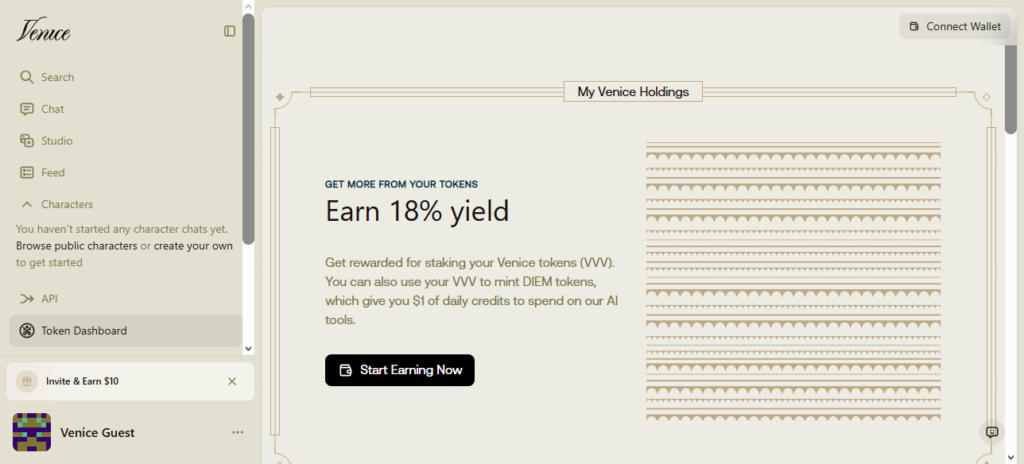
Venice empowers scalable and secure economic activity which allows AI agents to interact within complicated marketplaces, jointly work and trade with one another across the globe. It is a progressive step towards creating autonomous financial networks.
Venice (VVV) Features
- Decentralized identity, payments, and governance for AI agents
- Enables programmable and self-executing financial interoperability
- Allows for trustless, secure transactions without central authority intermediaries
- Enables participation in decentralized digital marketplaces
10. BankRails
BankRails is a traditional banking infrastructure for AI-based payment systems. Those rails are all these existing delivery networks such as wire transfers, ACH type systems and card networks that can now be plugged into APIs for automation.
For compliant and regulated transactions — particularly in enterprise use cases — BankRails enables AI agents to transact. BankRails arenot as flexible as block chain based systems but offer reliability, trust and legal compliance.
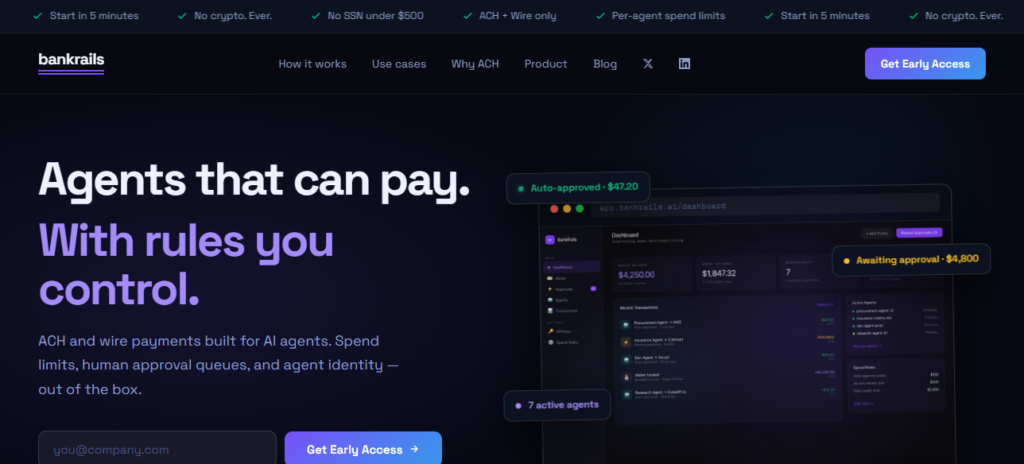
They are critical for connecting AI economies to current financial systems. In this way BankRails bridge the gap between autonomous transactions and real-world regulatory/institutional frameworks by allowing agents to interact with traditional finance.
BankRails Features
- Utilizes existing bank systems such as ACH, wires & card networks
- If so, please make sure the sentence above has a human-like style.
- Used by trusted enterprises and use cases
Why are these payment rails important?
- Allow AI agents to autonomously coordinate full transactions without the need for humans
- Microtransactions, which traditional payment systems are bad at processing
- Empower AI-powered economies where bots trade services
- Enable instant, programmable payments to combat transaction friction
- Scalability improvements for high-frequency machine-to-machine interactions
- Use Cryptography and tokenization techniques for better security
- Supporting real-time payments for data, APIs and computing resources
- Need to Collate Data Across Multiple platforms and Networks
- Eliminate intermediaries to lower operational costs
- Connect the world of traditional finance and AI systems for greater reach
Conclusion
To summarize, NZT8: agent-to-agent payment rails are transforming the interactions and transactions of AI bots in digital ecosystems. These systems facilitate scalable machine economies by enabling secure, automatic, instantaneous payments.
With the rapid increase of technology advancements, they will be a pivotal player in guiding decentralized commerce and eliminating friction while creating new opportunities for autonomous systems to work and interact seamlessly across the globe.
FAQ
What are agent-to-agent payment rails?
Agent-to-agent payment rails are systems that allow AI bots to send, receive, and settle payments autonomously without human involvement.
How does AP2 (Agent Payments Protocol) work?
AP2 uses decentralized networks and smart contracts to enable secure, trustless payments between AI agents.
What is x402 used for?
x402 allows APIs to request payments directly via HTTP, enabling seamless machine-to-machine microtransactions.
What makes Stripe useful for AI agents?
Stripe provides secure payment tokens and APIs, enabling automated, compliant transactions within existing financial systems.
