


In this article, I will review the Blockchain Projects Solving the Global AI Hardware Shortage and how they increase computing power availability.
With the rise in AI demand, decentralized blockchain solutions are making GPU resources available in a more streamlined, equitable manner.
These inventive solutions minimize scalability and infrastructure constraints. These alternative Computing Solutions are critical to the AI Hardware Supply Crisis and the growing demand for AI resources.
Our Criteria for Selecting Blockchain Projects to Address the Global Shortage of AI Hardware
- Distributed decentralized GPU framework and computing resources.
- Capacity to assist with both the training and inference of AI.
- Scalability of the network and the worldwide distribution of hardware.
- More affordable than the usual cloud service providers.
- Disruptive innovation of Blockchain and AI.
- Strength of the community and the projects.
- Trustworthiness and utility.
- The solution is real for AI developers and businesses.
- Safety and clear decentralized governance.
- Project/solution will likely solve the global AI hardware problem.
This article tackles how Blockchain Projects Solving the Global AI Hardware Shortage will transform decentralized networking and computing resources.
Considerably rising demand for artificial intelligence is met with growing blockchain platforms that ease GPU capacity distribution and diminish infrastructure costs and scalability.
Super successful blockchain projects deliver efficient services on par with cloud providers and enable AI progress at a global scale.
Key Poinst & Blockchain Projects Solving the Global AI Hardware Shortage
- Akash Network decentralizes GPU resources, improving AI compute availability globally.
- Render Network distributes unused GPUs, supporting scalable AI training workloads.
- io.net aggregates decentralized GPUs, reducing AI hardware access bottlenecks worldwide.
- Aethir provides a decentralized cloud computing infrastructure for AI applications globally.
- Bittensor incentivizes distributed machine learning, expanding accessible AI computing power.
- Gensyn connects idle hardware resources, enabling affordable AI model training.
- Hyperbolic offers decentralized GPU marketplaces, addressing growing AI hardware demands.
- Nosana leverages community hardware networks for efficient AI compute access.
- Ritual integrates decentralized infrastructure, supporting scalable AI development ecosystems.
- Grass monetizes unused internet resources, indirectly supporting decentralized AI infrastructure.
10 Blockchain Projects Solving the Global AI Hardware Shortage
1. Akash Network
Through its decentralized marketplace for GPU resources, Akash Network takes aim at the decentralized AI hardware market.
Rather than relying exclusively on large cloud providers, companies can obtain unused computing resources from Akash’s global network of participants.
This model helps lower infrastructure costs and provides AI developers with better access to more GPUs.
As AI development and adoption grow rapidly in 2026, Akash will attract more machine learning projects looking for low-cost options to run compute operations.
Akash’s blockchain provides an ecosystem with an emphasis on efficiency, accessibility, and scalability for next-generation AI.
Akash Network Pros & Cons
| Pros | Cons |
|---|---|
| Lower GPU computing costs | Performance varies by provider |
| Global decentralized marketplace | Limited enterprise adoption |
| Reduces cloud dependency | Network availability fluctuations |
| Scalable AI infrastructure | Learning curve for beginners |
2. Render Network
Render Network By providing a way for companies to access untapped GPU resources across the globe, Render Network is increasing AI computing access even more.
Although the platform was originally designed for rendering workloads, it has since been updated to cope with the requirements of even the most demanding AI and machine learning workloads.
Render’s unordered computing architecture has been designed with the requirements of AI developers in mind, particularly the challenges posed by the increasing cost of cloud computing.
It has been optimized for the widespread development of AI. As a result, Render is a growing leader in the distributed computing space.
Render Network Pros & Cons
| Pros | Cons |
| Efficient GPU resource utilization | High demand may affect pricing |
| Strong creator ecosystem | Dependent on node operators |
| Supports AI and rendering tasks | Variable hardware quality |
| Expanding enterprise adoption | Competitive decentralized market |
3. io.net
io.net rapidly became a premier decentralized GPU aggregation platform for global AI developers.
The network combines independent computing resources to build a flexible framework that runs large-scale machine learning tasks.
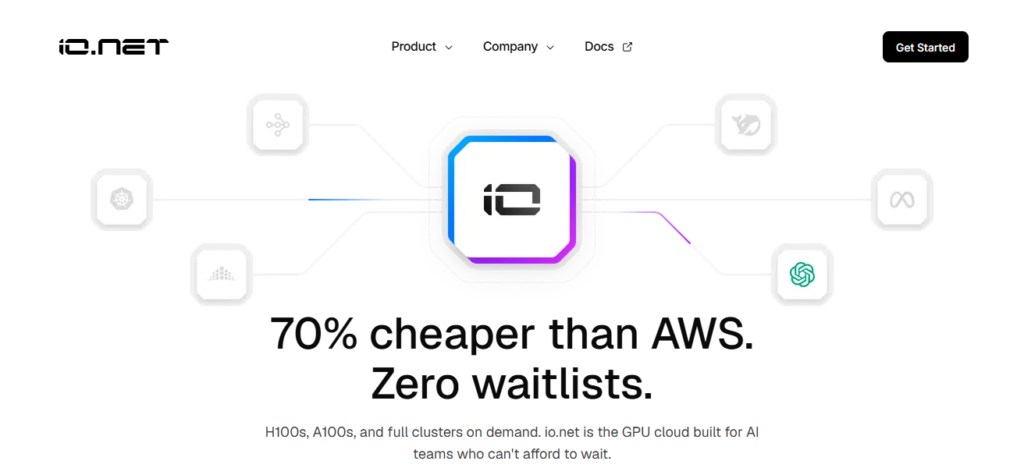
This approach minimizes reliance on centralized cloud providers and reduces costs. With the increasing need for AI training and inference, io.net addresses a crucial hardware gap with dispersed resource availability.
The blockchain-based framework within io.net facilitates accessibility, scalability, and efficiency for companies developing sophisticated AI technologies.
io.net Pros & Cons
| Pros | Cons |
| Large decentralized GPU network | Relatively new platform |
| Cost-effective AI training | Token volatility risks |
| Fast resource aggregation | Limited long-term track record |
| Reduces hardware shortages | Infrastructure still evolving |
4. Aethir
Aethir is a game-changer for decentralized cloud computing. They provide cloud-based enterprise GPU infrastructure for AI, and with a simple, yet elegant, distributed architecture,
Aethir has made available the high-performance computing resources and infrastructure for AI that, up until now, required huge capital expenditure (CX) in the form of physical computing resources.
The needs of the market and the boom in AI, analytics, and machine learning have made its services even more relevant.
With a decentralized cloud architecture, Aethir is helping the world innovate and is addressing the GPU shortage.
Aethir Pros & Cons
| Pros | Cons |
| Enterprise-grade GPU infrastructure | Competitive cloud market |
| High-performance computing access | Network growth still developing |
| Lower hardware investment needs | Potential service variability |
| Supports AI scalability | Regulatory uncertainties |
5. Bittensor
Bittensor takes a unique approach by combining blockchain and AI and incentivizing the provision of machine learning models and computations.
This distributed incentive system promotes the further development of distributed AI and the provision of computing resources.
Here, developers are free to use the network and its resources and get rewarded for their work. With the ongoing AI race, Bittensor brings an alternative infrastructure model for scalable, accessible computing resources and reflects the high demand for AI computing.
Bittensor Pros & Cons
| Pros | Cons |
| Rewards AI innovation | Complex ecosystem structure |
| Encourages distributed learning | Requires technical knowledge |
| Strong incentive model | Market volatility concerns |
| Decentralized AI development | Quality control challenges |
6. Gensyn
Gensyn is creating a system to connect AI developers with idle computing hardware. Gensyn targets individuals with idle computing power in the form of a network.
Traditionally, the hardware cost limits the ways AI researchers and startups can experiment with AI.
Gensyn aims to address these limitations by offering a way to utilize and amplify computing power as Gensyn scales.
Gensyn aims to provide a resource in real time as the AI ecosystem becomes more complex and advanced.
Gensyn Pros & Cons
| Pros | Cons |
|---|---|
| Utilizes idle computing resources | Still under active development |
| Affordable AI model training | Adoption remains early-stage |
| Expands compute accessibility | Limited ecosystem maturity |
| Efficient resource allocation | Technical onboarding required |
7. Hyperbolic
Hyperbolic is a decentralized marketplace for GPUs, specifically targeting high-performance, high-throughput AI Developer workloads.
Hyperbolic presents an affordable and less restrictive compute resource alternative to traditional cloud service providers.
Hyperbolic targets the hardware resource scarcity paradox by leveraging hardware that is surplus and underutilized worldwide.
Hyperbolic’s infrastructure is sufficient to complete the training, inference, and extensive research workloads of AI and beyond.
Hyperbolic posits that as the demand to use advanced computing resources increases, the adoption of AI will increase to the same degree.
Hyperbolic Pros & Cons
| Pros | Cons |
| Decentralized GPU marketplace | Smaller network compared to rivals |
| Competitive computing prices | Variable resource availability |
| Supports AI research workloads | Early ecosystem development |
| Reduces cloud dependence | Market adoption uncertainty |
8. Nosana
Nosana has developed a way to decentralize AI compute resources by empowering its network to provide idle community hardware.
Network participants can contribute their idle community hardware and, in return, receive compensation. This provides hardware to participants and allows developers to scale their hardware.
Nosana has improved hardware utilization and allows more access to the emerging AI Economy.
As the demand for AI computing resources increases globally, Nosana has provided decentralized computing resources on a global scale.
Nosana Pros & Cons
| Pros | Cons |
| Community-driven infrastructure | Hardware consistency challenges |
| Cost-effective computing access | Limited enterprise presence |
| Rewards network contributors | Network size still growing |
| Better hardware utilization | Performance may vary |
9. Ritual
Ritual is making decentralized frameworks easier for blockchain-based systems to integrate with AI.
Adding machine learning to decentralized networks opens the door to many scalable AI systems. Ritual reduces reliance on centralized services.

This strengthens resilience, accessibility, and transparency within the framework. Its structure helps developers create novel AI applications across various domains.
Ritual has a lot of work to do in 2026, as decentralized AI creates demand for more computational structures.
Ritual Pros & Cons
| Pros | Cons |
| Integrates AI with blockchain | Emerging technology sector |
| Improves decentralization | Limited mainstream adoption |
| Supports innovative applications | Ecosystem still expanding |
| Enhances transparency | Long-term scalability unproven |
10. Grass
Grass lets people sell their unused bandwidth for a monetary reward. This is a decentralized method of offering web access.
Grass collects data from the web for distributed participatory research, forming a basis for data sets that decentralized AI systems can use for training and inference. As AI systems become more data hungry,

Grass demonstrates a viable and scalable data collection/networking approach. Grass’s ever-expanding network illustrates the endless possibilities for decentralized systems in AI.
Grass Pros & Cons
| Pros | Cons |
|---|---|
| Monetizes unused bandwidth | Indirect AI hardware contribution |
| Builds decentralized data networks | Privacy concerns for some users |
| Easy participation model | Earnings may fluctuate |
| Supports AI data collection | Dependent on network growth |
Conclsuion
In Conclusion, the Blockchain Projects Attempting to Solve the Global AI Hardware Shortage fundamentally alter worldwide network computing resource access.
Project examples include Akash Network, Render Network, and io.net. Such projects expand the network of GPU resource access, diminish costs, and reduce reliance on centralized entities.
With the imminent growth in AI, so too will the importance of these distributed blockchain technologies in increasing computing resources and stimulating the innovative advancements needed for growth and integration.
FAQ
What is Akash Network known for?
Akash Network provides a decentralized marketplace for affordable GPU computing resources.
Why is Render Network important for AI?
Render Network utilizes unused GPUs to support AI training and rendering workloads.
What makes io.net unique?
io.net aggregates decentralized GPUs into a large-scale AI computing network.
Is decentralized AI computing more affordable?
Yes, decentralized networks often reduce costs compared to traditional cloud providers.
Which project focuses on idle hardware utilization?
Gensyn and Nosana both leverage unused hardware for AI computing tasks.
