


In this article I will talk about the Top QuickSwap Competitors for Polygon Swaps. I will talk about the top decentralized exchanges and swap aggregators for cryptocurrency traders.
You will learn about their major features, pros, and cons, liquidity options, and trading capabilities to help you compare various platforms and choose the most suitable alternative to QuickSwap for your token swapping requirements on Polygon.
Key Points & Top QuickSwap Competitors for Polygon Swaps
| Competitor | Explanation |
|---|---|
| Uniswap | A decentralized exchange enabling users to swap tokens across supported blockchain networks efficiently. |
| SushiSwap | A decentralized exchange offering token swaps, liquidity pools, and yield opportunities across networks. |
| 1inch | A decentralized exchange aggregator finding competitive swap rates across multiple liquidity sources automatically. |
| Curve Finance | A decentralized exchange specializing in efficient stablecoin swaps and similar-value cryptocurrency assets. |
| Balancer | A decentralized exchange providing customizable liquidity pools and automated portfolio management tools. |
| KyberSwap | A decentralized trading platform aggregating liquidity to deliver competitive token swaps across networks. |
| DODO | A decentralized exchange using proactive market-making algorithms to improve liquidity and reduce slippage. |
| Odos | A decentralized exchange aggregator optimizing multi-token swaps across various decentralized liquidity providers. |
| OpenOcean | A cross-chain trading aggregator comparing decentralized exchanges to find efficient token swap routes. |
| Ramses | A decentralized exchange on Arbitrum offering concentrated liquidity and incentives for liquidity providers. |
Top QuickSwap Competitors for Polygon Swaps
1. Uniswap
Uniswap is also a very popular decentralized exchange in the crypto ecosystem and is a good alternative to QuickSwap for Polygon token swaps. It uses automated market maker (AMM) technology that lets users trade tokens with liquidity pools, rather than traditional order books.
Supported trading pairs can be traded by traders, and liquidity providers add tokens to pools and earn trading fees. Uniswap also supports Polygon and several other blockchain networks, allowing users to trade compatible assets.

Good option to compare swap prices, available trading pairs, and transaction fees with QuickSwap with existing ecosystem, familiar interface, and liquidity infrastructure.
Uniswap — Pros and Cons
| Pros | Cons |
|---|---|
| Supports decentralized token swaps across multiple blockchain networks, including Polygon. | Liquidity varies by token pair, potentially increasing slippage for smaller trades. |
| Offers a well-established ecosystem and familiar trading interface. | Network fees and swap costs depend on the selected blockchain and transaction. |
| Provides liquidity pools for users seeking trading-fee opportunities. | Liquidity provision can expose users to impermanent loss. |
| Supports various tokens and automated market-making mechanisms. | Unsupported tokens and trading pairs cannot be swapped directly. |
2. SushiSwap
SushiSwap is a decentralized exchange that facilitates token swaps and liquidity provision across supported blockchain networks, including Polygon. It uses liquidity pools to enable trading between cryptocurrencies without a centralized third party, just like QuickSwap.

Depending on the network and product availability, users can swap supported tokens, add liquidity to eligible pools and discover other decentralized finance opportunities. SushiSwap also provides cross-chain swapping through its SushiXSwap product, thereby expanding its use case for users holding assets on multiple supported chains.
When deciding on a platform to use for their transactions, traders looking to compare SushiSwap and QuickSwap should take into account the pool liquidity, available tokens, trading fees, and estimated price impact.
SushiSwap — Pros and Cons
| Pros | Cons |
|---|---|
| Supports token swaps and liquidity pools across supported networks, including Polygon. | Liquidity may be lower than competitors for certain trading pairs. |
| Offers additional DeFi features depending on network deployment. | Available products and features differ between supported networks. |
| Provides opportunities for liquidity providers to earn trading fees. | Liquidity providers face impermanent loss and smart contract risks. |
| Supports cross-chain functionality through eligible products. | Cross-chain transactions may involve additional costs and complexity. |
3. 1inch
1inch is a decentralized exchange aggregator that aims to help crypto traders find the best exchange rates for swaps across various liquidity sources. Rather than just going to one exchange, it looks at all the available routes and finds the best possible trades for you to make.
This can be a good alternative to direct swapping through QuickSwap for Polygon users, especially when liquidity pools have different prices. Depending on the routes available, a trade may be split between multiple sources for better execution.
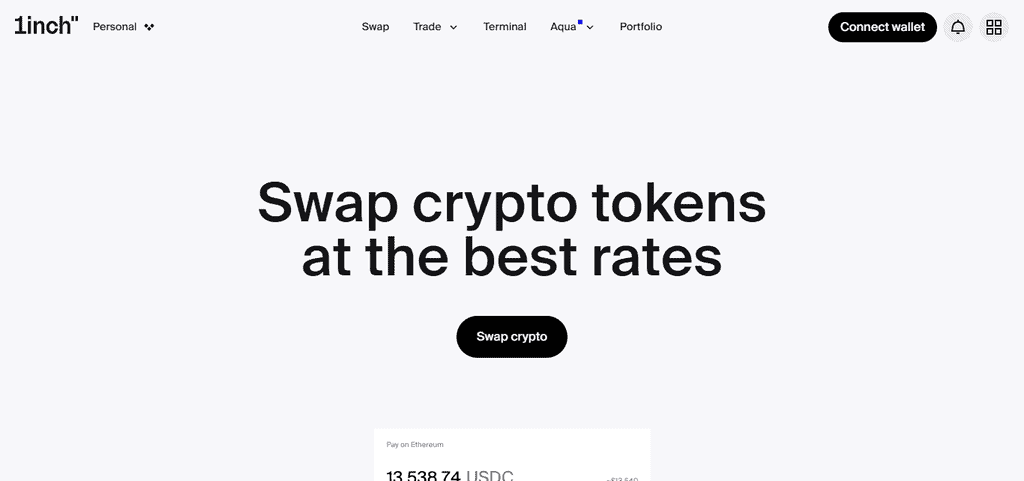
Before confirming a transaction, users should compare the quoted output, network fees, price impact and slippage settings. Actual savings will be a function of liquidity conditions and the tokens being traded.
1inch — Pros and Cons
| Pros | Cons |
|---|---|
| Aggregates liquidity sources to identify potentially competitive swap routes. | Aggregation does not guarantee the best execution for every transaction. |
| Can split trades across multiple liquidity sources when beneficial. | Complex routes can make transaction outcomes harder to evaluate. |
| Helps users compare swap prices across supported decentralized exchanges. | Available routes depend on network, token pair, and liquidity conditions. |
| Supports multiple blockchain networks, including Polygon. | Routing and transaction costs can affect the final amount received. |
4. Curve Finance
Curve Finance is a decentralized exchange protocol built especially for exchanging stablecoins and other assets of equal value. It has unique liquidity pool designs that minimize slippage while trading compatible assets. For some Polygon trading pairs, it is a good alternative to QuickSwap.

If there’s enough liquidity, users swapping between supported stablecoins might benefit from Curve’s pool design. The protocol also allows liquidity provisioning where users can deposit eligible assets into pools, and possibly earn trading fees. Not all token pairs have the best Curve pool available, so traders should compare pools, quoted exchange rates, fees and liquidity before executing a swap.
Curve Finance — Pros and Cons
| Pros | Cons |
|---|---|
| Specializes in efficient swaps between stablecoins and similar-value assets. | Less suitable for many volatile-token trading pairs. |
| Pool designs can reduce slippage for compatible assets. | Benefits depend on sufficient liquidity within the selected pool. |
| Supports liquidity provision and additional DeFi opportunities. | Pool participation involves smart contract and liquidity-related risks. |
| Has an established presence in decentralized finance. | Its interface and pool structures may require additional DeFi knowledge. |
5. Balancer
Balancer is a decentralized finance (DeFi) protocol for token swapping and a platform for creating unique liquidity pools. Unlike a traditional pool that must contain two assets in equal proportion, Balancer can be set up differently with varying asset weightings depending on the type of pool.
The flexibility makes it useful for traders looking for alternatives to QuickSwap and liquidity providers interested in more configurable pool structures. Balancer has supported deployments on Polygon, but not all pools and features are available on each deployment.
You can check out its trading opportunities by looking at pool depth, swap fee, expected output and price impact and compare it with QuickSwap. Liquidity providers should also be aware of impermanent loss and other pool-specific risks.
Balancer — Pros and Cons
| Pros | Cons |
|---|---|
| Supports customizable liquidity pools with different asset weightings. | Pool configurations can be more complicated for beginners. |
| Provides token swapping through supported liquidity pools. | Swap prices depend on pool composition and available liquidity. |
| Enables liquidity providers to explore different pool strategies. | Impermanent loss and rebalancing effects can reduce returns. |
| Supports portfolio-style pools and flexible liquidity structures. | Pool fees and risks vary depending on configuration. |
6. KyberSwap
KyberSwap is a decentralized exchange that enables users to swap tokens and access liquidity related services on supported blockchains including Polygon PoS. It provides trading infrastructure and aggregation for users to access available liquidity and compare execution routes for supported token pairs.
This makes KyberSwap a relevant alternative for traders who want to consider options other than QuickSwap. Depending on the network selected and the liquidity available, users may experience different exchange rates, transaction costs and price impacts.

The supported products also provide tools for liquidity providers. Users should verify the network, token contract addresses, quoted output and transaction details before trading to verify that the route they choose is suitable for their needs
KyberSwap — Pros and Cons
| Pros | Cons |
|---|---|
| Provides token swapping and liquidity-routing capabilities across supported networks. | Available liquidity and features vary between networks. |
| Helps users access competitive trading routes for supported tokens. | Routing cannot guarantee the lowest price in every market. |
| Offers tools for decentralized trading and liquidity provision. | Some features may require additional knowledge of DeFi protocols. |
| Supports Polygon PoS trading opportunities. | Token availability and execution quality depend on current market conditions. |
7. DODO
DODO is a decentralized exchange protocol powered by a proactive market maker (PMM) model to enhance liquidity efficiency and provide competitive trading prices. The approach differentiates DODO from traditional AMMs and provides another option for users comparing Polygon swap platforms.
Supported tokens can be exchanged for one another through the available liquidity pools. Liquidity providers may participate in eligible markets, subject to the rules of the protocol. The performance of DODO is depends on the trading pair, pool depth, market conditions and network deployment.

Users should compare the estimated output, slippage, transaction fees and available liquidity against QuickSwap. They should also verify support for the token pair they want on Polygon.
DODO — Pros and Cons
| Pros | Cons |
|---|---|
| Uses a proactive market maker model designed for liquidity efficiency. | Trading quality depends on the liquidity available in each pool. |
| Supports token swaps through eligible decentralized liquidity pools. | Some token pairs may have limited trading activity. |
| Provides liquidity provision opportunities for supported markets. | Liquidity providers face market, smart contract, and impermanent loss risks. |
| Offers an alternative pricing mechanism to conventional AMMs. | Its market-making model may be less familiar to new users. |
8. Odos
Odos is a decentralized exchange aggregator that searches for the most efficient paths for crypto swaps between supported liquidity sources. Its routing technology can look at combinations of available sources to find a better execution instead of executing a trade in a single liquidity pool.
This could provide Odos as a useful alternative for Polygon traders wishing to compare quoted prices and possible price impacts against QuickSwap. Its routing method could come in especially handy for trades involving multiple tokens or liquidity pools, depending on the current support.
But a more complex path does not necessarily lead to a better outcome. Before approving a swap, users should compare the final token amount received, network costs, slippage, and transaction requirements.
Odos — Pros and Cons
| Pros | Cons |
|---|---|
| Aggregates liquidity sources to seek efficient swap execution. | Route quality depends on available liquidity and supported integrations. |
| Can optimize routes across multiple pools for eligible trades. | More complex routes may involve additional execution considerations. |
| Helps traders compare potential outputs before submitting transactions. | Quoted prices can change before a transaction is confirmed. |
| Supports multi-chain trading where integrations are available. | Network and token support must be verified before swapping. |
9. OpenOcean
OpenOcean is a decentralized aggregator of exchanges that searches various exchanges and liquidity sources for trading routes. Its documentation mentions Polygon as one of its supported networks, and describes integrations with many decentralized exchanges.
Therefore, OpenOcean is a broad aggregation method and is an alternative to QuickSwap for those who want to compare swap prices without checking every exchange. The platform can come in handy in case the liquidity is distributed over many venues or the users want to compare different execution paths.

The results quoted are subject to change depending on current liquidity, available trading pairs and transaction conditions. Users are advised to check the expected output, network fees, price impact and route details before confirming a swap.
OpenOcean — Pros and Cons
| Pros | Cons |
|---|---|
| Aggregates liquidity across supported decentralized exchanges. | Aggregation does not guarantee superior prices for every trade. |
| Helps traders compare potential execution routes. | Route availability varies according to liquidity and integrations. |
| Supports multiple blockchain networks, including Polygon. | Some tokens and trading pairs may not be available. |
| Offers an alternative to manually comparing several exchanges. | Users still need to assess slippage, fees, and transaction risks. |
10. Ramses
Ramses is a decentralized exchange protocol that has concentrated liquidity and liquidity incentive mechanisms. Historically, it has been particularly associated with Arbitrum’s ecosystem, and today’s deployment information also includes Ramses on Polygon.
This gives it the potential to be an alternate for users seeking decentralized trading and liquidity opportunities outside of QuickSwap. Concentrated liquidity enables liquidity providers to concentrate their capital into certain price ranges, which can lead to greater capital efficiency when markets behave as expected.

However, liquidity depth and trading volume can vary greatly among networks and specific pools. Traders or suppliers of assets should review the current Polygon deployment, trading pairs, pool liquidity, fees and smart contract details.
Ramses — Pros and Cons
| Pros | Cons |
|---|---|
| Offers concentrated-liquidity mechanisms in supported deployments. | Concentrated liquidity can require more active management from providers. |
| Provides decentralized trading and liquidity pool functionality. | Liquidity depth can vary significantly between pools and networks. |
| Offers liquidity incentive mechanisms in eligible markets. | Incentives may change and do not guarantee positive returns. |
| Can suit users exploring specialized liquidity strategies. | Users must verify current Polygon support and available trading pairs. |
Conclusion
Last but not least, the Top QuickSwap Competitors for Polygon Swaps have a plethora of features for cryptocurrency traders. Different platforms have different trading and liquidity options including Uniswap, SushiSwap
1inch, Curve Finance, Balancer, KyberSwap, DODO, Odos, OpenOcean and Ramses. Compare transaction fees, liquidity, supported tokens and slippage before choosing an alternative to find one that best suits your Polygon swapping needs.
FAQ
Is Uniswap a good alternative to QuickSwap?
Yes, Uniswap offers decentralized token swaps on Polygon, with liquidity pools and automated market-making features for supported trading pairs.
How does 1inch compare with QuickSwap?
1inch aggregates liquidity from multiple exchanges to find competitive swap routes, while QuickSwap operates its own decentralized exchange protocol.
Which QuickSwap competitor is best for stablecoin swaps?
Curve Finance specializes in stablecoin and similarly valued asset swaps, potentially reducing slippage when suitable liquidity is available.
Is SushiSwap available on Polygon?
SushiSwap has supported Polygon trading, allowing users to swap eligible tokens and access liquidity pools where available.
