


This article analyzes Platforms Offering Cheap Decentralized GPU Compute for AI Models. It illustrates how low-cost, scalable, distributed computing power is disrupting modern AI infrastructure.
It also discusses top networks that facilitate inexpensive GPU access for training and inference while allowing developers to cut costs and balance high-performance and high-efficiency computing that is available and accessible to more people.
Key Points & Platforms Offering Cheap Decentralized GPU Compute for AI Models
- Akash Network provides decentralized GPU compute for affordable AI training
- Golem offers distributed computing resources powering scalable machine learning workloads
- Render Network connects idle GPUs, enabling cost-efficient AI rendering
- io.net aggregates global GPU clusters for a decentralized AI infrastructure platform
- Vast.ai marketplace provides low-cost GPU rentals for AI models
- Flux ecosystem enables decentralized cloud GPU computing for AI applications
- Nosana leverages the Solana network for a decentralized GPU AI compute platform
- Spheron Network provides a decentralized cloud infrastructure for AI workloads scaling
- Cudo Compute delivers distributed GPU power for machine learning tasks
- Salad leverages idle consumer GPUs worldwide for an AI training platform
10 Platforms Offering Cheap Decentralized GPU Compute For AI Models
1. Akash Network
Akash Network offers a decentralized GPU marketplace targeting low-cost options for AI training and inference workloads.
Using blockchain-based cloud infrastructure, developers access underutilized GPUs worldwide for a fraction of the price of traditional cloud services.
It is open source and ecosystem-friendly to containerized deployments and machine learning pipeline steps.
Akash has made great strides in the efficiency of GPU scheduling, Kubernetes integration, and added providers for better scalability and performance for AI Developers.
Spheron Network Features
- Web3-native cloud service
- Global access with lightning-fast decentralized compute services
- Reliable and super-fast system
- Easy deployment and integration with other Web3 services
2. Golem
Golem has a global peer-to-peer network of users renting idle computing power. This is a great option for scalable ML, rendering, and AI computation.

Golem breaks up a larger task and allows for processing in smaller subtasks across the global nodes. This system increases efficiency and drives down cost.
Golem has put a lot of recent focus on improving task verification and computer allocation speed, and is a great choice for most AI startups.
Golem Features
- Peer-to-peer distributed computing network.
- Breaks down large AI workloads into smaller tasks.
- Makes good use of idle computing resources around the world.
- Great for AI, rendering, and batch-processing workloads
3. Render Network
The Render Network links leftover GPU computing power from users around the world with people needing advanced rendering and AI computing resources.
Originally used for 3D rendering, the network has also been used for AI model workloads. The network uses cost efficiency by matching supply and demand.

More contributors are joining the network due to the improved node integration and updated AI inference task support in the ecosystem.
Render Network Features
- Elicits idle GPUs for decentralized computing.
- Designed to handle rendering and AI workloads.
- Contributors are rewarded using a token-based incentive system.
- GPU demand and supply are dynamically adjusted
4. io.net
io.net creates a single decentralized AI infrastructure layer from a collection of distributed GPU clusters.
The focus is on providing compute with very low latency and high performance for the tasks of training, fine-tuning, and inference of AI models.
The collection of spare GPUs from many providers reduces the need for many centralized cloud providers.
Improved cross-cluster orchestration and load balancing are some of the innovations, as well as the expansion of AI tooling for enterprises. All make io.net a robust competitor in decentralized GPU compute for modern AI models.
io.net Features
- Unifies the world’s GPU clusters into a single network.
- Designed for low-latency AI training.
- Multi-sourced GPU infrastructure.
- Provides enterprise-level, decentralized AI computing
5. Vast.ai
Vast.ai is an easy way to rent a GPU as a highly decentralized marketplace where AI and GPU enthusiasts offer low-cost computing services.
A key advantage is that users choose the GPU they want and can even customize by cost or even choose the fastest and most responsive.

It is especially useful for Machine Learning because of all the experiments that need to be run on large models.
New features, such as better search filters and clearer transparent pricing, have made it more user-friendly for AI practitioners while working with a low budget.
Vast.ai Features
- Real-time market for renting GPUs.
- A large variety of GPUs to choose from.
- Affordable GPU-based AI model training.
- Uptime and performance are visibly tracked.
6. Flux
Flux delivers a decentralized Web3 cloud suite with GPU compute resources for AI. It promotes the flexible deployment of distributed frameworks worldwide and lessens dependence on centralized, large-scale cloud providers.
AI developers can now deploy workloads with better availability and redundancy. Flux has recently added support for parallel computing
Enhanced Web3 interoperability and a growing number of decentralized node operators. Flux is increasingly used as an infrastructure for AI integration with blockchain.
Flux Features
- Decentralized Web3 cloud supporting GPUs.
- Computing distributed across a global network of nodes.
- Highly redundant and reliable system.
- Designed for blockchain.
7. Nosana
Nosana, built on Solana, provides decentralized, cost-effective GPU compute resources for AI. It is designed to support the processing needs for continuous integration, as well as the training and inference of AI, cost-effectively.
Nosana aims to provide localized compute resources by using a distributed network to minimize latency.
Enhanced job scheduling, faster execution, and an ever-growing number of GPU providers have solidified Nosana’s position as a leader in AI decentralized GPU compute infrastructure.
Nosana Features
- Built on the Solana blockchain.
- Optimized for AI CI/CD and inference workloads.
- Fast GPU jobs with distributed scheduling.
- Decentralized compute marketplace.
8. Spheron Network
Spheron Network offers cloud infrastructure that is decentralized and aimed at closed, scalable GPU compute resources for AI.
It is designed to ease the friction of deploying ML workloads in a variety of distribution methods. Spheron offers many compute resources and takes a highly automated, developer-centric approach.
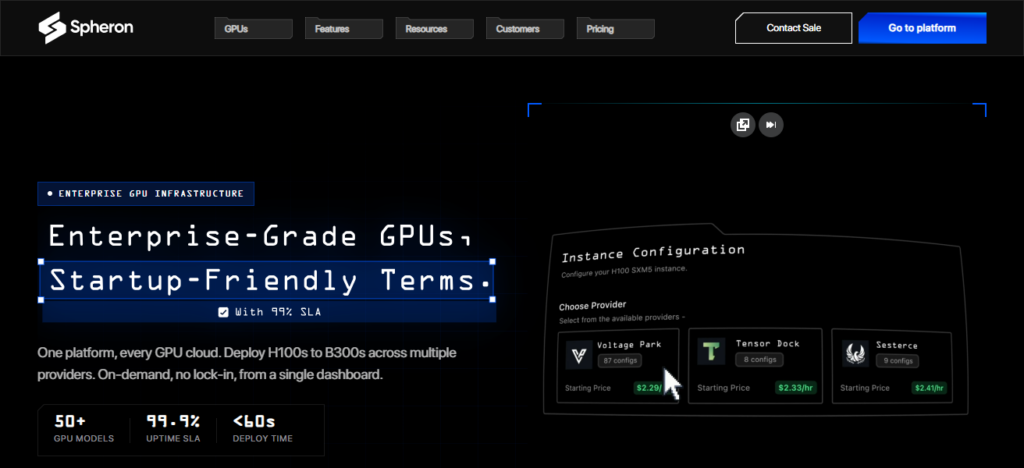
Recent enhancements in deeply automated, multi-cloud integrations and GPU compute resources have increased Spheron’s relevance for early-stage startups building decentralized infrastructure AI solutions.
Spheron Network Features
- AI-optimized, decentralized, and flexible marketplace computing
- Fast scheduling for GPU jobs
- CI/CD support with a focus on AI
- Built on the Solana blockchain
9. Cudo Compute
Cudo Compute provides distributed GPU computing for ML, AI training, and rendering. It turns unused compute resources and participants from around the world into a computing ecosystem that is cheaper to use.
The system has easy-to-use and simple intake resources that scale to workloads with less friction.

Street reputations have improved with new performance monitors, new enterprise integrations, and new tools to better manage and utilize GPUs.
Because of these updates, this platform is a great choice compared to other GPU cloud services for AI developers.
Cudo Compute Features
- Simplified AI application deployment
- Multi-cloud and decentralized infrastructure
- Automated GPU workload scaling
- Advanced orchestration for developers
10. Salad
Salad is a distributed computing service that offers AI training and rendering via consumer GPUs that Salad and the user have left idle.
Salad promotes a resource-sharing model that relies on the “gameification” of computing resource sharing, which encourages users to contribute their resources by rewarding them for doing so.

Because of this, Salad is relatively one of the best available services for low-cost GPU computing.
Salad has also optimized its background computing, rewards, and AI task computing, updating and improving its positioning for developers and creators around the world to access GPUs.
Salad Features
- Uses idle consumer GPCs internationally
- Contributing is a game and a reward system
- AI Compute power is cheap
- Background computation and training
Conclusion
In summary, the decentralized GPU compute platforms are profoundly altering the structure of AI by providing cheaper, scalable, and globally accessible compute power.
Examples such as blockchain-based solutions Akash Network, Nosana, and Vast.ai are examples of the ways in which these platforms are solving the heavy reliance on expensive centralized compute clouds.
When used collectively, these solutions can compute power even more efficiently for AI training, making it more accessible and more efficient. The need for AI is also playing a major role in the decoupling of GPU compute power across the globe.
FAQ
Is Akash Network suitable for AI training?
Yes, Akash Network supports scalable and affordable AI workloads.
Can Golem be used for machine learning?
Yes, Golem supports ML, rendering, and batch processing tasks.
Is Render Network only for rendering?
No, Render Network now also supports AI workloads.
What makes Vast.ai popular?
Vast.ai offers low-cost, flexible GPU rentals globally.
