

This article identifies the top decentralized AI chatbots while exploring the intersection of blockchain-based infrastructure and communications systems within the context of AI.
The chatbots listed here are the best for a reason— their features and use cases are numerous and beyond the scope of traditional methods of communication. This guide will offer you insight into the commercial success of Web3 AI chatbots.
Key Poinst & Best Decentralized AI Chatbots Built on Blockchain Infrastructure
SingularityNET – Decentralized AI marketplace enabling secure blockchain-powered intelligent service exchanges.
Fetch.ai – Autonomous AI agents perform tasks using decentralized blockchain networks.
Ocean Protocol – Securely shares data for AI training through blockchain.
Cortex – Executes AI models directly on decentralized blockchain infrastructure.
Oraichain – Integrates AI services and smart contracts on blockchain.
ChainGPT – Blockchain-focused AI chatbot delivering crypto insights and automation.
Alethea AI – Creates intelligent digital characters powered by decentralized AI.
Numerai – Uses decentralized machine learning models for financial predictions.
Bittensor – Incentivizes collaborative AI development through blockchain-based rewards systems.
Venice AI – Privacy-focused decentralized chatbot ensuring secure AI interactions.
10 Best Decentralized AI Chatbots Built on Blockchain Infrastructure
1. SingularityNET
SingularityNET is a popular decentralized Artificial Intelligence ecosystem. Developers are allowed to create, share, and monetize their AI offerings.
SingularityNET uses a blockchain-based marketplace to eliminate central authority and facilitate AI transactions.
Interoperability and accessibility updates offer developers user-friendly features across various blockchains.
SingularityNET supports advanced applications of machine learning and artificial intelligence. This is the Denver-based project’s main selling point, allowing businesses to take advantage of its rapid scalability.
SingularityNET Pros & Cons
| Pros | Cons |
|---|---|
| Decentralized AI marketplace for developers | Complex for beginners |
| Supports multiple blockchain networks | Token price volatility |
| Enables AI service monetization | Limited mainstream adoption |
| Transparent ecosystem operations | Technical learning curve |
| Strong AI community support | Some services require advanced knowledge |
2. Fetch.ai
Fetch.AI uses a combination of AI and blockchain technology to build a decentralized infrastructure designed to support autonomous software agents.
These agents have the ability to analyze data, run a logistics network, conduct financial transactions, and even run a smart city without the need for constant supervision.
Many of its recent updates have focused on automation, helping companies further enhance their internal operations and reduce costs.
Fetch.AI is preparing for the next generation of digital ecosystems by enabling machine-to-machine communication in a totally decentralized network.
Fetch.ai Pros & Cons
| Pros | Cons |
| Autonomous AI agent technology | Enterprise adoption still growing |
| Reduces operational costs | Complex architecture |
| Supports machine-to-machine automation | Requires technical expertise |
| Useful for smart cities and logistics | Competitive AI sector |
| Scalable decentralized infrastructure | Network growth depends on adoption |
3. Ocean Protocol
Ocean Protocol is a decentralized network designed for data sharing, and privacy-preserving data monetization.
One valuable aspect of Ocean Protocol in AI is that it offers data that can be used to train machine learning models.
Ocean Protocol’s recent updates have focused on data tokenization that supports privacy-preserving data exchange.
Many companies, especially developers and researchers, are looking for decentralized AI. As the AI industry grows, so will the demand for AI training and data.
Ocean Protocol Pros & Cons
| Pros | Cons |
| Secure data monetization platform | Data quality varies by provider |
| Strong privacy protection features | Complex tokenized data model |
| Supports AI model training | Regulatory uncertainty around data markets |
| Encourages data ownership | Limited awareness among traditional businesses |
| Transparent blockchain transactions | Adoption barriers for non-technical users |
4. Cortex
One of the first platforms to facilitate the deployment of artificial intelligence models on-chain is Cortex. Traditionally, centralized servers are needed to run AI models.
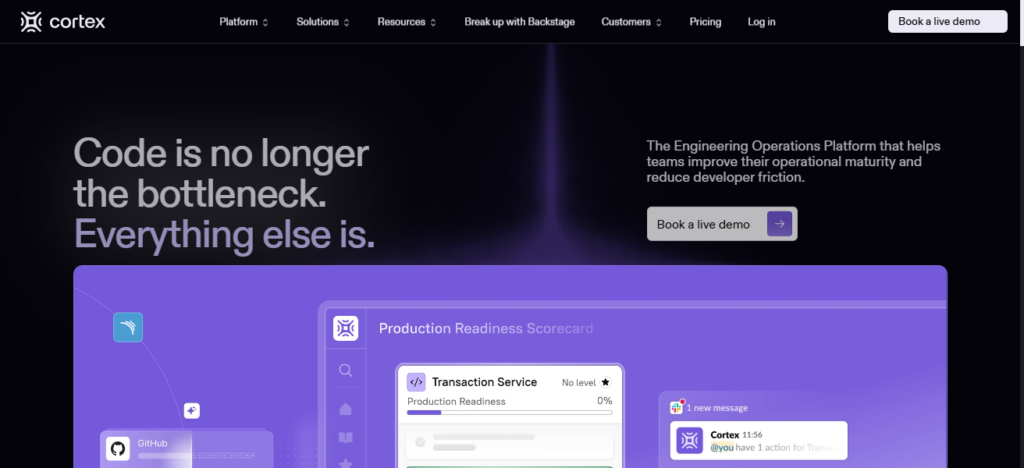
Developers can deploy AI algorithms in smart contracts on the Cortex platform. While the traditional way to run AI models on a blockchain is to rely on a central server, the Cortex platform reduces reliance on centralized servers.
Significant progress has already been made in the field of model efficiency and optimization. Cortex is pioneering the combined use of blockchain and AI to provide a safe and secure environment without reliance on central authorities.
Cortex Pros & Cons
| Pros | Cons |
| Runs AI models directly on blockchain | High computational requirements |
| Increases transparency and trust | Limited AI model compatibility |
| Supports AI-powered smart contracts | Smaller ecosystem than competitors |
| Reduces centralized dependence | Development can be challenging |
| Innovative blockchain-AI integration | Performance limitations on-chain |
5. Oraichain
Oraichain is an AI-integrated blockchain ecosystem that merges artificial intelligence and smart contracts.
Developers can submit AI outputs to the AI oracle in the ecosystem, and only then will the outputs be executed in the smart contract.
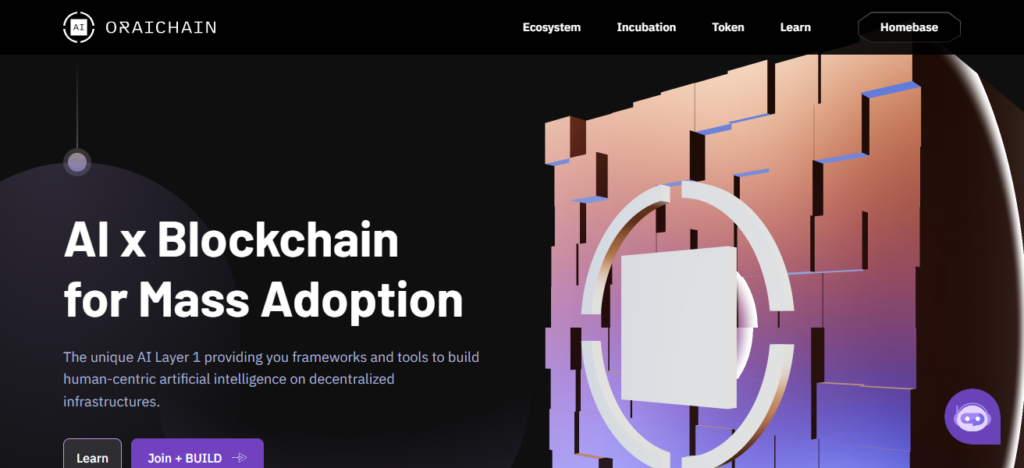
This increases the reliability of the AI outputs and, in turn, the security of the whole dapp. The evolving ecosystem has greatly enhanced its AI oracle services.
Oraichain merges machine learning with a decentralized verification system, thus resolving some of the trust-related issues of AI.
This makes it an ideal and important solution for businesses seeking to build and integrate intelligent AI operations.
Oraichain Pros & Cons
| Pros | Cons |
| AI oracle verification system | Growing but smaller ecosystem |
| Enhances smart contract reliability | Requires blockchain expertise |
| Supports multiple AI services | Adoption still expanding |
| Strong security mechanisms | Limited mainstream recognition |
| Useful for enterprise applications | Complex integration process |
6. ChainGPT
ChainGPT is an AI platform created exclusively for the blockchain and cryptocurrency community.
It features AI for the generation of smart contracts, the analysis of markets and blockchains, the automation of content generation, and much more.
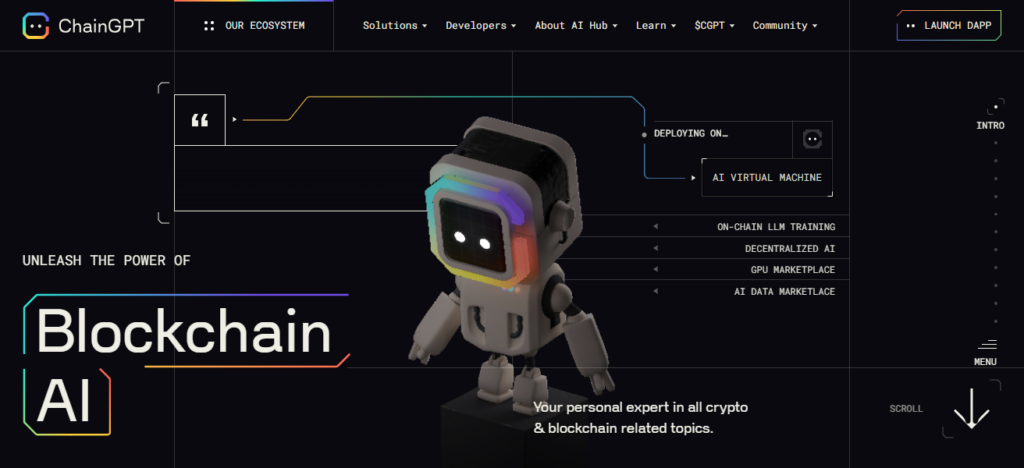
ChainGPT is gaining prominence as a dedicated Web3 and blockchain innovation assistant. The latest version of ChainGPT has expanded its AI conversational capabilities and support for DeFi operations.
ChainGPT Pros & Cons
| Pros | Cons |
|---|---|
| Specialized for blockchain users | Crypto-focused use cases |
| Generates smart contracts efficiently | Accuracy depends on prompts |
| AI-powered market insights | Not ideal for non-crypto users |
| Supports Web3 development | Premium features may require payment |
| User-friendly interface | Rapidly evolving competition |
7. Alethea AI
Alethea AI is innovating the way we interact with the digital world by merging virtual characters with decentralized AI.
These characters communicate using advanced AI, and they have the ability to learn and engage in many different digital spaces.
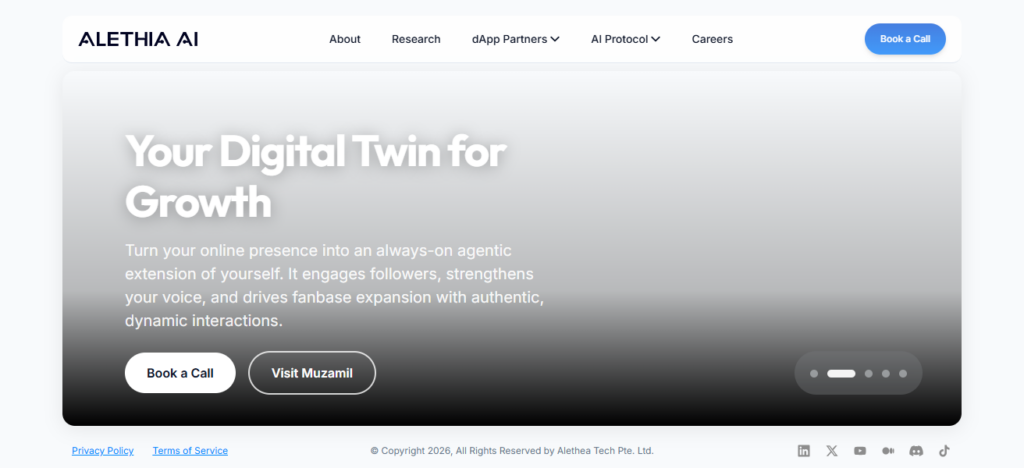
Their most recent updates have improved their functionality regarding the metaverse and creator economies.
Alethea AI combines the power of AI with blockchain to allow digital ownership, which is a game-changer for many businesses and content creators.
Their digital beings are interactive, and with the combination of intelligent design and decentralized frameworks, they push the boundaries of what’s possible with AI.
Alethea AI Pros & Cons
| Pros | Cons |
| Creates intelligent AI characters | Niche market focus |
| Supports metaverse applications | Adoption depends on virtual ecosystems |
| Enables digital asset ownership | Limited real-world enterprise use |
| Innovative creator economy tools | Learning curve for creators |
| Combines AI with NFTs | Market demand can fluctuate |
8. Numerai
Numerai is a decentralized hedge fund where a machine learning model is the main player. Data scientists build financial prediction models, enter a friendly competition, and receive rewards based on the model’s prediction outcomes.
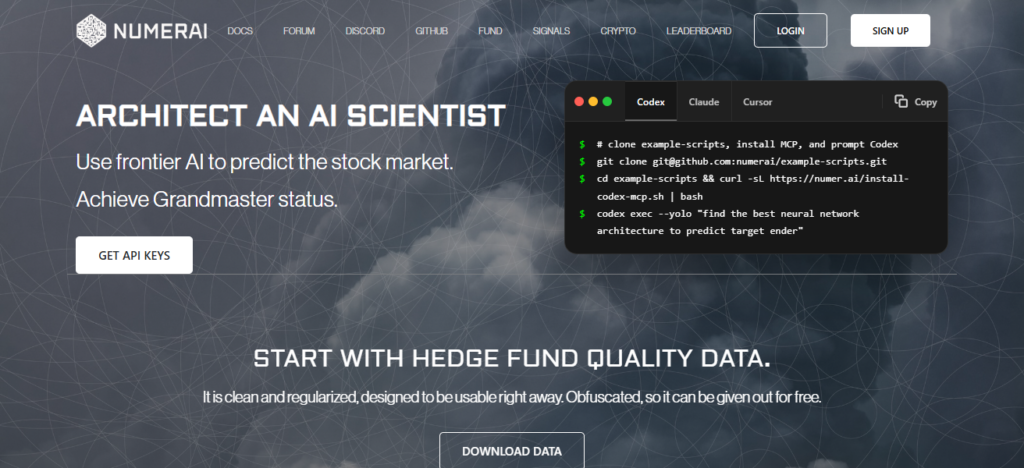
Recent community boosts for data scientists have improved prediction outcomes and model diversity.
Numerai creates a new financial forecasting model that is based on a decentralized AI, while also creating a friendly investment space across the globe.
Numerai Pros & Cons
| Pros | Cons |
| Unique crowdsourced AI predictions | Focused primarily on finance |
| Rewards skilled data scientists | Requires advanced data expertise |
| Preserves participant privacy | Limited appeal outside investing |
| Strong machine learning ecosystem | Competitive prediction environment |
| Blockchain-based incentives | Complex for beginners |
9. Bittensor
Bittensor is a decentralized AI model and network, and its unique framework pushes participants to collaboratively improve its AI.
This is done through a form of blockchain-based model improvement that rewards participants with tokens.

This recent model improvement and network extension have significantly increased participation from developers and researchers.
Bittensor is paving the way for community-based AI infrastructure by continuing to encourage knowledge sharing and model improvement.
Bittensor Pros & Cons
| Pros | Cons |
| Rewards AI model contributions | Highly technical platform |
| Encourages decentralized innovation | Difficult for newcomers |
| Open AI development ecosystem | Token volatility risks |
| Strong research community | Network complexity |
| Scalable machine learning network | Infrastructure still evolving |
10. Venice AI
Venice AI uses decentralised tech to give people AI services that are privacy-first. Many AI services don’t give users as much control, leaving users insecure and data reliant.

Venice AI improved chatbot performance and privacy protections. Venice AI improved accessibility for people wanting AI services that are privacy-protecting and personable. Venice AI is a user-focused, decentralised, and privacy-centric AI service.
Venice AI Pros & Cons
| Pros | Cons |
| Strong privacy-focused approach | Smaller ecosystem than major AI platforms |
| Secure AI interactions | Fewer integrations available |
| Reduced centralized data collection | Limited brand recognition |
| User-centric platform design | Features still expanding |
| Growing demand for privacy solutions | Adoption remains early-stage |
Why use blockchain for AI chatbots?
- Transparency with AI interactions
- Protect user data with decentralization
- No more reliance on centralized servers
- Secure P2P AI communication
- Ownership of your data and AI
- Less censorship & platform control
- Trust AI-generated responses
- Token incentives for users/developers
- Better security for data breaches/hacks
- Worldwide, no permission needed access for AI
How We Choose the Best Decentralized AI Chatbots Built on Blockchain Infrastructure
- Integration of AI with actual blockchain technology
- Decentralization across network infrastructure
- Chatbot and AI automation use cases with high engagement
- Data security, privacy, protection, and mitigation of risk
- Ecosystem and token viability
- Size of community and developer engagement
- Stability and scalability under heavy load
- Multi-chain interoperability and integration with other platforms
- Established reputation and recognized in the industry
Conclusion
In closing, the Best Decentralized AI Chatbots Built on Blockchain Infrastructure are revolutionary in the world of AI.
These systems bring layering of AI and Blockchain of security, creating products that are user-controlled, private, and transparent.
Although still in a formative stage, these products are the first of their kind in the Web3 world, indicating the users’ control of communications, automation, and data, providing formidable challenges to the conventional centralized AI Chatbot systems globally.
FAQ
What is SingularityNET used for?
A marketplace for buying and selling decentralized AI services.
Is Fetch.ai a chatbot platform?
It uses autonomous AI agents for automation and digital tasks.
What does Ocean Protocol do?
It securely shares data for AI training using blockchain.
Are decentralized AI chatbots secure?
Yes, they reduce centralized data risks using blockchain systems.
