


In this article, I will discuss the Best Smart Contract Vulnerability Scanners to Run Before Depositing Funds. Here, I will focus on preventing DeFi and Web3 Protocol Risks.
These scanners help you to see smart contracts for bugs, exploits, and bad behavior. Better security is the goal.
You will learn how tools like CertiK Skynet, Slither, and MythX help shield users from potential blockchain gaps and thereby ultimately protect users from losing money.
Key Points & Best Smart Contract Vulnerability Scanners to Run Before Depositing Funds
CertiK Skynet: AI-driven security platform analyzing smart contracts for vulnerabilities continuously
Slither: A static analysis tool detecting Solidity vulnerabilities in codebases efficiently and accurately
MythX: Security analysis platform for Ethereum smart contract auditing thoroughly verified
OpenZeppelin Defender: Automated monitoring and protection suite for smart contracts production deployments
Halborn: Cybersecurity firm offering comprehensive blockchain smart contract audits globally trusted
Hacken: Web3 security auditor providing smart contract risk assessments and penetration testing
Certora Prover: A formal verification tool ensuring correctness of smart contracts’ mathematical guarantees
SlowMist: Blockchain security company specializing in threat detection services, incident response
ConsenSys Diligence: Expert auditing service for Ethereum smart contract security formal verification
PeckShield: Blockchain security firm offering a real-time vulnerability monitoring analytics platform
10 Best Smart Contract Vulnerability Scanners to Run Before Depositing Funds
1. CertiK Skynet
CertiK Skynet uses AI to create a smart contract security monitoring system. It constantly reviews smart contracts to check for vulnerabilities and examines the behavioral patterns of smart contracts to assess risk.
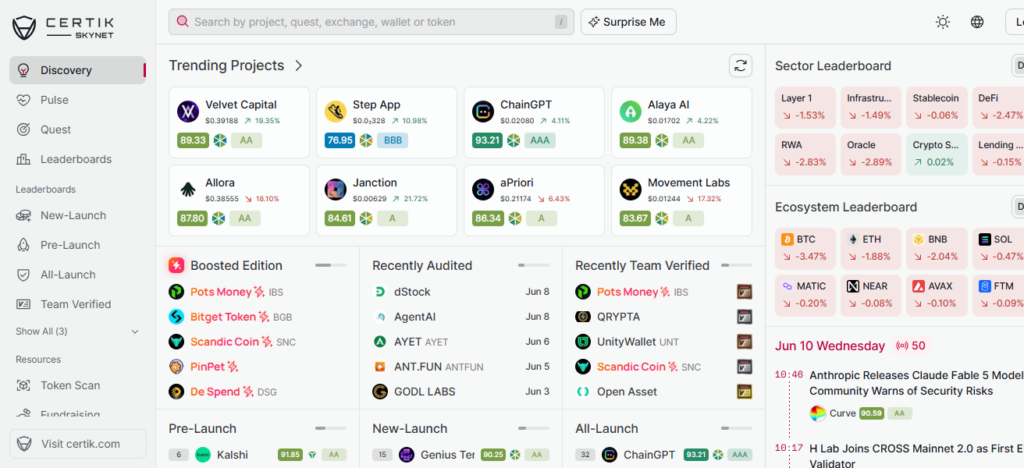
Using machine learning to enhance on-chain efforts, Skynet identifies potential threats with ease. In the rapidly evolving world of Web3, where many hacks are occurring, Skynet offers investors the ability to assess how safe a protocol is before interacting with it.
CertiK Skynet Pros & Cons
Pros
- Offers a smart contract monitoring system that uses AI and real-time data
- Helps DeFi protocols by offering fully informed risk scoring
- Rapidly identifies suspicious patterns on-chain
- Recognized by most blockchain projects around the world
Cons
- Paid enterprise plans are required for some features
- Risk alerts are occasionally inaccurate and may not be significant
- Unclear how risks are evaluated using AI in the scoring model
- Has scope limitations for smaller chains
2. Slither
Slither is a popular choice for the static analysis of Solidity smart contracts. It searches for common vulnerabilities like re-entrant calls, numeric overflow, and other logic issues.
By parsing code descriptions and providing developers with security information prior to the execution of the contract, Slither greatly aids smart contract developers.

Automating the analysis of smart contracts, Slither is often a part of the CI/CD pipelines in many modern development environments.
Slither Pros & Cons
Pros
- Incredibly fast and efficient at identifying smart contract vulnerabilities
- Integrates well with CI/CD
- Excellent for identifying classic vulnerabilities like re-entrancy
- Open source and trusted
Cons
- Works only for smart contracts that are built on Solidity
- Cannot identify runtime/logic vulnerabilities
- Results can be misinterpreted in some cases and require expertise
- Little support for advanced DeFi attack vectors
3. MythX
MythX provides security analysis for smart contracts on Ethereum. Available on the cloud, MythX conducts in-depth security analysis using symbolic execution, fuzzing, and static analysis.
Its detection of hidden security weaknesses is crucial for the rapidly evolving DeFi space, since traditional security analysis tools are often inadequate.
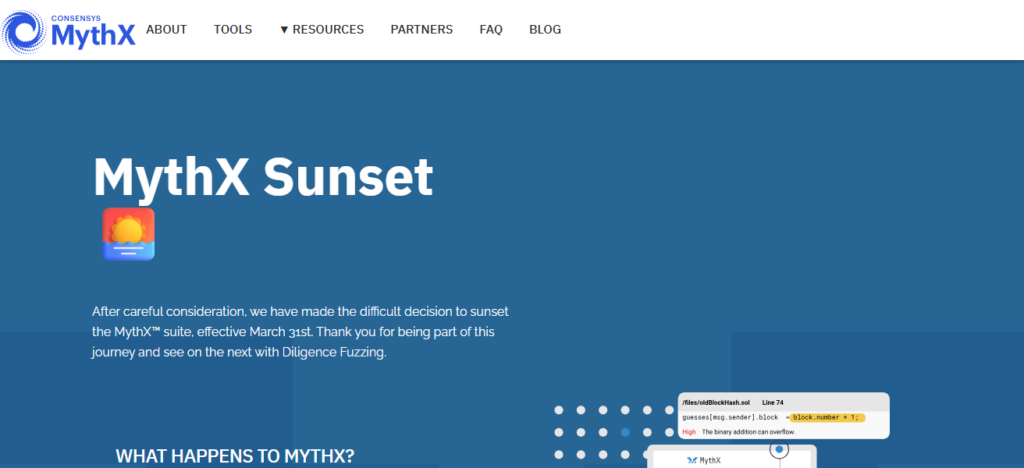
MythX is integrated into IDEs such as Remix and Truffle, and is equally beneficial for developers and auditors who need automated security analysis for critical vulnerabilities.
MythX Pros & Cons
Pros
- Uses both symbolic execution and fuzzing
- Can identify more advanced smart contract vulnerabilities
- Integrates well with popular smart contract frameworks, Remix and Truffle
- Good UX with a cloud-based solution
Cons
- Usability comes at a cost, as advanced features are paid for
- Not user-friendly for large contracts, as scan times can be long
- Contract analysis cannot be performed offline
- Results may require additional investigation
4. OpenZeppelin Defender
Defender is the security and automation platform for smart contracts from OpenZeppelin. It provides tools for the ongoing management of smart contracts, including the automated processing of on-chain actions that fall outside the defined parameters of acceptable behavior.
Defender is designed for the speed of exploits in new Web3 technologies, and is the automation and security solution of choice for many DeFi protocols.
Defender is used to secure contract upgrades and the controlled pausing of contracts and other administrative functions.
OpenZeppelin Defender Pros & Cons
Pros
- Provides a system to automate monitoring and querying
- Can halt contracts in an emergency
- Works directly with OpenZeppelin security offerings
- Can assist in the safer management of production smart contracts
Cons
- Requires security knowledge and a time investment to configure
- Higher tiers have a cost associated with them and provide added features
- Designed for team use rather than a single user.
- Limited use without appropriately designed contracts.
5. Halborn
Halborn is a blockchain-focused cybersecurity company that conducts smart contract audits. With an emphasis on high-value DeFi and Web3 projects, Halborn combines automation and manual reviews to expose vulnerabilities that are often overlooked.
Halborn is the preferred blockchain auditor for many firms due to the trust and business that Halborn now attracts.

Its security reports are a significant tool in helping investors understand the risks of using on-chain platforms
Halborn Pros & Cons
Pros
- Offers extensive manual and automated audits
- Trusted partner for institutional-grade crypto projects
- Detects advanced smart contract vulnerabilities
- Delivers comprehensive security reports
Cons
- Higher cost than automated solutions
- Audits can take significant time to complete
- No instant self-service tool
- Small projects may find it hard to engage services
6. Hacken
Hacken is a company focused on Web3. They offer smart contract audits, penetration testing, and real-time risk scanning.
Their main focus is the identification of risks and weaknesses that are likely to be leveraged in DeFi protocols and in blockchain.

Hacken provides users with a scoring system, a useful way to evaluate the trustworthiness of a project. Recently, Hacken has developed a new service for the ongoing security of its clients.
This service helps users determine if a protocol is secure enough to allow them to interact with it and/or to deposit their digital assets into it.
Hacken Pros & Cons
Pros
- Has DeFi penetration testing services
- Has a continuous security scoring system
- Combines manual and automated audits
- Focuses on the prevention of in-the-wild exploits
Cons
- Advanced features are available on subscription plans
- May require a technical background to interpret
- Not fully automated for on-the-spot scanning
7. Certora Prover
Certora Prover is a tool for the formal verification of smart contracts. It has the ability to prove the correctness of smart contract logic.
Unlike traditional methods that involve the detection of bugs, Certora Prover is able to verify the correctness of smart contracts against governing assertions and constraints.
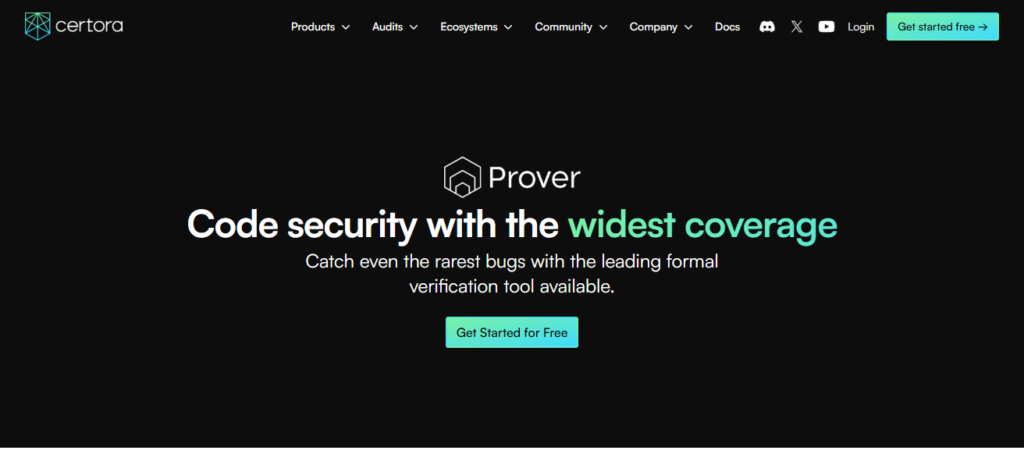
This provides a high level of confidence to smart contract users that the contract is safe. Certora Prover is being adopted more and more by blockchain projects
To verify the correctness of complex smart contracts prior to deployment. It is also a useful tool for the verification of smart contracts by users who are risk-averse.
Certora Prover Pros & Cons
Pros
- Can mathematically prove the correctness of smart contracts
- Eliminates some categories of vulnerabilities entirely
- Trusted for the safety and security of DeFi protocols
- Used by leading blockchain engineers
Cons
- Can be very difficult to set up and use
- Formal specification of contracts required
- Not useful for on-the-spot/quick scanning
- Not useful for non-developers
8. SlowMist
SlowMist is a blockchain protocol security company that specializes in the detection of threats and incidents and the auditing of smart contracts.
They maintain a very large collection of real-world DeFi hacking incidents and the attacks that were used to carry them out.

With this information, SlowMist can easily discover attacks. Because of how quickly cross-chain attacks are developing,
SlowMist has improved its systems, giving both users and developers the ability to assess the risks of using new or unaudited smart contracts.
SlowMist Pros & Cons
Pros
- Large database of attack patterns
- Strong incident response and recovery focus
- Monitors threats to blockchains in real-time
- Supports multi-chain security analysis
Cons
- Less beginner-friendly services
- Some services are enterprise-focused
- Limited customization for small projects
9. ConsenSys Diligence
ConsenSys Diligence is a specialist auditing service that offers manual review, security check automation, and more for Ethereum.
They tend to find issues that many other automated reviewing tools won’t spot. Given the role Ethereum plays in DeFi, its audits have a huge impact on the level of trust the ecosystem as a whole can rely on.
ConsenSys Diligence provides thorough risk analysis on audits so that users and investors are informed of protocol risks before they decide on financial contracts with the system.
ConsenSys Diligence Pros & Cons
Pros
- Smart contract audits at the expert level
- Recognizes complex vulnerabilities
- Excellent reputation in the Ethereum community
- Security reports are extremely thorough
Cons
- Audits are very costly
- Long delays in completing audits
- Lacks real-time automated scanning
- Primarily focuses on the Ethereum community
10. PeckShield
PeckShield is a security analytics and monitoring platform, providing analysis on-chain for smart contract audits and spotting suspicious behavior.
They are also at the forefront of tracking exploits and phishing schemes, as well as abnormal transfers and out-of-the-ordinary movements of funds.
Given the nature of the ever-changing Web3, PeckShield provides many investors with tools to assess if DeFi contracts mistreat funds before they decide to invest.
PeckShield Pros & Cons
Pros
- Monitoring threats to blockchain in real-time
- Early detection of phishing and exploit attempts
- Stronger analytics on suspicious transactions
- Popular for tracking DeFi risks
Cons
- Less depth compared to full audits
- Alerts data requires a lot of interpretation
- Premium features could be pricey
Conclusion
In summary, deploying capital to a DeFi protocol without using a smart contract vulnerability scanner is not advisable.
CertiK Skynet, Slither, MythX, and PeckShield are a few of the tools in the market that help identify vulnerabilities, exploits, and malicious behaviors occurring on-chain.
Used in combination with paid audits from Halborn or ConsenSys Diligence, your investment risks are minimized.
Ultimately, however, no tool offers a safety guarantee, and users will benefit from a combination of smart contract vulnerability scanners and audit reports.
FAQ
Are smart contract audits 100% safe?
No, audits reduce risk but cannot guarantee complete safety.
Which tool is best for beginners?
Slither and CertiK Skynet are easier to start with.
Do I need multiple scanners?
Yes, combining tools improves overall security accuracy.
Are free tools reliable?
Some are reliable, but premium tools offer deeper analysis.
Can scanners detect rug pulls?
They can detect suspicious patterns but not all scams.
