


This article will cover top Blockchain RPC Providers that assist developers in designing Web3 applications. RPC Providers allow for dependable blockchain connections, speedy node access, and API/infrastructure provisions for dApps, DeFi, NFT, and enterprise projects.
We will examine the features, benefits, and downsides these Blockchain RPC Providers have to offer and which development needs they will serve.
Key Points & Best Blockchain RPC Providers
- Alchemy Provides reliable blockchain infrastructure APIs with scalable RPC access for developers worldwide.
- Infura Offers Ethereum and Web3 RPC services powering decentralized applications and platforms.
- QuickNode Delivers fast blockchain node access with global endpoints and developer tools.
- Chainstack Provides managed blockchain nodes with secure RPC connections across multiple networks.
- Ankr Enables decentralized RPC infrastructure supporting various blockchain networks and applications.
- GetBlock Provides instant blockchain node access through dedicated and shared RPC endpoints.
- Blockdaemon Offers enterprise-grade blockchain infrastructure and secure RPC node management solutions.
- Moralis Provides Web3 APIs and RPC infrastructure for building blockchain applications.
- Pocket Network Uses decentralized nodes to deliver censorship-resistant blockchain RPC infrastructure services.
- NOWNodes Provides affordable blockchain RPC endpoints with quick node deployment options.
10 Best Blockchain RPC Providers
1. Alchemy
As one of the top blockchain RPC providers, Alchemy provides excellent infrastructure for developers building Web3 applications.
Alchemy provides high-performance node access, enhanced APIs, and scalable blockchains across networks including Ethereum, Polygon, Arbitrum, Optimism, Solana, and others.
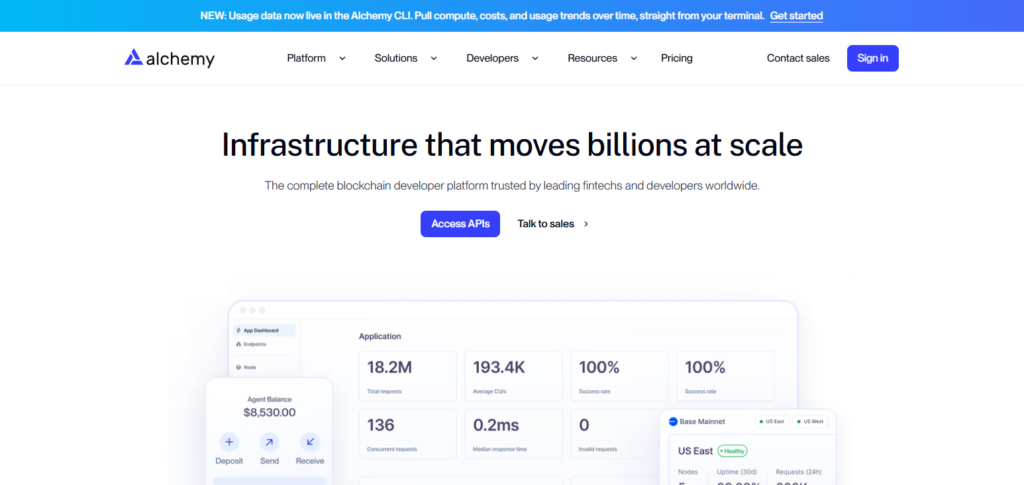
Alchemy allows developers to forgo the headache of managing complex blockchain infrastructure by allowing developers to set up RPC endpoints and provides monitoring, analytics, and debugging tools.
Most enterprise applications of DApps, NFT marketplaces, DeFi protocols, and enterprise blockchain projects use Alchemy.
With an excellent developer experience, RPCs with enterprise-grade security, Alchemy is the go-to solution for scalable Web3 development in 2026.
| Pros | Cons |
|---|---|
| High-performance RPC infrastructure with excellent uptime reliability. | Advanced features can become expensive for large-scale applications. |
| Supports multiple blockchain networks and Web3 ecosystems. | Free plans have limited request capacity. |
| Provides powerful APIs, analytics, and developer tools. | Mainly focused on popular blockchain networks. |
| Easy integration for DeFi, NFT, and enterprise applications. | Requires learning for advanced infrastructure management. |
2. Infura
Infura is one of the more popular blockchain RPC infrastructure providers. It is known for thousands of Web3 applications that rely on Infura for network access.
Based on the Consensys service, Infura offers secure Ethereum and multi-chain APIs that let developers access blockchains without the need to run their own nodes.
Infura is a multi-chain infrastructure that provides analytics and scalable RPC along with developer tools for Ethereum, Polygon, Linea, IPFS, and many other networks. Infura is one of the most used RPC infrastructure providers for wallets
DeFi, NFT applications, and blockchain development, due to its enterprise-grade infrastructure. The focus on enterprise customers and an ever-improving infrastructure for Web3 accessibility grants Infura a top tier position in blockchain RPC services.
| Pros | Cons |
|---|---|
| One of the most trusted Ethereum RPC providers globally. | Ethereum-focused services may limit some multi-chain needs. |
| Provides reliable APIs with strong infrastructure support. | High usage applications may require premium pricing. |
| Backed by Consensys with enterprise-level security. | Centralized architecture creates dependency risks. |
| Supports IPFS and multiple Web3 development tools. | Customization options are limited compared with self-hosted nodes. |
3. QuickNode
QuickNode is an efficiently designed provider of high-performance blockchain RPC. Fast node access, powerful APIs, and global blockchain infrastructure are some of the supported features dispersed across many networks
like Ethereum, Bitcoin, Solana, Polygon, Avalanche, many more, and also the infrastructure itself. Features that the infrastructure offers include real-time data streaming, on-chain analytics, and NFT APIs among others, and also many developer tools that further ease the building of a web 3.0 application.
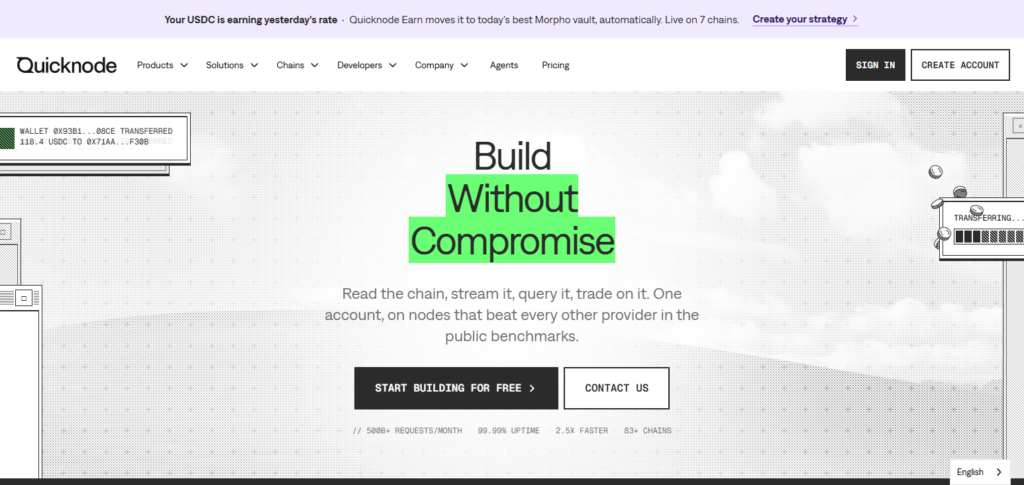
With distributed infrastructure, QuickNode infrastructure helps developer and business application reliability and latency. Performance, infrastructure integration ease, and multi-blockchain support and use are some of the many reasons why QuickNode is a provider of infrastructure solution among modern Web3 applications.
| Pros | Cons |
|---|---|
| Provides fast blockchain connections with low latency. | Pricing can increase for high-volume applications. |
| Supports many blockchain networks and developer tools. | Some advanced features require paid subscriptions. |
| Offers real-time APIs and blockchain data solutions. | Beginners may find features overwhelming initially. |
| Strong performance for enterprise Web3 applications. | Limited decentralization compared with distributed RPC models. |
4. Chainstack
Chainstack eases access to RPC endpoints built with a secure blockchain infrastructure. There’s no need for self-hosting nodes, since Chainstack manages them. The infrastructure is built with many of the leading networks Ethereum, Polygon, BNB Chain, Avalanche, and Solana and many more.
Chainstack features automated node deployment, dedicated infrastructure, and monitoring tools. Chainstack provides scalable blockchain connectivity and enterprise-grade security for Web3 projects.
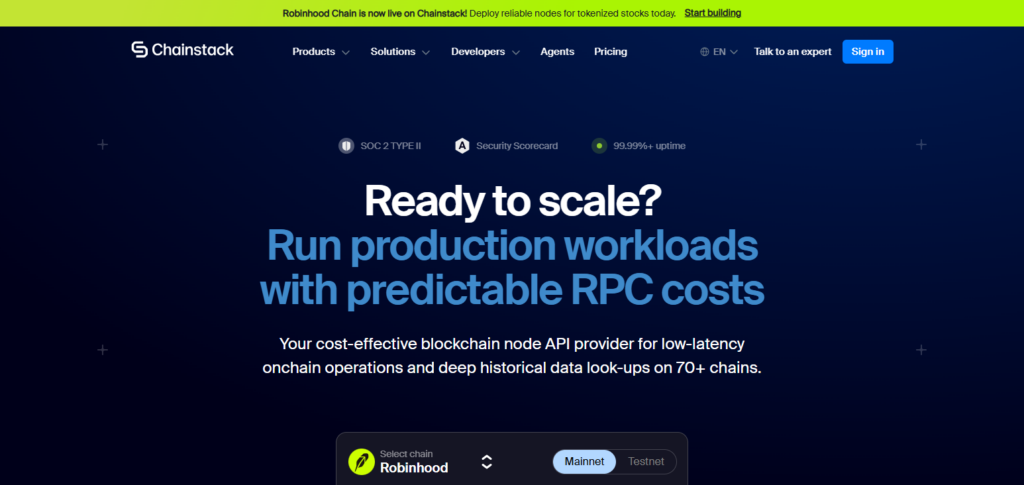
The infrastructure aims to ease access to blockchains and maintain reliability in business operations. Developers build on Chainstack to create DeFi, Gaming and NFT applications and Blockchain based enterprise solutions. With its flexibility, high performance, and multi-chain RPC infrastructure, Chainstack is a preferred RPC provider.
| Pros | Cons |
|---|---|
| Provides easy managed blockchain node deployment. | Pricing may be higher for dedicated infrastructure. |
| Supports multiple blockchain networks and protocols. | Requires technical knowledge for advanced configurations. |
| Offers enterprise-grade security and monitoring features. | Smaller developer ecosystem compared with major providers. |
| Reduces complexity of maintaining blockchain nodes. | Some features depend on selected network availability. |
5. Ankr
Ankr is a decentralized blockchain infrastructure developer. They provide RPC services, node solutions, and Web3 development tools.
They have a distributed RPC network which enables developers to integrate their applications across a range of blockchains like Ethereum, Polygon, BNB Chain, Fantom, Avalanche, and others.
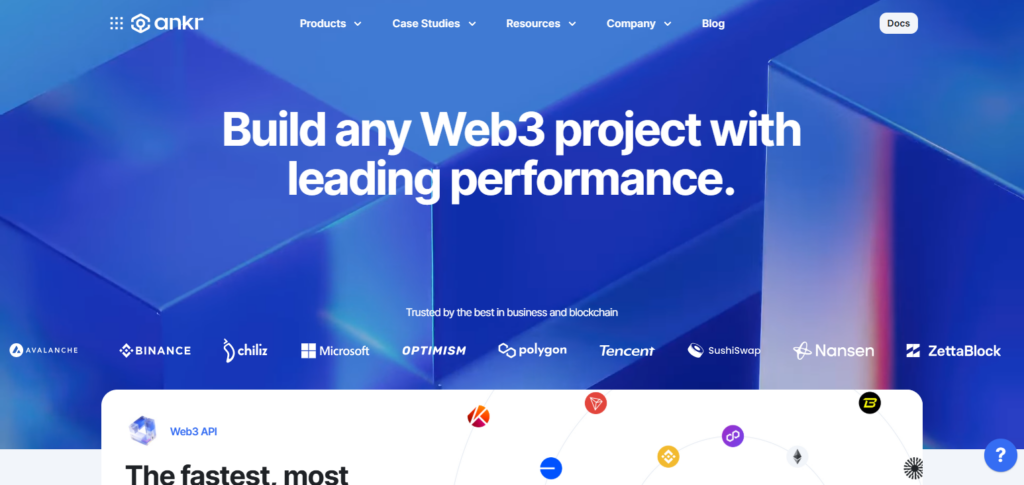
They access decentralized infrastructures to provide developers speedy and affordable access to blockchains. They provide premium decentralized infrastructures.
They have an RPC network, APIs, and staking solutions. With their global decentralized node network, they provide developers easy access to blockchain data and reduces the reliance on centralized services.
| Pros | Cons |
|---|---|
| Offers decentralized RPC infrastructure with global coverage. | Performance may vary across different node providers. |
| Supports many blockchain networks and Web3 applications. | Enterprise features may require additional configuration. |
| Provides affordable RPC solutions for developers. | Documentation can be improved for beginners. |
| Combines RPC services with staking and Web3 tools. | Less dominant compared with Alchemy and Infura. |
6. GetBlock
GetBlock is a blockchain RPC developer which provides instant access to full nodes of many blockchain networks. They provide shared and dedicated node infrastructure and are helpful for developers and businesses of blockchain applications.
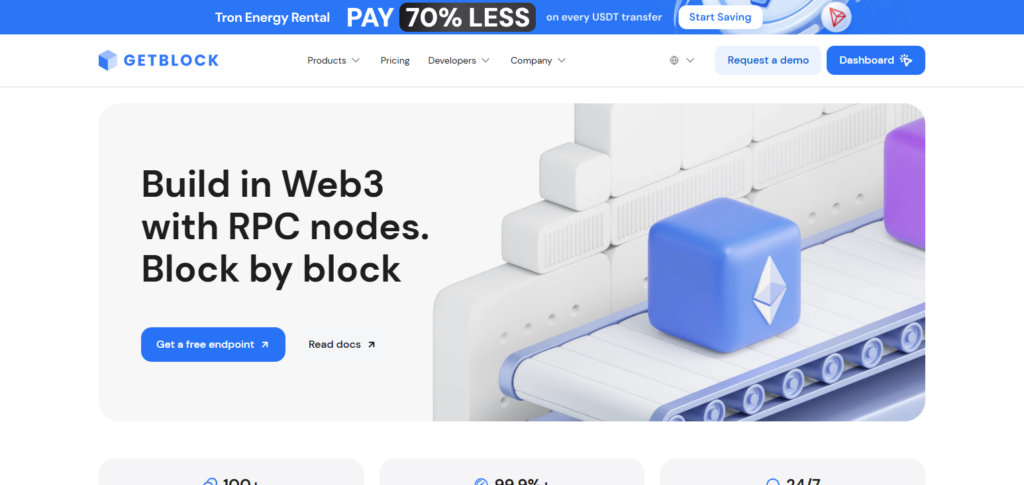
They have support for the most popular blockchains like Bitcoin, Ethereum, Litecoin, Solana, Polygon, and others. They provide developers the ability to integrate their wallets. DeFi and decentralized applications can be integrated with secure RPC endpoints.
They have a focus for affordable, quick, and stable connectivity to blockchains. They have many flexible pricing options and many supported protocols. They are great for small startups and developers who require quick access to blockchain nodes.
| Pros | Cons |
|---|---|
| Provides quick access to multiple blockchain nodes. | Limited advanced developer tools compared with competitors. |
| Offers affordable RPC solutions for startups. | Smaller ecosystem and community support. |
| Supports dedicated and shared node options. | Performance depends on selected blockchain network. |
| Simple setup process for blockchain applications. | Enterprise scalability options are limited. |
7. Blockdaemon
Blockdaemon is an enterprise-oriented blockchain infrastructure provider. Their offerings include secure node hosting, RPC services, and staking infrastructure, as well as greater blockchain institutional solutions.
Their platform spans many blockchain networks, allowing enterprises to develop robust Web3 solutions and not deal with problematic node operations.
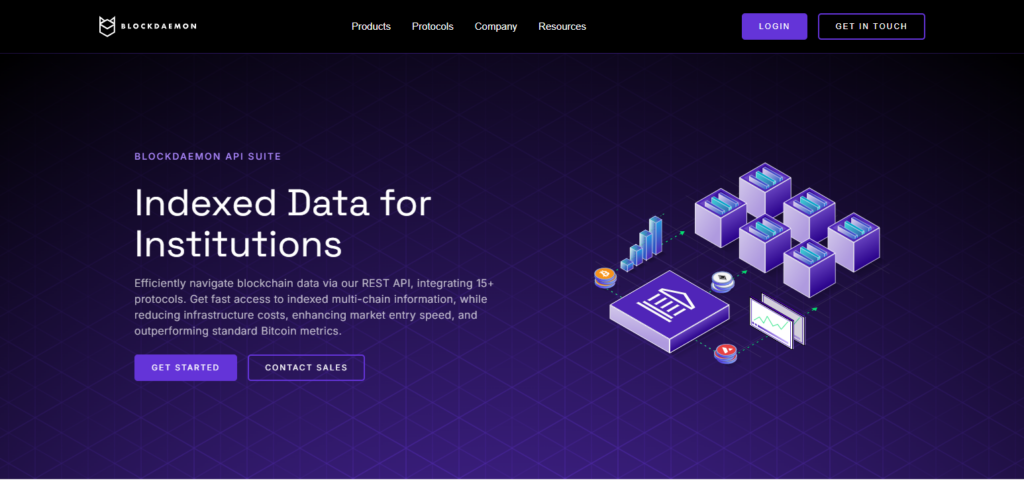
Blockdaemon offers security and compliance, along with monitoring and scalable infrastructure, ideal for financial institutions, exchanges, and enterprises of any size.
Their RPC services retain high availability and performance while providing rapid access to blockchain networks. Blockdaemon’s infrastructure and strong institutional adoption give them a uniquely important position to support enterprises in their adoption of blockchain.
| Pros | Cons |
|---|---|
| Designed for enterprise blockchain infrastructure requirements. | Pricing is generally higher than developer-focused providers. |
| Provides strong security and compliance features. | May be complex for small developers. |
| Supports institutional blockchain operations and staking. | Less suitable for simple hobby projects. |
| Offers reliable node management and monitoring tools. | Requires enterprise-level technical understanding. |
8. Moralis
Moralis offers Web3 APIs and blockchain infrastructure tools that ease the building of dApps. Using their RPC services, developers can query blockchain data and interact with various networks via simple APIs.
Their user-friendly infrastructure facilitates many major networks and offers various tools such as NFT APIs, token data APIs, wallet analytics, and block stream services.
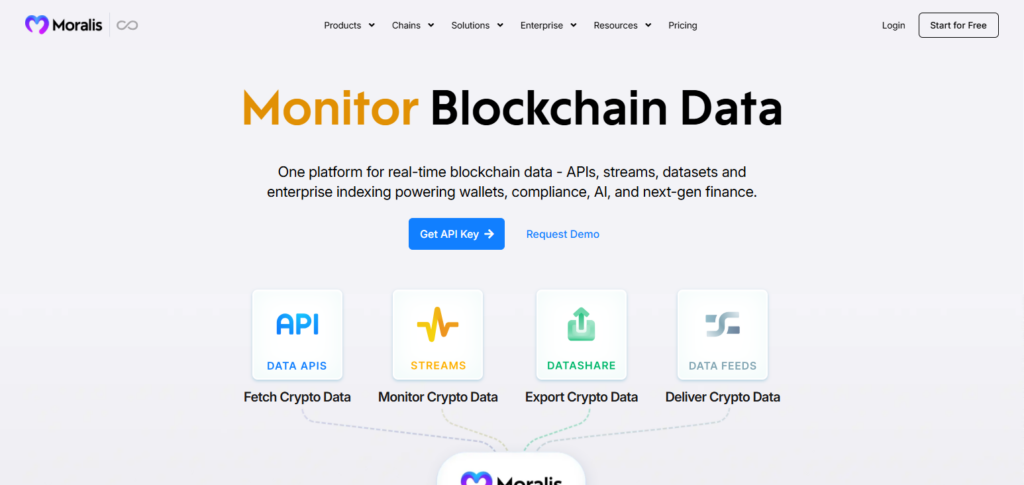
Moralis’ infrastructure helps dApp developers ease the burden of backend services, and as a result, is a highly adopted tool for building DeFi services, NFT marketplaces, games, and tools for blockchain analytics.
| Pros | Cons |
|---|---|
| Simplifies Web3 development with easy-to-use APIs. | Advanced infrastructure customization is limited. |
| Provides NFT, wallet, and blockchain data APIs. | Heavy applications may require higher pricing plans. |
| Suitable for startups building blockchain applications. | Less focused on enterprise node management. |
| Reduces backend development complexity significantly. | Depends on third-party blockchain infrastructure. |
9. Pocket Network
Pocket Network provides decentralized RPC services by linking developers to many independent blockchain nodes across the globe.
Centrally controlled RPC services are prone to many issues that Pocket Network has avoided by implementing a decentralized model.
Decentralization also strengthens censorship resistance, reliability, and flexibility of the network. Flexible design and ease of use amplify Pocket Network’s usefulness to developers across many blockchain ecosystems.
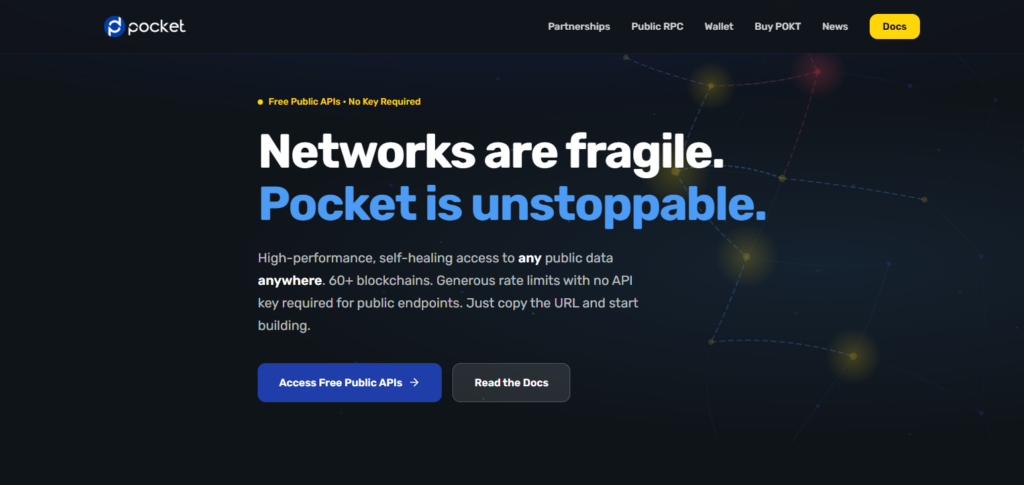
As part of its mission to lessen the impact of centralized services, Pocket Network provides layers of infrastructure for Web3 via decentralized architecture.
For projects that seek transparency and resilience in community-focused, decentralized blockchain infrastructure, Pocket Network is an enticing choice.
| Pros | Cons |
|---|---|
| Provides decentralized and censorship-resistant RPC infrastructure. | Network performance depends on distributed node operators. |
| Reduces reliance on centralized blockchain providers. | Decentralized architecture can create complexity. |
| Supports multiple blockchain ecosystems. | Developer tools are less mature than competitors. |
| Encourages community-driven Web3 infrastructure. | Adoption is smaller compared with traditional RPC providers. |
10. NOWNodes
NOWNodes is a provider of affordable blockchain RPC endpoints in addition to providing developers and businesses with node infrastructure.
The extensive list of blockchain networks supported by NOWNodes includes Bitcoin, Ethereum, Litecoin, Dogecoin, and other commonly used protocols.
Easy and quick access to nodes is provided by NOWNodes so that clients are not burdened with the upkeep of their own servers or blockchain infrastructure.
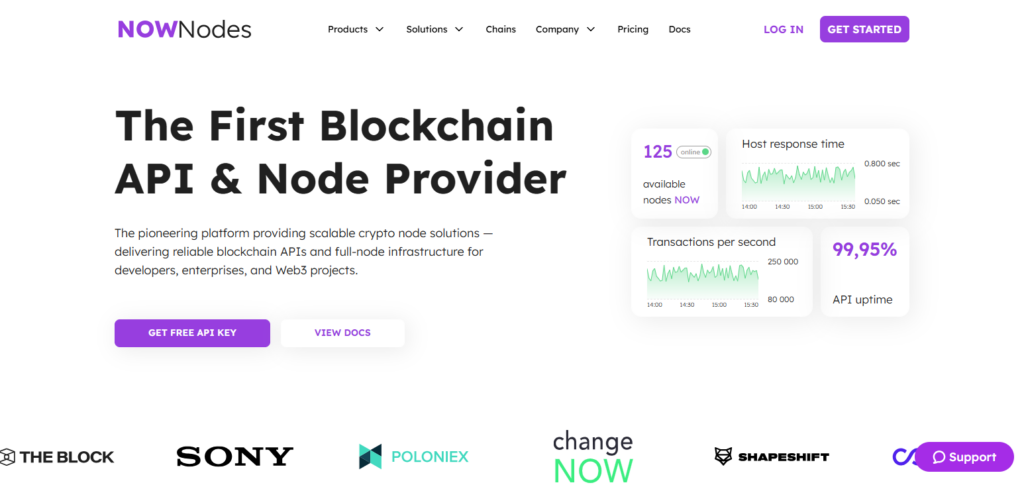
NOWNodes provides dependable and timely API services tracing a clear path of integration to wallets, exchanges, and decentralized apps.
Developers and startups in need of uncomplicated access to blockchain services are the primary target for NOWNodes’ RPC services. Its simple integration and multi-network support ensure NOWNodes is a viable RPC service for many Web3 projects.
| Pros | Cons |
|---|---|
| Offers affordable blockchain RPC access for developers. | Limited advanced analytics and monitoring features. |
| Supports many popular blockchain networks. | Smaller brand presence in enterprise markets. |
| Quick node deployment and easy API integration. | Fewer developer tools compared with premium providers. |
| Suitable for startups and smaller Web3 projects. | Enterprise-level customization options are limited. |
Conclusion
In Conclusion – Best Blockchain RPC Providers The Best Blockchain RPC Providers enables developers to construct Web3 applications that are faster, safer, and more scalable.
Alchemy, Infura, QuickNode, Chainstack, and Ankr are prime examples of RPC providers that developers should consider due to their reliable infrastructure, multi-chain support, and powerful development tools.
The selection of an RPC provider is based on performance and pricing, and the networks supported as it relates to the requirements of a given project.
Each of these RPC platforms strive to improve the accessibility of blockchain technology to the most recent generation of decentralized applications.
FAQ
Why are Blockchain RPC Providers important?
They help developers access blockchain data, submit transactions, and build Web3 applications without managing their own blockchain nodes.
Which is the Best Blockchain RPC Provider in 2026?
Alchemy, Infura, and QuickNode are considered among the best providers because of their reliability, speed, and multi-chain support.
Are Blockchain RPC Providers free to use?
Many providers offer free plans with limited requests, while advanced features and higher usage require paid subscriptions.
Which Blockchain RPC Provider is best for Ethereum development?
Infura and Alchemy are popular choices for Ethereum developers due to their stable infrastructure and strong API support.
