


In this article, I will cover the Rollup-as-a-Service platforms that are among the best available to help developers and businesses with tools to create scalable blockchain networks.
These platforms make the rollup deployment process much easier, offer customizable infrastructure, speed up transactions, and lessen the complexity of development.
I will analyze the best RaaS solutions in the market, the top characteristics of each, the advantages of each, and how all of these solutions shape the future of decentralized applications and the Web3 blockchain.
What Are Rollup-as-a-Service Platforms?
Rollup-as-a-Service platforms offer developers and businesses customizable Layer 2 rollups on top of existing blockchain layers. This flexibility allows customers to bypass complicated architectural technology.
These platforms provide automated solutions for the development, security, scaling, and maintenance for rollups and support modular architecture systems such as OP Stack, Arbitrum Orbit, and zk-rollups. RaaS provides projects with speedy transactions with reduced costs. RaaS achieves the scalability for application-specific blockchains
Key Points & Best Rollup-as-a-Service Platforms
- Conduit – Simplifies deploying custom blockchain rollups with scalable infrastructure solutions.
- Caldera – Provides modular rollup deployment using customizable blockchain technology stacks.
- Gelato Rollups – Enables fast, secure, and developer-friendly Ethereum rollup creation.
- AltLayer – Offers rapid rollup launches with flexible restaking security mechanisms.
- Stackr Labs – Builds micro-rollups supporting application-specific blockchain scalability requirements.
- Dymension – Provides modular rollup networks through efficient RollApp infrastructure technology.
- Saga Chainlets – Enables developers creating dedicated application-specific blockchain environments easily.
- Astria – Delivers decentralized shared sequencer infrastructure for customizable rollup ecosystems.
- Eclipse – Combines Ethereum security with Solana Virtual Machine performance capabilities.
- Opside – Offers zero-knowledge rollup services with automated deployment features.
10 Best Rollup-as-a-Service Platforms
1. Conduit
As one of the foremost Rollup-as-a-Service platforms, Conduit streamlines the process for developers with the desire to create post-validated blockchain networks.
Conduit employs a forefront of automation to deploy the OP Stack, Arbitrum Orbit, and modular rollup frameworks with little to no sophisticated blockchain engineering.
Conduit’s innovation eliminates the need for nodes, upgrades, monitoring, or maintenance for rollup networks, which provides developers the opportunity to concentrate on their applications opposed to the infrastructure.
Conduit provides customizable rollup environments for gaming, DeFi, AI, and consumer applications. With the result of lower costs and greater accessibility to both startups and enterprises, Conduit successfully increases the speed of blockchain scaling.
Conduit – Key Features
| Feature | Description |
|---|---|
| Custom Rollup Deployment | Enables developers to launch application-specific rollups quickly and efficiently. |
| Multi-Framework Support | Supports OP Stack, Arbitrum Orbit, and modular rollup technologies. |
| Automated Infrastructure | Handles nodes, monitoring, upgrades, and network maintenance automatically. |
| Developer-Friendly Tools | Simplifies blockchain deployment without requiring deep protocol expertise. |
| Enterprise Scalability | Supports gaming, DeFi, AI, and consumer blockchain applications. |
2. Caldera
Caldera Rollup-as-a-Service provides developers the ability to create custom blockchain networks with a flexible design thanks to a low barrier to entry for technical knowledge.
Caldera provides several frameworks for modular rollups with the OP Stack, Arbitrum Orbit, and Polygon CDK. With an emphasis on modular blockchain architecture
Caldera offers the ability to choose the execution layer, data availability, and settlement for the network. Automated security and performance of applications, as well as infrastructure, are a standard offering.
Caldera is particularly responsive to the quickly growing markets for gaming chains, DeFi, or enterprise blockchain networks, and provides a fast scalable solution for rollups with a range of modular operational constraints.
Caldera – Key Features
| Feature | Description |
|---|---|
| Modular Architecture | Allows developers to customize execution, settlement, and data layers. |
| Multiple Rollup Frameworks | Supports OP Stack, Arbitrum Orbit, and Polygon CDK. |
| Automated Deployment | Provides fast rollup creation with simplified infrastructure management. |
| Security Management | Offers reliable monitoring and operational security features. |
| High Performance | Enables scalable blockchain networks for demanding applications. |
3. Gelato Rollups
Gelato Rollups offers one of the first Rollup-as-a-Service platforms, letting developers build Ethereum-compatible Layer 2 networks.
Gelato Rollups is modular blockchain technology made easy for developers. It offers rollups focused on specific use cases with smart contracts and Web3 services built into the rollup.
Gelato is built to let developers customize their rollups and chains while still getting the security guarantees of the Ethereum network and the scalability of Ethereum transactions.
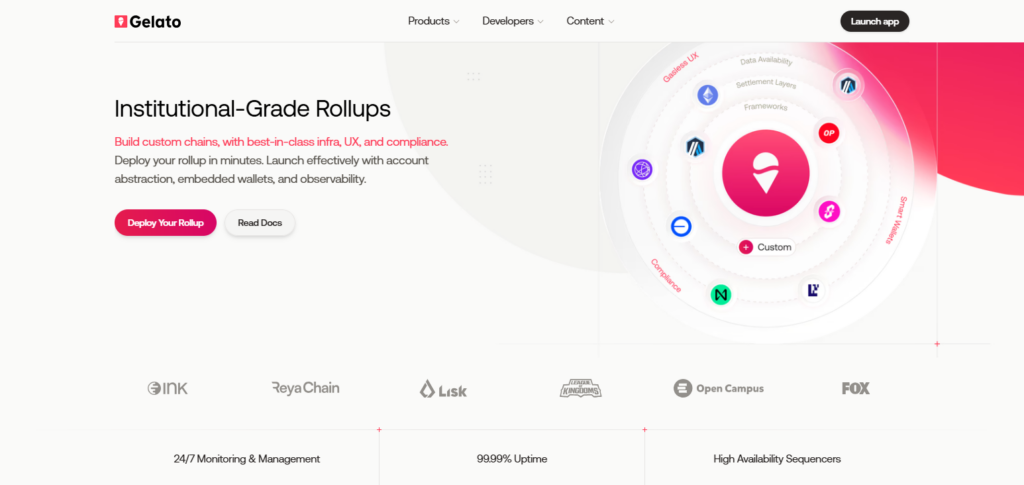
Rollups, combined with Gelato’s innovative services of account abstraction and Web3 automation, are more services of decentralized apps.
Gelato Rollups is focused primarily on gaming, finance, and business rollups that would like custom blockchains and are optimized for low latency, low cost, and easy rollup maintenance.
Gelato Rollups – Key Features
| Feature | Description |
|---|---|
| Ethereum Compatibility | Creates Ethereum-based Layer 2 networks with scalable execution. |
| Web3 Automation | Integrates automation tools for efficient decentralized applications. |
| Smart Contract Support | Provides developer tools for customized blockchain applications. |
| Low-Cost Transactions | Improves scalability with faster and cheaper transactions. |
| Infrastructure Services | Includes reliable Web3 services for rollup ecosystems. |
4. AltLayer
AltLayer is a Rollup-as-a-Service platform that prioritizes ease of use and security when creating application specific rollups.
AltLayer has a unique offering called restaked rollups, which provide improved security to blockchains by incorporating a restaking feature and an Ethereum validation framework.
AltLayer aims to provide rollups that can be made either temporary or permanent, and is optimized for decentralized gaming, AI, and other services.
AltLayer offers to build and design decentralized networks with a framework for rapid use and security. AltLayer is an innovative solution to the common problem of creating a secure and scalable stand alone blockchain and is becoming popular for its easily customizable and flexible blockchain infrastructure design that enable Web3 innovations.
AltLayer – Key Features
| Feature | Description |
|---|---|
| Restaked Rollups | Enhances security using Ethereum restaking mechanisms. |
| Rapid Deployment | Enables quick creation of temporary or permanent rollups. |
| Application-Specific Chains | Supports customized blockchain environments for different use cases. |
| Flexible Framework Support | Works with popular rollup development frameworks. |
| Decentralized Security | Provides stronger validation through restaking technology. |
5. Stackr Labs
With application specific micro-rollups, Stackr Labs enables developers to create highly customizable rollup based blockchain environments. Traditional large scale Layer 2 rollup solutions impose a one size fits all model on developers.
Stackr’s lightweight rollups target specific applications, helping developers avoid wasting resources and costs associating with rollup network congestion.
Stackr Labs gives developers new tools to create rollups that can execute application logic using a self contained rollup network while guaranteeing the security properties of a blockchain. Furthermore
Stackr has the potential to innovate decentralized gaming, AI and agent based applications, autonomous and other rollup Web3 services.
The barriers to developing rollups that Stackr Labs has reduced, allows developers to easily build scalable rollup based blockchain applications without the complicated rollup infrastructures or a deep understanding of the protocols.
Stackr Labs – Key Features
| Feature | Description |
|---|---|
| Micro-Rollups | Builds lightweight rollups optimized for specific applications. |
| Application Customization | Allows developers to design tailored blockchain environments. |
| Independent Processing | Enables applications to process logic separately. |
| Developer Tools | Provides simplified resources for rollup creation. |
| Efficient Scaling | Reduces costs through optimized blockchain infrastructure. |
6. Dymension
With its RollApps technology, Dymension allows developers to rapidly build application specific blockchains. The modular, Rollup-as-a-Service, ecosystem separates the execution, settlement and data availability layers, giving developers control to tailor their custom networks to application specific requirements.
Rapid deployment of decentralized applications is a central value proposition of the RollApps infrastructure, which retains interoperability within the wider blockchain ecosystem. RollApps can be designed and built with a high degree modularity to target specific applications, such as gaming
DeFi, social networks and enterprise applications, while improving scalability and significantly reducing costs of transactions. Dymension’s RollApps ecosystem introduces a new paradigm for blockchain application construction by making rollups modular and simpler for builders of decentralized applications.
Dymension – Key Features
| Feature | Description |
|---|---|
| RollApp Technology | Enables application-specific blockchain deployment efficiently. |
| Modular Blockchain Design | Separates execution, settlement, and data availability layers. |
| Cross-Chain Support | Improves interoperability between different blockchain ecosystems. |
| Developer Flexibility | Allows customized networks based on requirements. |
| Reduced Transaction Costs | Provides scalable infrastructure with efficient processing. |
7. Saga Chainlets
Saga Chainlets offers tailored blockchain solutions to create high-performance applications and game-centric environments.
Chainlets allows teams to establish independent chains and utilize customizable resources, while still benefitting from Saga’s security and interoperability frameworks.
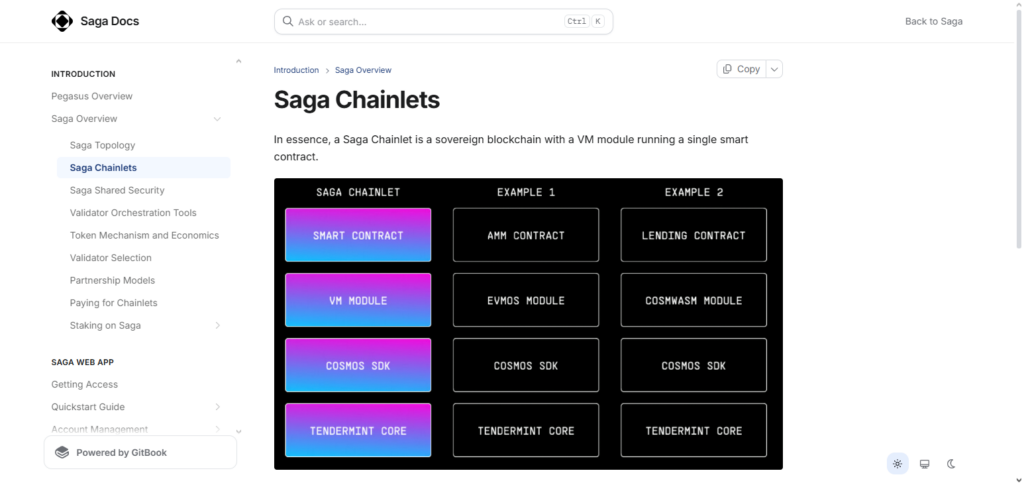
Saga Protocol is designed to enhance the blockchain experience by simplifying the deployment and enabling automated network creation, maintenance, and scaling from the infrastructure.
Developers are empowered with more control of their application environments and less friction as they are not sharing the same network, which is prone to congestion. When looking for dedicated, developer-oriented, scalable blockchain infrastructure, Saga Protocol is among the best.
Saga Chainlets – Key Features
| Feature | Description |
|---|---|
| Dedicated Blockchains | Creates independent chains for specialized applications. |
| Automated Deployment | Simplifies blockchain creation and network management processes. |
| Gaming Optimization | Supports high-performance gaming and entertainment applications. |
| Custom Resources | Provides adjustable infrastructure based on application needs. |
| Interoperability Support | Connects Chainlets with broader blockchain ecosystems. |
8. Astria
When it comes to rollups, Astria is one of the best solutions for decentralized infrastructure of shared sequencers. Central sequencers of traditional rollups introduce limitations and possible associated risks.
Astria’s solution of shared sequencers is unprecedented as it enables multiple rollups to utilize a single shared sequencer, thus achieving decentralization and simplifying operations. Modular rollups are easily created and managed, thanks to Astria’s architecture.
Added to this, Astria’s design focuses on blockchain modularity and offers enhanced synergies to the rollup infrastructures. Developers in the blockchain sphere will find that Astria has excellent offerings for secure, decentralized, and scalable solutions.
Astria – Key Features
| Feature | Description |
|---|---|
| Shared Sequencer Network | Provides decentralized sequencing infrastructure for multiple rollups. |
| Improved Decentralization | Reduces dependency on centralized rollup operators. |
| Modular Architecture | Supports flexible and customizable blockchain development. |
| Rollup Interoperability | Enables communication between different rollup networks. |
| Simplified Operations | Removes sequencer management complexity for developers. |
9. Eclipse
Eclipse is a pioneering rollup solution that integrates the security of Ethereum rollups with the high-speed execution of Solana Virtual Machines (SVM).
With Eclipse, developers can construct faster applications with the execution competency of Solana, while also benefiting from the liquidity and ecosystem of Ethereum. Eclipse is designed for high throughput Layer 2 rollups and DeFi, gaming, and consumer applications.
Eclipse aims to construct the easiest solutions to use the security of the Ethereum ecosystem, and the liquidity and infrastructure of Solana. Eclipse is a performance-focused, interoperable rollup, and fast scalable solution for blockchains.
Eclipse – Key Features
| Feature | Description |
|---|---|
| SVM-Based Execution | Uses Solana Virtual Machine for high-speed processing. |
| Ethereum Settlement | Provides Ethereum security and ecosystem compatibility. |
| High Throughput | Supports applications requiring fast transaction processing. |
| Cross-Ecosystem Benefits | Combines Solana performance with Ethereum liquidity. |
| Developer Scalability | Enables advanced DeFi and consumer applications. |
10. Opside
Opside is a zero-knowledge rollup construction platform. Opside’s goal is to create a seamless construction solution for zero-knowledge rollups by incorporating automated rollup deployment and decentralized proof infrastructure.
Practically, this will assist the creation of scalable and privacy-preserving blockchains. Opside is focused on the gaming, DeFi, enterprise, and privacy segment of blockchains. As the zero-knowledge rollups are a hot topic for scalable and privacy-preserving solutions,
Opside is creating a construction solution for rollups by integrating zero-knowledge cryptography and drastically reducing fees.
Opside – Key Features
| Feature | Description |
|---|---|
| Zero-Knowledge Rollups | Enables privacy-focused and scalable blockchain solutions. |
| Automated Deployment | Simplifies creation of zk-rollup networks. |
| Decentralized Proving | Provides distributed infrastructure for proof generation. |
| Privacy Applications | Supports secure DeFi and enterprise use cases. |
| Cost Efficiency | Reduces blockchain expenses through zk technology. |
How To Choose the Best Rollup-as-a-Service Platform
Examine Compatibility with Blockchain Frameworks Identify support for OP Stack, Arbitrum Orbit, and zk-rollups. Analyze compatibility with your preferred blockchain ecosystems and development. Rollup-as-a-Service platforms should allow the blockchain service architecture to be upgraded.
Evaluate Security and Decentralization Review security, validation, and fraud-proofing. Favor strong settlement and decentralized verification on Ethereum. Survey the protection for various attacks, failures, and manipulations of the network.
Assess the Level of Customization Favor the ability to customize execution, settlement, and data availability layers. Rollups may be modular and designed for a specific application. Modular rollups should permit the various DeFi, gaming, and enterprise use cases.
Examine Costs and Transaction Scalability Review gas and the speed and performance of the network. Analyze the ability to scale with increased transaction growth. Favor solutions with an optimal cost and throughput.
Review Supported Developer Ecosystem Survey available SDKs & APIs, tech docs, and community resources. Favor an active developer community. Rooted ecosystems foster growth and support development.
Conclusion
In Conclusion Best Rollup-as-a-Service Platforms Rollup-as-a-Service platforms are revolutionizing the scalability of blockchains for Layer 2 builds by providing faster, highly customizable, and more affordable solutions.
Leading players in the space like Conduit, Caldera, Gelato Rollups, AltLayer, and more provide developers the tools to build application-specific networks.
As the blockchain modular infrastructure demand continues to grow, RaaS platforms will support more Web3 development, enterprise use, and scalable dApps.
FAQ
Which are the best Rollup-as-a-Service Platforms?
Popular RaaS platforms include Conduit, Caldera, Gelato Rollups, AltLayer, Stackr Labs, Dymension, Saga Chainlets, Astria, Eclipse, and Opside.
What types of applications use RaaS platforms?
RaaS platforms support DeFi applications, blockchain games, AI projects, enterprise solutions, social platforms, and customized Web3 ecosystems.
How do Rollup-as-a-Service platforms improve scalability?
They process transactions outside the main blockchain while using Layer 1 networks for security, reducing congestion and improving transaction speed.
Can businesses create private or customized rollups?
Yes, businesses can build application-specific rollups with customized features, governance models, performance settings, and security options.
