


This article will cover the Best Multi-Carrier Shipping APIs with Real-Time LTL Rates. These APIs are designed to aid businesses with logistics and offer instant freight rate comparisons across different carriers.
These APIs help businesses eliminate shipping costs, increase the speed of shipment, and help simplify the Less-than-Truckload LTL pricing.
Here, you’ll discover how these API integrations improve the ease of the supply chain and support the scalability of your e-commerce, all while providing real-time updates and the ability to make smarter decisions in the LTL shipment area.
10 Best Multi-Carrier Shipping APIs with Real-Time LTL (Less-Than-Truckload) Rates
1. EasyPost API
EasyPost is a multi-carrier shipping API that has widespread adoption in the market. Examples of major shipping carriers that EasyPost supports LTL rate comparisons for, include UPS and FedEx, as well as other regional freight carriers.

With EasyPost, developers have the ability to access live shipping rates and generate and track shipping labels through a single integration point. EasyPost LTL support is beneficial to logistics platforms that require scalable freight automation.
EasyPost removes the unnecessary burden from developers in the logistics space, as it consolidates the APIs of numerous shipping carriers into a single, structured API. High volume shippers have improved performance through shipping speed and accuracy.
Pros & Cons EasyPost API
| Pros | Cons |
|---|---|
| Easy integration with unified API for multiple carriers | Advanced LTL features may require enterprise plan |
| Strong carrier coverage including major freight providers | Pricing can increase for high-volume usage |
| Real-time shipping rate accuracy improves cost control | Limited customization in some API workflows |
| Excellent tracking and label generation system | Regional carrier coverage may vary |
2. Shippo API
Shippo supports a multi-carrier shipping API that allows real-time rate shopping and LTL freight options in select regions. Shippo connects businesses to over 40 carriers and provides quotes based on package weight and dimensions through its API.
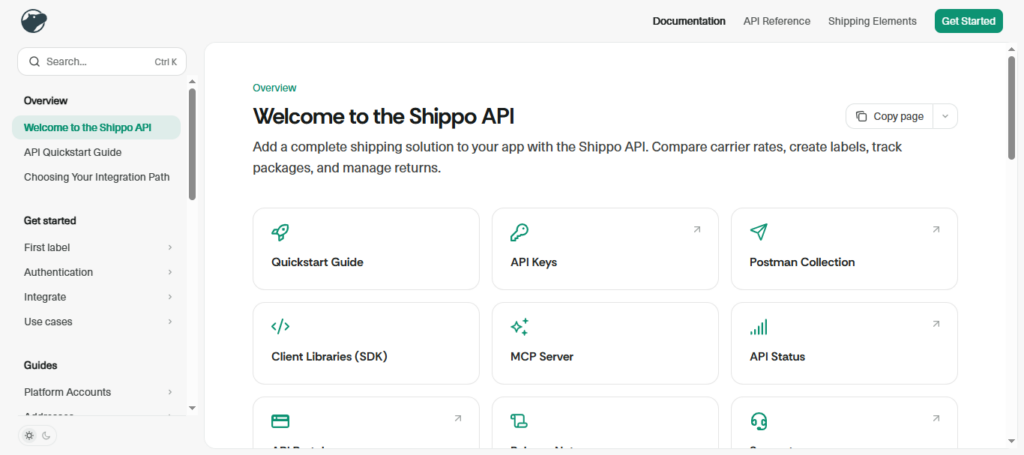
Shippo has great adoption in the e-commerce space, as it allows for easy integration with automated label generation.
The real-time rate engine allows Shippo users to make cost-effective shipment decisions and enhances shipment transparency. Shippo is great for logistics operations as it aids the scaling of shipping needs in both the domestic and international arenas.
Pros & Cons EasyPost API
| Pros | Cons |
|---|---|
| Simple API integration for developers | Limited LTL coverage in some regions |
| Supports 40+ global carriers | Advanced freight features are restricted |
| Strong e-commerce automation support | Pricing increases with scaling usage |
| Real-time rate comparison improves decision-making | Not ideal for complex enterprise logistics |
3. ShipEngine API
ShipEngine is a shipping API designed with developers in mind. It has the ability to compare shipping rates from multiple carriers in real-time, including LTL freight. Further, businesses can fully automate the selection of shipping rates, the creation of shipping labels, and even track shipments.
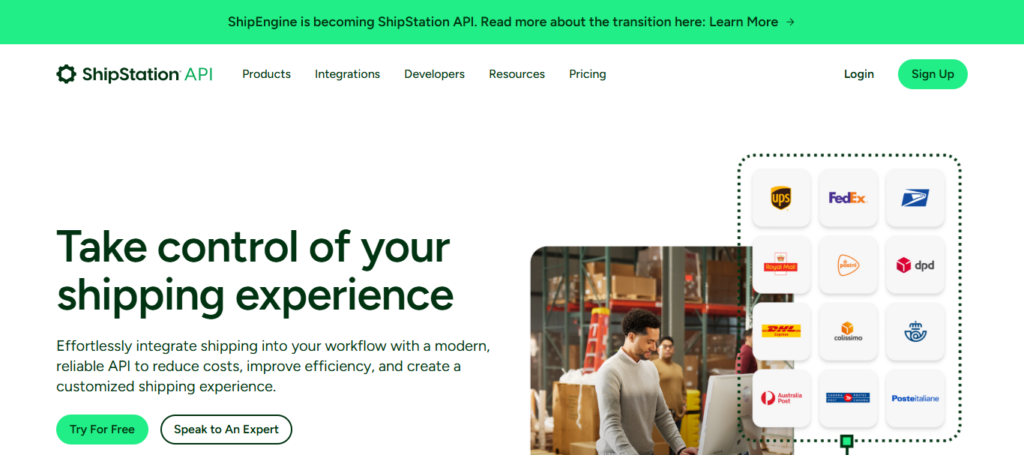
ShipEngine is especially helpful in high-volume fulfillment environments as its API supports fulfillment speed and accuracy. ShipEngine’s intelligent rate filtering and dynamic carrier selection features help companies achieve their delivery goals, gain operational visibility, and even save on shipping costs.
Pros & Cons EasyPost API
| Pros | Cons |
|---|---|
| Advanced real-time rate filtering system | Learning curve for beginners |
| Strong automation for labels and tracking | Enterprise pricing can be expensive |
| Excellent for high-volume shipping workflows | Limited offline documentation support |
| Supports dynamic carrier selection | Requires technical expertise for setup |
4. ClickPost Shipping API
ClickPost is a high-level logistics platform designed with the needs of large-scale businesses in mind. From real-time multi-carrier rate aggregation to LTL shipping, ClickPost has it all.
With the capability of utilizing over 500 carrier options, ClickPost automates the selection of the best carrier for a particular shipment based on cost and performance.
This is the go-to API of choice for many large-scale e-commerce businesses. Integrating easily into OMS, WMS, and TMS, ClickPost is convenient for supply chain operations that require extensive control over logistics.
Pros & Cons EasyPost API
| Pros | Cons |
|---|---|
| Supports 500+ carriers globally | Not suitable for small businesses |
| AI-based carrier selection improves efficiency | High implementation complexity |
| Strong integration with enterprise systems | Requires onboarding support |
| Reduces RTO and improves delivery success | Pricing is enterprise-focused |
5. ShipStation API
ShipStation is a multi-carrier shipping API like no other. Users can access a network of over 250+ carriers, facilitating comparison of shipping rates and even the creation of shipping labels, all from a single API.
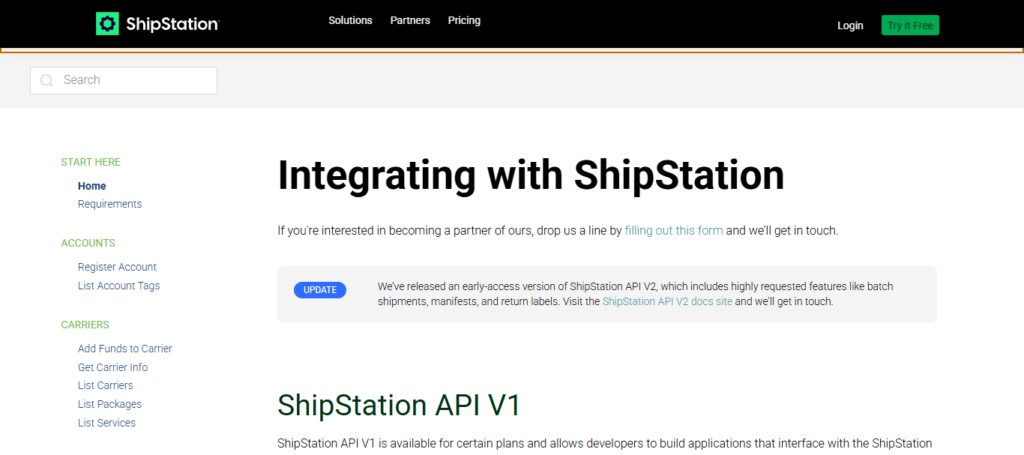
ShipStation’s ease of use and the ability to integrate with a plethora of other applications has made it a favorite among many businesses.
Further, this API is a reliable and scalable option for many businesses. ShipStation is favored among e-commerce businesses due to its strong carrier connectivity and helpful automation features.
Pros & Cons EasyPost API
| Pros | Cons |
|---|---|
| Supports 250+ carriers | LTL support is not deeply advanced |
| Easy-to-use dashboard and API | Limited enterprise-grade customization |
| Strong automation for fulfillment | Can slow under heavy enterprise load |
| Good integration with e-commerce platforms | Advanced features require higher plans |
6. ParcelManagement Rate Shopping API
ParcelManagement has an advanced rate shopping API that evaluates over 50+ carriers’ pricing, including freights and LTL services. They value cost optimization. Their API helps customers fix billing errors, inconsistent charges, and duplicate charges.
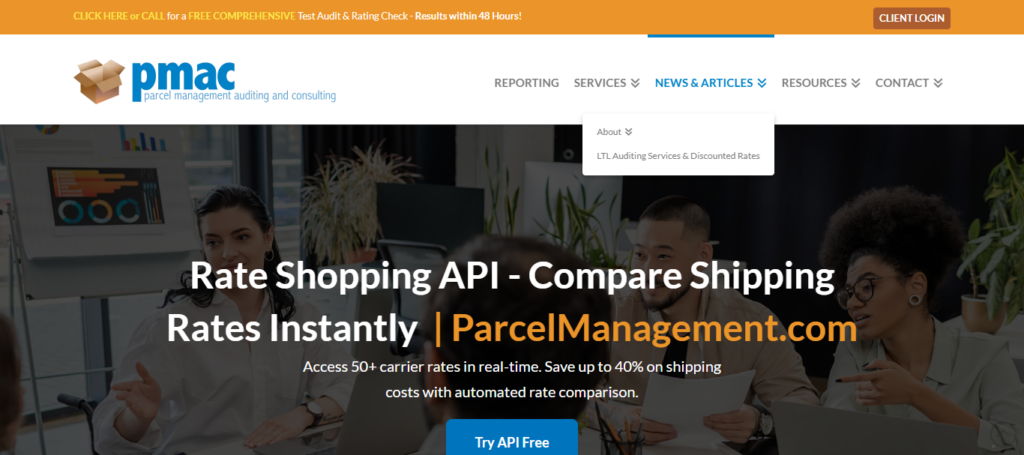
The API enables customers to determine the most cost-effective shipping method while keeping service standards.
ParcelManagement has a structured rate comparison tool that helps a customer’s logistics team make cost-effective shipping decisions and reduce the overall cost of transportation for the company’s daily shipping activities.
Pros & Cons EasyPost API
| Pros | Cons |
|---|---|
| Strong cost optimization features | Limited global carrier network |
| Detects billing errors and overcharges | Less focus on automation features |
| Real-time rate comparison engine | UI/UX tools are basic |
| Good for freight cost auditing | Not ideal for fast scaling startups |
7. Warp LTL Rate API
Like the rest of Warp’s developer-focused suite of APIs, the Warp LTL Rate API takes the hassle out of getting real-time LTL freight rate quotes. Instead of having to sift through a ton of unstructured data found in traditional carrier portals
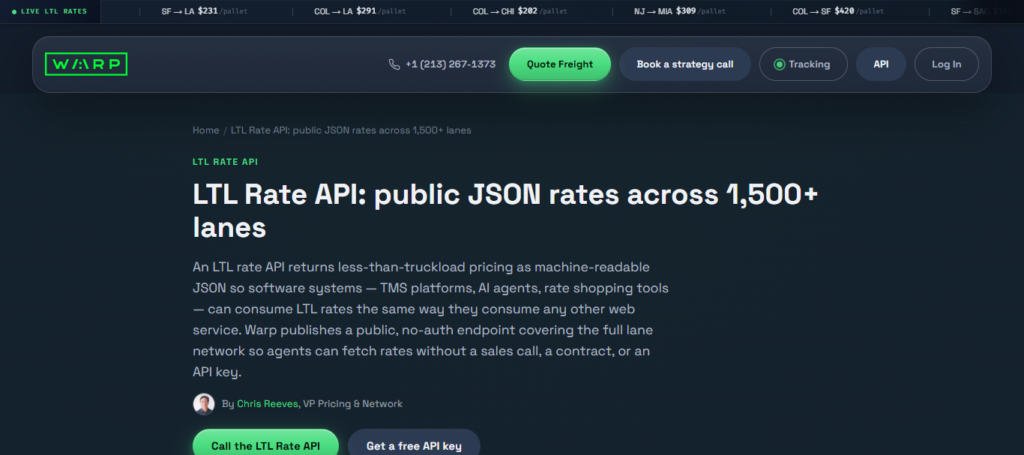
users get lane-based quotes that include pricing, predicted transit times, and a list of competing carriers, all in structured JSON format. This API is a dream come true for developers of logistics and trade-simulation applications.
Pros & Cons Warp LTL Rate API
| Pros | Cons |
|---|---|
| Highly structured LTL freight data | Limited brand recognition |
| Real-time lane-based pricing | Smaller carrier ecosystem |
| Developer-friendly JSON output | Focused only on LTL use cases |
| Ideal for AI logistics systems | Limited enterprise integrations |
8. Routely API
Real-time LTL rate comparison and automated carrier selection are the two main features of Routely’s multi-carrier shipping optimization platform, along with a slew of other transportation and logistics optimization features.
Routely’s API is intended for enterprises that have stringent controls on shipping costs and an equally important focus on improving delivery performance.
Routely’s quoting system is one of the fastest in the industry, allowing users to instantly compare multiple carrier options to maximize cost savings.
Routely API Pros & Cons
| Pros | Cons |
|---|---|
| AI-powered freight optimization | Not suitable for small businesses |
| Fast real-time rate comparison | Complex setup process |
| Strong cost-saving capabilities | Limited public documentation |
| Enterprise-grade logistics control | Requires integration support |
9. AfterShip Shipping API
While AfterShip is most recognized for its tracking services, they do provide shipping services for multiple carriers with real-time rate visibility. In addition, they offer LTL freight tracking and connect to 1,000+ carriers around the globe.
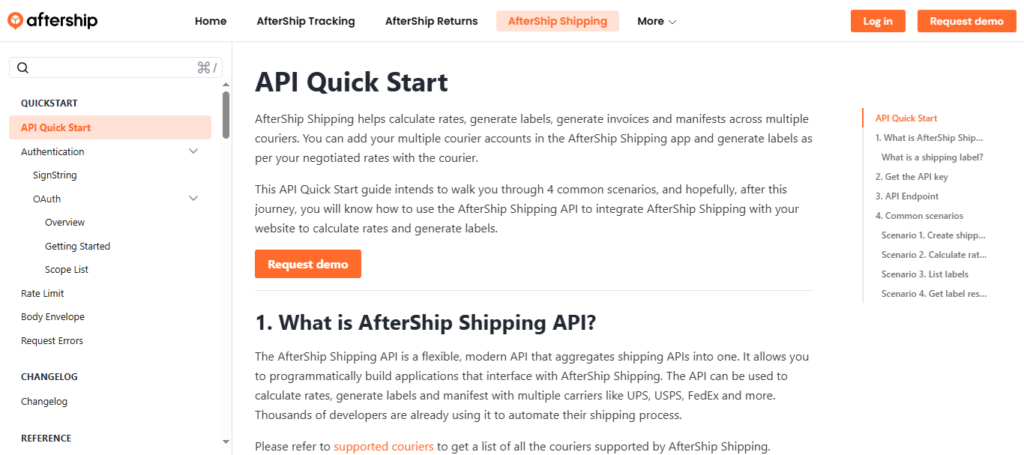
AfterShip focuses on the post-purchase phase of the customer journey and provides businesses with the ability to track the status of freight and analyze delivery performance.
AfterShip provides an API to enable businesses to streamline their shipping and tracking workflows.
Pros & Cons AfterShip Shipping API
| Pros | Cons |
|---|---|
| Supports 1,000+ carriers | LTL shipping is secondary feature |
| Strong tracking and analytics system | Not a pure shipping-first API |
| Excellent post-purchase experience tools | Limited freight optimization |
| Global logistics coverage | Advanced shipping tools require upgrades |
10. Shipstore Multi-Carrier API
Shipstore has developed an integrated multi-carrier shipping API and offers LTL services to facilitate pricing and booking via the leading freight carriers.
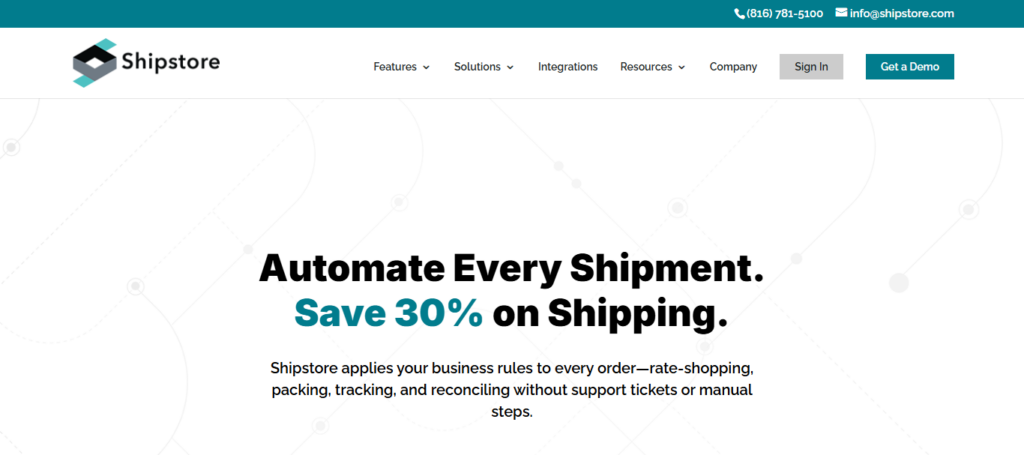
By consolidating multiple carrier APIs, Shipstore allows businesses to easily determine the pricing and service tradeoffs of different carriers. Shipstore is ideal for eCommerce and logistics teams looking for fast pricing and simple carrier execution.
Since Shipstore is designed to easily integrate with the checkout flow, it improves order conversion and minimizes shipping cost loss.
Pros & Cons Shipstore Multi-Carrier API
| Pros | Cons |
|---|---|
| Easy integration with checkout systems | Limited enterprise customization |
| Real-time LTL rate comparison | Smaller global footprint |
| Improves conversion rates | Advanced analytics not strong |
| Simplifies carrier selection | Limited documentation depth |
Conclusion
In conclusion, the Best Multi-Carrier Shipping APIs with Real-Time LTL rates are a must-have for logistics and e-commerce businesses who wish to innovate.
These APIs allow immediate comparisons and automated selection with a higher rate of success. Companies can harness their competitive edge by utilizing these APIs to support growth and supply chain visibility.
FAQ
Which API is best for LTL shipping?
EasyPost and ShipEngine provide strong LTL support and scalable enterprise logistics solutions.
Do shipping APIs support freight LTL rates?
Yes, several APIs support LTL freight pricing with real-time carrier comparisons available.
How do shipping APIs reduce costs?
They compare multiple carriers instantly, selecting cheapest and fastest shipping option automatically.
Is EasyPost good for LTL shipping?
Yes, EasyPost offers reliable LTL integration with major carriers and regional freight partners.
Can small businesses use these APIs?
Yes, Shippo and ShipStation are ideal for small business shipping automation needs.
