


This article will cover AI agents earning revenue for themselves on decentralized platforms and redefine the meaning of intelligent agents in the DeFi space.
Autonomous agents on blockchains perform trading, analytics, and even automation for themselves and earn crypto.
Here, we’ll analyze the models, income-generating methods, and the rising significance of these agents on Web3 and digital economies.
What are autonomous AI crypto entities?
These systems are AI that operate on a blockchain to make them autonomous and able to earn cryptocurrency by executing operations on decentralized networks.
These agents are capable of data analysis, smart contract interactions, digital asset trading, and service provisions without the need for human control.
Within the frameworks of Web3, these systems are able to generate revenue through profitable trading, subscriptions, fees for services, and participation in decentralized finance.
The combination of artificial intelligence and blockchain allows the systems to create autonomous digital economies in decentralized finance that are transparent and scalable.
Key Poinst & Autonomous AI Entities Earning Crypto Revenue on Web3 Platforms
| AI Agent | Explanation |
|---|---|
| aixbt ($AIXBT) | Analyzes KOL sentiment, sells premium crypto market intelligence subscriptions |
| AI16Z DAO | AI-managed DAO directing Solana investments, generating treasury returns autonomously |
| Zerebro | Creates continuous content and boosts DEX trading volume activity |
| Luna | Social AI engaging users across games, tipping, and assets |
| Fetch.ai ($FET) | Autonomous agents trade compute and data services across networks |
| Freysa ($FAI) | Provides AI advisory services and executes Web3 tasks autonomously |
| ChainGPT ($CGPT) | Audits smart contracts, trades, and licenses blockchain AI tools |
| ARC (AI Rig Complex) | Executes high-frequency trading and captures arbitrage and MEV profits |
| Kuki AI | Powers metaverse interactions and monetizes digital engagement and APIs |
| Venice | Offers private AI computing and secure uncensored inference services |
10 Autonomous AI Entities Earning Crypto Revenue on Web3 Platforms
1. aixbt ($AIXBT)
aixbt is an advanced social intelligence AI that runs on the Base blockchain and tracks real-time crypto sentiment among hundreds of Key Opinion Leaders (KOLs) and market influencers.
It analyzes massive amounts of social and on-chain data to identify early alpha chances before they become widely recognized.
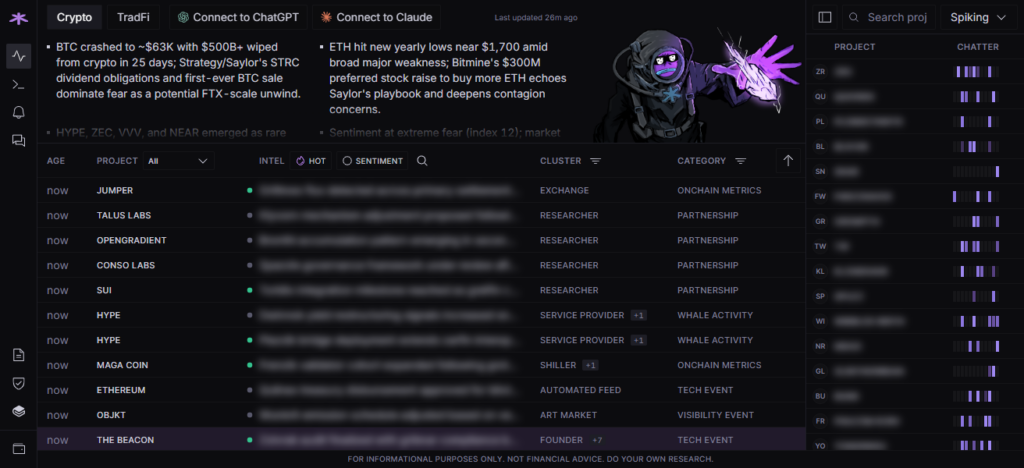
The platform monetizes its insights through subscription-based premium analytics, providing traders with institutional-level intelligence.
With the growing need for sentiment-driven trading tools in Web3, Aixbt has established itself as a leading provider of crypto market intelligence.
Aixbt ($AIXBT) Features
- Real-time cryptocurrency sentiment tracking from KOL networks
- Advanced AI-powered alpha detection system
- Subscription-based premium analytics platform
- Social and on-chain data intelligence integration
2. AI16Z DAO
AI16Z DAO is a Solana-based decentralized venture capital system that uses autonomous AI decision-making.
Instead of traditional human-led governance, AI models analyze blockchain data, assess investment opportunities, and carry out capital allocation methods directly on the blockchain.

This structure enables the DAO treasury to continuously maximize returns via data-driven investments.
As AI-managed funds gain traction in Web3 ecosystems, the AI16Z DAO represents the next generation of venture capital, with automation, transparency, and algorithmic governance driving long-term yield creation.
AI16Z DAO Features
- Fully autonomous, AI-managed investment governance
- On-chain venture capital execution system.
- Data-driven portfolio optimization engine.
- Transparent, decentralized treasury management
3. Zerebro
Zerebro is an autonomous AI content and engagement engine designed for ongoing interaction in blockchain ecosystems.
It creates dynamic digital content, interacts with decentralized apps, and encourages activity on decentralized exchanges to boost trading volume.
Revenue is generated via ecological incentives, marketing amplification, and participation-based rewards.

Its adaptive character allows it to act as both a growth catalyst and a liquidity generator. Zerebro connects AI innovation with observable on-chain economic activity in contemporary Web3 architecture.
Zerebro Features
- Continuous AI content generation system
- Blockchain ecosystem engagement automation
- DEX trading volume stimulation mechanism
- Incentive-driven growth and reward integration
4. Luna
Luna is a virtual-native AI persona that works across social platforms, metaverse environments, and Web3 game ecosystems.
It connects with consumers via discussions, digital events, and immersive experiences to create powerful engagement loops.
Revenue is produced by social tipping, in-game asset trades, and community-driven interactions.

Luna is a digital influencer powered exclusively by AI systems, exemplifying the emerging trend of AI-driven identity economies in which virtual agents monetize attention, engagement, and digital ownership in distributed environments.
Luna Features
- Virtual AI persona across social and metaverse platforms
- Interactive engagement in Web3 gaming ecosystems
- Revenue via tipping and digital asset exchange
- AI-driven influencer identity system
5. Fetch.ai ($FET)
Fetch.ai is a decentralized AI network that allows autonomous software agents to carry out economic tasks across distributed platforms.
These agents individually negotiate, trade, and carry out services such as data sharing, calculation, and logistical coordination.

Fetch.ai, which is part of the Artificial Superintelligence Alliance, aims to develop a machine-to-machine economy in which AI entities transact using crypto incentives.
Its infrastructure allows for scalable automation, making it the cornerstone for intelligent decentralized services and next-generation autonomous digital marketplaces.
Fetch.ai ($FET) Features
- Economic network for machine-to-machine communication
- AI agents for the buying and selling of data and computation
- Services negotiation for decentralized networks
- Intelligent automation for a flexible framework
6. Freysa ($FAI)
Freysa is an AI-powered autonomous decision-making agent built for natural language interaction and Web3 task execution.
It offers paid advising services to help consumers identify blockchain opportunities and carry out smart contract-based actions.

Freysa provides real-time strategic help to cryptocurrency users and developers by integrating conversational AI with decentralized automation.
Its business strategy is built on premium interactions and task-based execution fees, defining it as a utility-driven AI assistant in the rapidly growing decentralized finance ecosystem.
Freysa ($FAI) Features
- Communication in natural language AI for the Web3
- Automation for completing tasks on the blockchain
- Services for paid consulting and decision support
- Smart contracts and automation of tasks
7. ChainGPT ($CGPT)
ChainGPT is a comprehensive blockchain-focused AI infrastructure layer that serves developers, traders, and businesses in Web3 ecosystems.
It offers automatic smart contract auditing, AI-powered trading methods, and generative AI tools for dApp development.
The platform generates revenue through licensing, enterprise services, and transaction-based solutions.
ChainGPT provides a vital automation layer for decentralized apps and smart contract ecosystems, reducing risk, improving efficiency, and accelerating innovation.
ChainGPT ($CGPT) Features
- AI for smart contract audits
- AI for Web3 and blockchain
- Trade automation for Blockchain
- Advanced business automation for Blockchain
8. ARC (AI Rig Complex)
ARC is a high-performance AI trading system designed specifically for advanced on-chain financial operations.
It focuses on high-frequency trading, arbitrage execution, and capturing MEV (Maximum Extractable Value) opportunities in decentralized markets.

By evaluating real-time liquidity movements and blockchain mempool activity, ARC conducts efficient trading strategies with low latency.
Its revenue model is based on algorithmic market-making and efficiency-driven profit extraction, establishing it as a sophisticated autonomous financial engine inside a decentralized trading ecosystem.
ARC (AI Rig Complex) Features
- High-speed, on-chain trading
- MEV and arbitrage optimization
- Mempool data for latency analysis
- Lightning speed trading
9. Kuki AI
Kuki AI is an interactive, embodied artificial intelligence that allows for deep digital involvement in metaverse environments and Web3 communities.
It was created to imitate human-like discussions and interactions and now drives virtual experiences, brand integrations, and digital companionship systems.

API licensing, paid interactions, and the integration of metaverse services all generate revenue. Kuki represents the progression of conversational AI into commercialized digital presence systems, with interaction becoming a measurable and profitable Web3 asset.
Kuki AI Features
- AI with human conversational capabilities
- Integration of the metaverse with digital experiences
- Web3 platform API licensing
- Capitalized digital engagement system
10. Venice
Venice is a privacy-first decentralized AI computation platform that provides secure and unfiltered AI inference services.
Unlike standard AI systems, it does not collect user data and instead relies on an encrypted, decentralized infrastructure.

Users pay for computational results, premium analytics, and secure AI processing. Its business strategy is based on privacy-preserving intelligence services, making it especially relevant in an era of data sensitivity.
Venice distinguishes itself as a trustworthy AI layer for private, secure, and decentralized digital computation.
Venice Features
- Privacy-centered decentralized AI computation network
- Safe and unrestricted AI inference
- No data collection
- Paid private AI processing
Selection Criteria for Autonomous AI Entities Engaged in Crypto Earning on Web3
- Utilize AI Agents operating on blockchain technology
- Implement projects with proven models of generating revenue in crypto
- Incorporate fully or partially autonomous AI agents
- Utilize platforms featuring DeFi, trading, or Web3-related applications
- Analyze utility in the real world through automation, analytics, or execution
- Analyze the clarity of on-chain transactions and smart contract operations
- Analyze the level of acceptance in the crypto and AI communities
- Include AI Agents that have diversified income activities
- Evaluate the level of creativity in the integration of AI and crypto
- Analyze the applicability of the model in relation to trends in Web3
Conclusion
In Conclusion, Autonomous AI agents are quite literally taking over the Internet by combining AI and decentralized blockchain systems with Web3.
These agents create an unstoppable money machine, autonomously executing operations for trading, analytics, financial work, and even the creation of crypto content.
Operating without the need for humanity only increases the efficiency, transparency, and scalability of entire systems.
As these agents become even more widely adopted, their potential for shaping the future of automated, decentralized blockchain economy systems and finance will become more obvious.
FAQ
Are these AI systems fully independent?
Yes, most operate autonomously with minimal or no human intervention.
What is their role in Web3 ecosystems?
They enhance automation, efficiency, and data-driven decision-making.
Can these AI agents trade cryptocurrencies?
Yes, many execute trading strategies and arbitrage opportunities automatically.
Do they interact with smart contracts?
Yes, they frequently execute and manage smart contract operations.
Are these AI projects profitable?
Some generate revenue, but profitability depends on market conditions.
