


This article will highlight the Best Crypto Exchanges for Business. I will take you through the key features available for secure trading, high liquidity, and advanced tools for corporate and institutional users.
These platforms provide APIs, support for Fiat, and full global access to assist enterprises with the management of their digital assets.
This article will show you the way that these exchanges assist business growth and compliance, and enable dynamic and scalable Crypto Operations in the constantly evolving financial markets.
key Points & Best Crypto Exchanges for Businesses
| Exchange | Explanation |
|---|---|
| Binance | Supports high liquidity global trading advanced business APIs integration tools |
| Coinbase | Trusted US exchange offering secure custody institutional business solutions platform |
| Kraken | Professional exchange with strong security staking and business accounts support |
| OKX | Comprehensive trading platform providing APIs derivatives and enterprise services suite |
| Bybit | Fast growing exchange offering derivatives trading and business tools solutions |
| Bitstamp | Long standing European exchange providing reliable fiat onramps businesses globally |
| Gemini | Regulated exchange offering secure custody and institutional trading services platform |
| KuCoin | Global exchange supporting wide altcoin access and business APIs integration |
| Bitfinex | Advanced exchange with deep liquidity margin trading institutional access features |
| Crypto.com | All in one platform providing exchange payments and business services |
10 Best Crypto Exchanges for Businesses
1. Binance
Binance has substantial trading volume, resulting in high liquidity. Its trading infrastructure is advanced and complex, making it ideal for businesses.
Trading and investing can be done at great speeds. The Binance Trade API offers opportunities for automated trading systems and portfolio management, which are more uncommon at this scale in the crypto space.
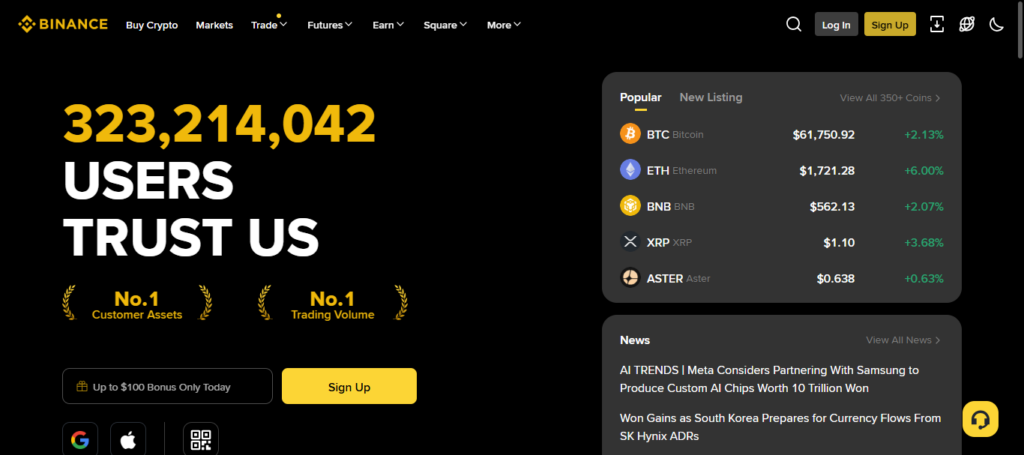
Integrating with Binance API provides more access to market data. Binance has its own ecosystem as well, with a processor called Binance Pay and a digital wallet called Binance Wallet. Flexible trading and risk management are supported, along with cross-border operations due to multiligual support.
| Pros | Cons |
|---|---|
| Extremely high liquidity for global business trading | Regulatory restrictions in some countries |
| Advanced API for algorithmic and institutional trading | Complex interface for beginners |
| Wide range of trading products (spot, futures, options) | Occasional regulatory scrutiny and updates |
| Low trading fees for high-volume businesses | Customer support can be slow during peak times |
| Strong ecosystem including Binance Pay and Wallet | Limited fiat support in certain regions |
2. Coinbase
Coinbase is a fully regulated US crypto trading platform with substantial compliant practices. It offers custody and trading solutions to businesses and fintechs, especially hedge funds, due to its focus on institutional security.
Coinbase Prime offers excellent OTC trading, custody, and portfolio analytics, especially for institutions, due to its security.
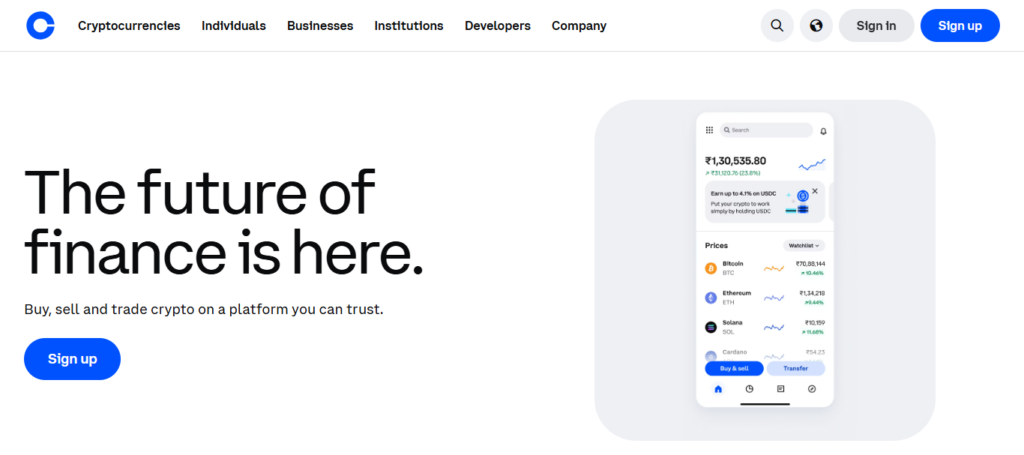
Compared to its competitors, Coinbase operates in a more regulated environment and as such, is more transparent with its compliance.
Recently, Coinbase has improved its transaction throughput and lowered the cost for enterprise users in its Layer-2 Base ecosystem. Due to its API, many businesses can easily adopt crypto.
| Pros | Cons |
|---|---|
| Highly regulated and trusted in the US market | Higher trading fees compared to competitors |
| Strong institutional service (Coinbase Prime) | Limited altcoin variety |
| Excellent security and custody solutions | Some advanced features locked to enterprise users |
| Easy fiat on/off ramps for businesses | Slower global expansion than rivals |
| Strong compliance for regulated industries | Less flexible for high-risk trading strategies |
3. Kraken
Kraken is one of the oldest exchanges in the crypto space, and for good reason. Kraken combines features for institutional traders with security. Businesses use Kraken because it has less downtime compared to its competitors, has advanced order type features, and has a comprehensive API.
Kraken Institutional offers OTC trades, staking custody for corporate clients, and custody services. Kraken also has a transparent proof-of-reserves feature, enhancing trust with enterprise clients.
Recently, Kraken started expanding its global license offerings and derivatives, helping foreign Kraken clients. Kraken is a useful tool for businesses who want to have a long-term crypto strategy because it offers a lot of compliance centric features and has a lot of liquidity.
| Pros | Cons |
|---|---|
| Strong security and proof-of-reserves transparency | Interface less modern than competitors |
| Reliable uptime and system stability | Limited payment integrations compared to Binance |
| Advanced institutional trading tools | Fewer promotional or reward programs |
| Strong regulatory compliance in multiple regions | Some features restricted by jurisdiction |
| Competitive staking and OTC services | Smaller ecosystem compared to Binance |
4. OKX
OKX is a global crypto exchange that offers a complete range of trading and Web3 services. OKX’s spot trading, futures, options, and DeFi tools are all integrated into one ecosystem. Businesses use OKX’s APIs to manage liquidity, execute trades, and even implement automated trading strategies.

OKX has also expanded its Web3 wallet and DeFi features, making it even easier for businesses to engage with the blockchain.
OKX is also focusing on compliance and global licensing in order to increase institutional use of the exchange. OKX’s advanced trading platform and infrastructure is designed for professional traders and fintech firms that need scalable solutions.
| Pros | Cons |
|---|---|
| Full ecosystem: spot, futures, DeFi, Web3 wallet | Can feel overwhelming for new users |
| Strong API support for automated trading | Regulatory availability varies by country |
| High-speed trading infrastructure | Limited fiat channels in some regions |
| Advanced derivatives trading options | Complex product structure for beginners |
| Strong global expansion strategy | Customer service response time varies |
5. Bybit
Bybit has emerged as a primary exchange among professional traders and crypto businesses, with a predominant focus on derivatives. With Bybit, high-leverage trading coupled with rapid execution and deep liquidity is the norm.
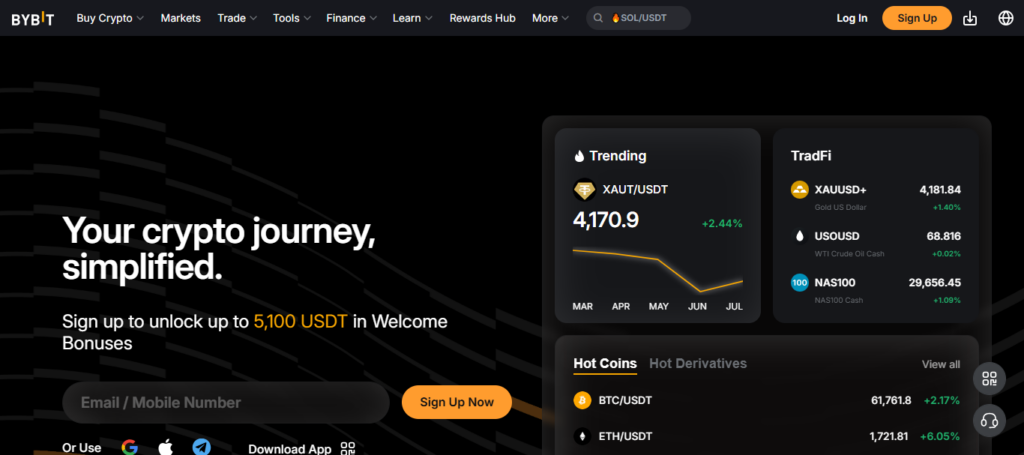
Bybit provides institutional APIs that enable automated trades and analytics in real-time, improving the trading experience for businesses. Bybit has also branched into spot trading, copy trading, and other Web3 ventures.
Bybit’s continual investment in upgrading security and compliance for different jurisdictions is commendable. Its easy-to-navigate platform and sophisticated trading tools is why so many advanced traders, including those that trade in algorithms, favor Bybit.
| Pros | Cons |
|---|---|
| Excellent derivatives trading platform | Historically focused more on derivatives than spot |
| Fast execution with low latency | Limited fiat support in some regions |
| Strong copy trading and automation tools | Regulatory restrictions in certain countries |
| Competitive trading fees | Smaller institutional ecosystem than Coinbase |
| Expanding Web3 and spot services | Fewer long-term investment tools |
6. Bitstamp
Bitstamp is among the oldest, reliable, predicable, and compliant crypto exchanges in Europe. Because of its reliable banking partnerships, Bitstamp is preferred by businesses for fiat crypto transactions.
Bitstamp’s institutional offerings include a secure custody solution, OTC desks, and APIs for enterprise-grade systems. Bitstamp also leads the industry with its dedication to transparency and alignment with regulations.
Bitstamp is truly a gateway for businesses looking to take a cautious and compliant first step into crypto. Investments in Bitstamp’s technology in recent years have significantly improved liquidity, trade execution, and overall performance of the trading engine.
With over a decade of perfect uptime and reliability, Bitstamp is still often the first choice for business crypto to digital asset compliance.
| Pros | Cons |
|---|---|
| One of the oldest and most trusted exchanges | Limited cryptocurrency selection |
| Strong European regulatory compliance | Less advanced trading features |
| Reliable fiat-to-crypto banking integration | Higher fees compared to newer exchanges |
| Stable and consistent performance | Limited innovation in DeFi/Web3 |
| Good institutional onboarding support | Smaller global ecosystem |
7. Gemini
Headquartered in the United States, Gemini is a cryptocurrency exchange designed to optimize compliance, security, and trust from institutions. Businesses utilize Gemini for custody solutions, insured storage for their digital assets, and a regulated environment for trading.
Gemini ActiveTrader is designed for users needing professional grade tools from advanced charting, APIs, and rapid trade executions. In recent years, Gemini has expanded their services to institution staking and lending.
SOC 2 Certification and Gemini’s stringent regulatory monitoring are attractive features for enterprises in the finance and fintech spaces. Gemini’s focus on transparency and risk management also makes it a preferred exchange for businesses.
| Pros | Cons |
|---|---|
| Highly regulated US exchange with strong compliance | Higher trading fees |
| Strong institutional custody services | Limited altcoin availability |
| SOC 2 certified security standards | Fewer trading pairs than competitors |
| Insurance-backed digital asset storage | Slower feature expansion |
| Strong trust in fintech and enterprise sectors | Limited global availability |
8. KuCoin
KuCoin is a popular, global exchange known for its extensive altcoin offerings and flexible trading services. Businesses utilize the exchange’s APIs to implement automated trading and gain access to liquidity to assist with diversified portfolios.
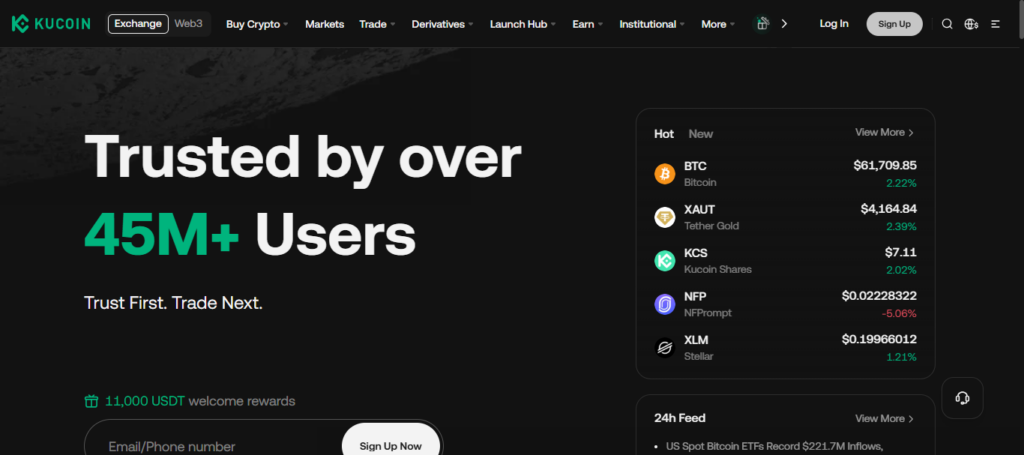
Financial services of all kinds can be conducted on KuCoin due to its support for spot trading, futures trading, staking, and lending.
Recently KuCoin has focused on enhancing security and business accounts for institutions. With its flexible offerings and low fees, KuCoin is a popular exchange for businesses of all sizes.
| Pros | Cons |
|---|---|
| Very large selection of altcoins | Regulatory uncertainty in some regions |
| Low trading fees for businesses | Less institutional-grade reputation |
| Strong API for automated trading | Security concerns in past incidents |
| Flexible staking and lending options | Fiat support not as strong globally |
| Good for emerging crypto projects | Customer support can be inconsistent |
9. Bitfinex
Bitfinex offers a deep liquidity cryptocurrency trading option that is best for businesses. They provide trading margin and derivatives for businesses that need to execute high volume trades. Bitfinex offers institutional grade APIs for businesses to run algorithmic trading with their liquidity.
Their order books offer minimal slippage with the ability to run large scale trades. They also offer lending and staking for yields to grow.
Bitfinex improves their systems and infrastructure to support their enterprise clients. Their focus and dedication to enterprise clients means that hedge funds and trading businesses utilize Bitfinex.
| Pros | Cons |
|---|---|
| Deep liquidity for large institutional trades | Complex interface for beginners |
| Advanced margin and derivatives trading | Limited fiat onboarding options |
| Strong API for algorithmic trading systems | Past regulatory controversies |
| Professional-grade trading environment | Smaller retail user base |
| Efficient order execution with low slippage | Less beginner-friendly ecosystem |
10. Crypto.com
Crypto.com offers a full digital asset solution with an exchange and a full suite of crypto business services. Businesses are able to set up a crypto payment gateway, crypto cards, and digital asset management all with Crypto.com.
Their institutional services include OTC trading, custody, and a trading API. They have expanded their ecosystem to include DeFi, NFTs, and Web3 offering business even more options for blockchain integration.
Their business friendly omni-channel compliance focus and a user friendly interface means that businesses of all sizes can use Crypto.com to implement a crypto financial system.
| Pros | Cons |
|---|---|
| All-in-one ecosystem (exchange, card, payments) | Higher fees on some services |
| Strong global brand partnerships | Complex product ecosystem |
| Easy crypto payment integration for businesses | Customer support delays reported |
| Wide Web3 and DeFi expansion | Limited advanced trading tools |
| Strong compliance and licensing growth | Some features region-restricted |
Conclusion
To sum up, the Best Crypto Exchanges for Businesses focus on fortifying the infrastructure of businesses with liquidity and sophisticated trading tools oriented towards institutional frameworks.
Best crypto exchanges in the category of Binance, Coinbase, and Kraken demonstrate frameworks for compliance, provision of APIs along with the global reach, making it easier for the businesses to adopt Cryptos.
Selection of a specific exchange is determined based on cost the business incurs, safety and other functionalities of the exchange. The given exchanges offer the businesses the pathway for a better infrastructure in the fast evolving crypto ecosystem.
FAQ
What are the best crypto exchanges for business use?
The top exchanges for businesses include Binance, Coinbase, Kraken, OKX, Bybit, Bitstamp, Gemini, KuCoin, Bitfinex, and Crypto.com. These platforms offer institutional-grade trading, APIs, and liquidity.
Which crypto exchange is best for institutional trading?
Coinbase and Kraken are often preferred for institutional trading due to strong compliance, custody solutions, and regulatory transparency.
Which exchange offers the lowest trading fees for businesses?
Binance and KuCoin generally provide the lowest trading fees, especially for high-volume business accounts.
Which crypto exchange is safest for companies?
Gemini, Coinbase, and Kraken are considered highly secure due to strict compliance, insurance coverage, and strong custody systems.
