


In this article, I cover the Best AI-Powered Help Desk Ticketing Softwares for Enterprise IT Support that are changing the way IT service management operates today.
With AI, automation, and predictive analytics, these next-gen platforms are able to handle tickets and optimize IT processes in an efficient way and with minimal time invested. Discover the best tools, their features, and benefits as well as how enterprises can select the best choice.
What is AI-Powered Help Desk Ticketing Software?
AI-Powered Help Desk Ticketing Software is an AI-based IT Service Help Desk system that automates and improves the efficiency of support workflows.
With intelligent ticket categorization, prioritization, and distribution, automated response chatbots, and virtual assistants, this system is a robust addition to any IT support division.
With machine learning and NLP at the core of this system, the predictive capability of the system is outstanding. IT service teams will see a noticeable reduction in the time taken to resolve support tickets.
It provides organizations with effective support solution system that shows significant improvement in productivity, quality, and experience. With minimal manual input and amazing accuracy, it allows IT divisions to better manage enterprise level support operations.
Key Points & Best AI-Powered Help Desk Ticketing Softwares for Enterprise IT Support
| Software | Explanation |
|---|---|
| ServiceNow | Enterprise platform automating IT workflows, ticketing, and AI-driven support resolution capabilities integrated |
| Zendesk | AI-powered help desk offering omnichannel ticketing and automated customer support workflows efficiently |
| Freshservice | Cloud-based IT service management platform with AI automation and incident tracking features |
| Jira Service Management | Agile ITSM tool enabling AI ticketing, incident management, and DevOps integration capabilities |
| ManageEngine ServiceDesk Plus | Comprehensive IT help desk solution with AI-powered ticket routing and analytics dashboard |
| SolarWinds Service Desk | AI-driven IT service desk improving incident resolution and asset management workflows efficiency |
| BMC Helix ITSM | Enterprise ITSM platform using AI for predictive ticketing and automation support capabilities |
| Zoho Desk | AI-powered customer service platform offering smart ticketing and workflow automation features suite |
| HappyFox | AI-based help desk software providing ticket management and customer support automation tools |
| Spiceworks | Free IT help desk platform offering AI ticketing and network monitoring tools |
10 Best AI-Powered Help Desk Ticketing Softwares for Enterprise IT Support
1. ServiceNow
ServiceNow is one of the most powerful enterprise-grade AI ITSM platforms on the market. Large enterprises leverage this platform to automate digital workflows in their organizations. Utilizing the “Now Assist” features, which are powered by AI, ServiceNow can summarize tickets, offer suggested responses, and even automate the resolution of incidents.
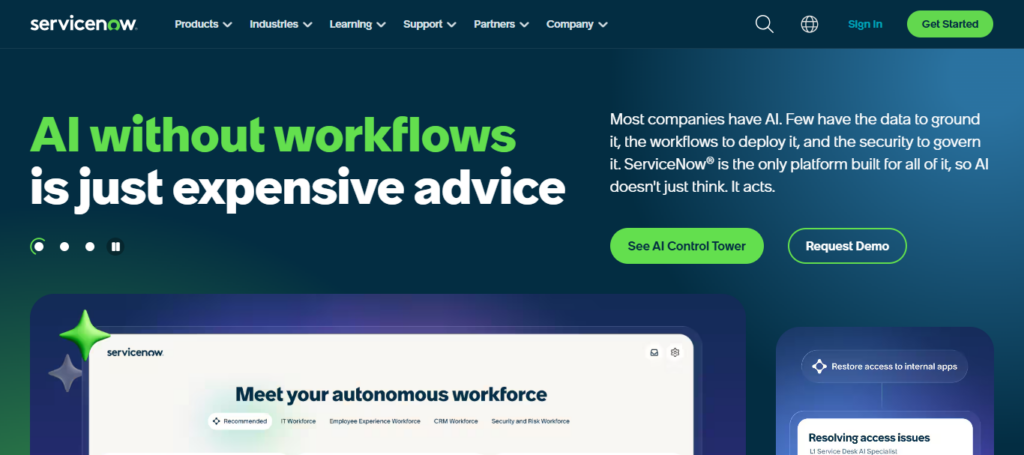
The development team has focused on the use of generative AI for ServiceNow updates to enhance the speed of ticket classification, along with the predictive risk analysis and intelligent incident routing.
ServiceNow merges IT Operations with HR and Customer Services to offer better visibility and cross organizational collaboration. Large enterprises leverage ServiceNow to reduce the burden of repetitive tasks, speed up SLA fulfillment, and improve the overall experience of employees.
The AIOps module of ServiceNow helps identify anomalies and gaps in the system, which reduces the overall downtime of the services and improves the IT resilience of the organization.
ServiceNow Pros & Cons
| Pros | Cons |
|---|---|
| Highly scalable enterprise-grade ITSM platform | Very expensive for small organizations |
| Advanced AI (Now Assist) for automation | Complex implementation and configuration |
| Strong AIOps for predictive incident management | Requires skilled administrators |
| Unified IT, HR, and business workflows | Long deployment time in enterprises |
| Excellent compliance and security features | Customization can become resource-heavy |
2. Zendesk
Zendesk is one of the top, customer and IT support scalable AI-powered help desk solutions. The cutting-edge AI features of Zendesk include, but are not limited to, generative responses, smart macros, and automated intent-based ticket classification and triage.
The Zendesk omnichannel solution merges email, chat, telephonic, and social media support into a single interface. More and more enterprises are adopting Zendesk’s AI agents to automate the handling of support queries and to eliminate human intervention in support incident resolution.

The time taken to respond to an individual support incident is drastically improved. Zendesk also offers improved business intelligence and analytics solutions that track and measure support-related customer satisfaction and agent performance.
The most recent version of Zendesk has introduced AI copilot solutions that assist frontline support agents, increase the speed of support incident resolution, and ensure seamless support to customers in different time zones.
Zendesk Pros & Cons
| Pros | Cons |
|---|---|
| Powerful omnichannel support system | Advanced AI features costly |
| Easy-to-use interface for agents | Limited deep ITSM capabilities |
| Strong AI automation and chatbots | Can become expensive at scale |
| Fast setup and deployment | Reporting customization is limited |
| Excellent customer experience tools | Less suitable for complex IT operations |
3. Freshservice
Freshservice is an ITSM tool adept at automating support workflows. Its development team built the platform using AI technologies, which they named Freddy AI. Freddy AI categorizes tickets, assumes their context, and even foresees and preemptively identifies incipient incidents.
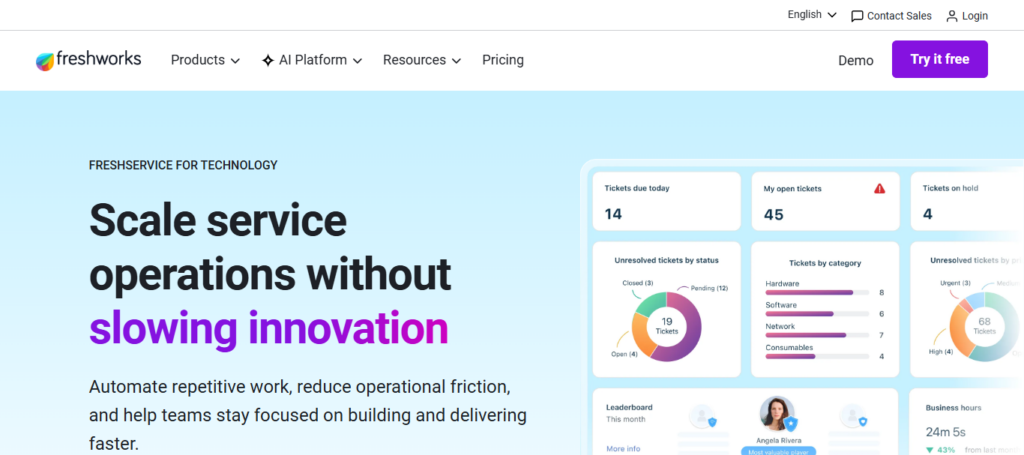
The tool uses self-service portals and automated approvals to streamline IT workflows and assist users with IT functions. Recent improvements to the platform’s ticketing system focus on systematic GenAI prompt engineering (ticket summarization) and enhanced conversational support system methods to resolve incidents.
Considering that Freshservice adopts and integrates ITIL support processes, enterprises use the tool to streamline ticketing. Freshservice’s analytics dashboard helps IT personnel resolve issues by identifying service performance anomalies before they become significant issues.
Freshservice Pros & Cons
| Pros | Cons |
|---|---|
| AI-powered Freddy automation engine | Limited enterprise-level customization |
| Clean and modern user interface | Advanced features require higher plans |
| Strong ITIL-based workflows | Integration ecosystem smaller than competitors |
| Fast implementation and setup | May not suit very large global enterprises |
| Good asset management features | AI still evolving compared to leaders |
4. Jira Service Management
For a DevOps-centric IT workflow tool, Jira Service Management covers all the bases. The tool incorporates IT automation and AI at each junction. Jira Code is an automation rule that uses AI to run the ticket, incident, and IT request loop, connecting all the dots to resolve issues quicker.
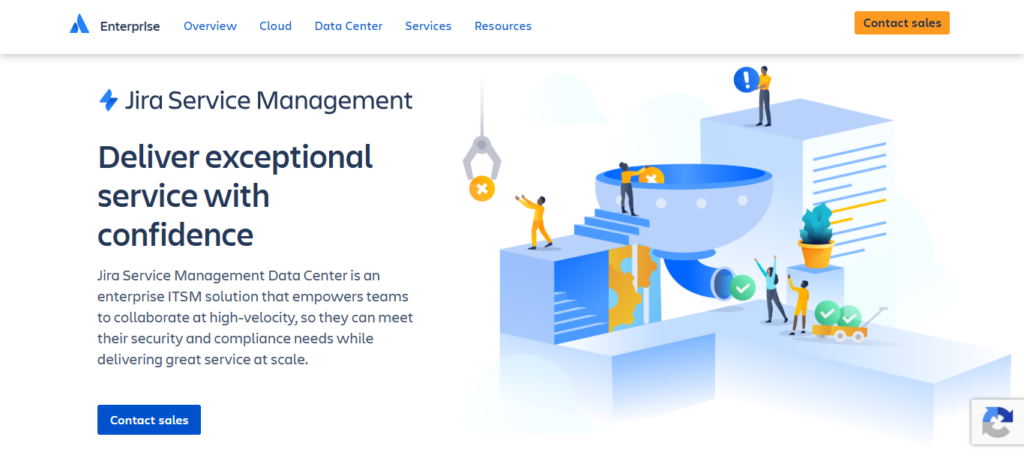
Recent advancements include machine learning-based virtual agents (for instant resolution) and AI tools that help IT personnel support and collaborate in real time, and that reduce MTTR (mean time to resolution). Enterprises prefer using the tool for the seamless integration of Jira Software and Confluence.
Jira Service Management Pros & Cons
| Pros | Cons |
|---|---|
| Strong DevOps and ITSM integration | Complex for non-technical teams |
| AI-driven automation and incident linking | Requires Atlassian ecosystem familiarity |
| Excellent for agile environments | UI can feel overwhelming initially |
| Deep integration with Jira Software | Advanced features need premium plans |
| Powerful collaboration features | Setup requires configuration effort |
5. ManageEngine ServiceDesk Plus
ManageEngine ServiceDesk Plus is an enterprise IT help desk system that offers an integrated solution combining ticketing, asset management, and workflow automation—all powered by AI. Their smart engine uses the history of help desk tickets to automatically classify tickets and assign them a level of urgency, as well as suggest steps for resolution.
Latest releases provide users with AI-driven virtual assistants that facilitate the troubleshooting process in the absence of help desk personnel. It also has the capability of using predictive analytics to foresee commonly occurring IT
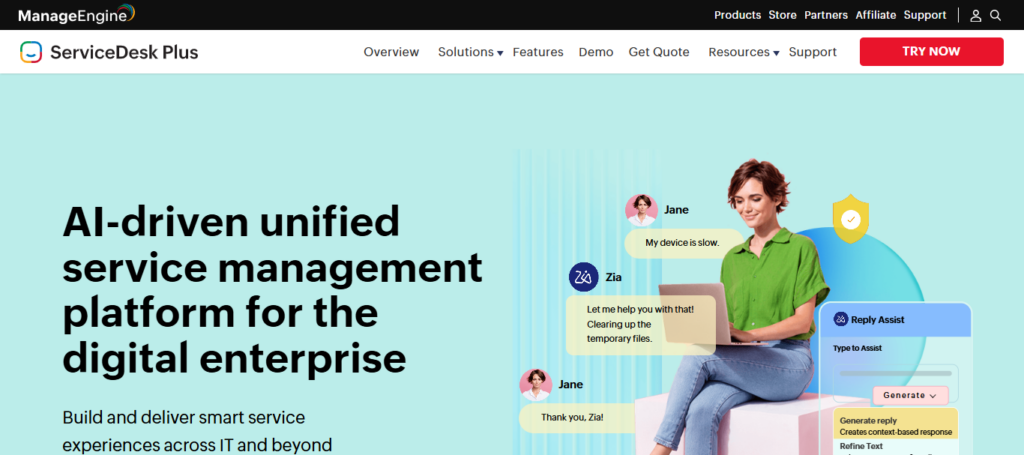
Problems and issue alerts before they affect the operations of the company. For ITIL-centered service management, IT departments prefer this product because it allows for structured mitigation of incidents and service desk compliance.
ManageEngine ServiceDesk is a highly configurable platform, making it a solution of choice for mid-to-large enterprises with limited budgets that require a comprehensive ITSM solution with highly flexible automation features.
ManageEngine ServiceDesk Plus Pros & Cons
| Pros | Cons |
|---|---|
| Cost-effective enterprise ITSM solution | UI less modern compared to competitors |
| AI-powered ticket routing and automation | Advanced AI features are limited |
| Strong asset management capabilities | Can be slower with large-scale deployments |
| Highly customizable workflows | Requires manual configuration |
| Good ITIL compliance support | Integration options not as extensive |
6. SolarWinds Service Desk
SolarWinds Service Desk is a solution for AI-centric IT service management that offers a high level of automation for the resolution of incidents, as well as visibility to IT assets. Using machine learning, it classifies tickets, recognizes anomalous events, and prescribes actions based on previously reported incidents.
The platform has excellent interoperability with monitoring instruments and, as a result, empowers IT teams to rapidly diagnose and resolve issues with the IT infrastructure. Modern enhancements have introduced customized automation workflows and an advanced ticket escalation prediction tool.
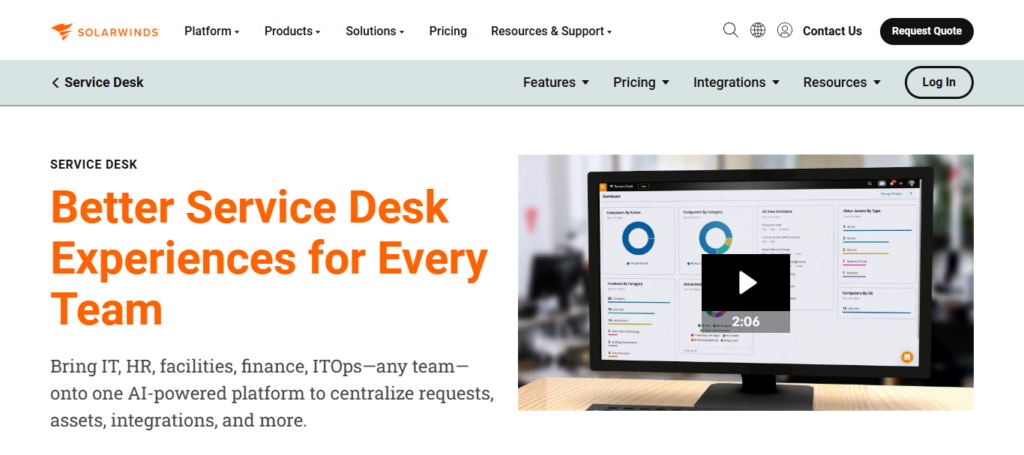
Its reliance for comprehensive IT asset tracking and service management is well earned due to its high AI-centric automation and minimal manual touch, thus improving response time. SolarWinds’ offers one of the best integration features for IT monitoring and service desk operations solutions.
SolarWinds Service Desk Pros & Cons
| Pros | Cons |
|---|---|
| Strong IT monitoring + service desk integration | Limited advanced AI compared to leaders |
| AI-based ticket classification | Pricing can increase with scale |
| Good asset tracking features | UI not as modern or intuitive |
| Fast incident resolution workflows | Smaller ecosystem of integrations |
| Reliable for IT operations teams | Less focus on customer support use cases |
7. BMC Helix ITSM
BMC Helix ITSM is an enterprise service automation platform built using a combination of advanced AI and cognitive automation. Helix ITSM employs machine learning to predict support incidents and automate ticket resolution with recommendations.
Helix ITSM also incorporates AIOps, which automatically analyzes system logs and detects anomalies. Recently, BMC has introduced generative AI assistants to help agents resolve complicated IT issues.
BMC Helix is used by enterprises to support large, complex, and automated IT environments. A cloud-native design ensures that Helix ITSM is highly scalable, and AI-enabled operations reduce downtime and improve IT services across enterprise infrastructures.
BMC Helix ITSM Pros & Cons
| Pros | Cons |
|---|---|
| Advanced AIOps and predictive analytics | Very high cost for implementation |
| Strong enterprise scalability | Complex deployment process |
| AI-driven incident resolution | Requires specialized training |
| Cloud-native architecture | Integration setup can be lengthy |
| Excellent for large global enterprises | Overkill for small IT teams |
8. Zoho Desk
Built for both IT and customer support teams, Zoho Desk is a desk platform with a smart AI assistant, Zia. Zia performs ticket prioritization, sentiment analysis, and suggests automated replies. Recent changes have included generative AI, allowing agents to draft replies in a matter of seconds, as well as ticket histories in brief.
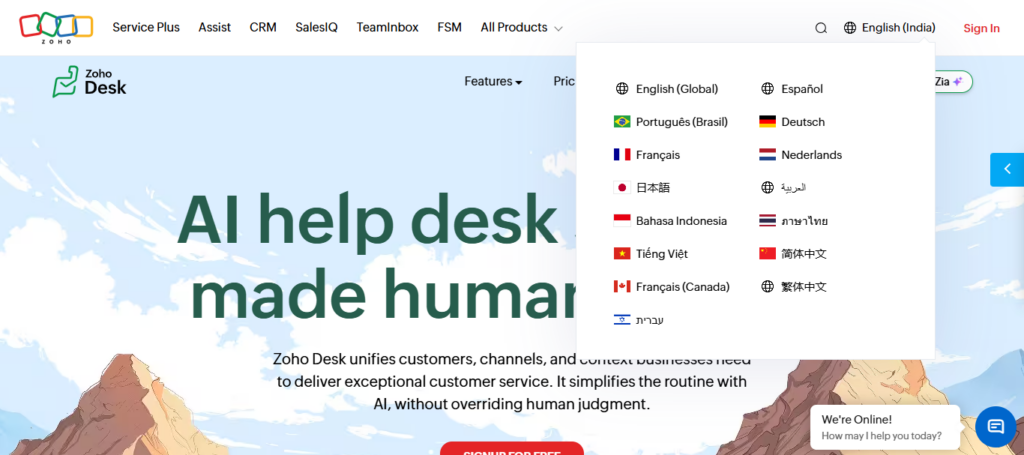
Featuring omnichannel support, Zoho Desk integrates email, chat, phone, and social media in one location. Using Zoho Desk allows enterprises to respond requests quicker and increase customer satisfaction. Task automation also allows IT support to concentrate on advanced issues. Due to the affordable design, Zoho Desk is popular with expanding enterprises.
Zoho Desk Pros & Cons
| Pros | Cons |
|---|---|
| Affordable AI-powered help desk solution | Limited advanced enterprise ITSM depth |
| Zia AI for smart automation | Fewer high-end enterprise features |
| Easy to deploy and use | Scaling limitations for very large enterprises |
| Strong omnichannel support | Reporting not as advanced as competitors |
| Good workflow automation tools | Less robust AIOps capabilities |
9. HappyFox
HappyFox is a cloud platform that helps automate ticketing workflows and customer support. Smart rules and an AI engine classify support requests and send them to the appropriate team. Newer versions incorporate chatbots, automate SLA enforcement, and balance workloads for support agents on board.
HappyFox provides analytics for assessing support and satisfaction trends. IT departments of various enterprises use HappyFox to optimize support and minimize delays in fulfilling requests. It is a more approachable and powerful solution for support environments in a rapid growth phase that substitute for more ITSM-compliant and feature-rich solutions.
HappyFox Pros & Cons
| Pros | Cons |
|---|---|
| Simple and intuitive interface | Limited deep AI capabilities |
| Fast setup and deployment | Fewer enterprise-grade integrations |
| Smart ticket routing automation | Not ideal for complex ITSM environments |
| Strong SLA management features | Reporting features are basic |
| Good for mid-sized enterprises | Less scalable for global organizations |
10. Spiceworks
Spiceworks is a free, IT helpdesk solution that includes ticketing and support tools that use network monitoring and a community focus. While free is the main draw, Spiceworks updates have included AI to assist in ticket routing and classification of issues.
IT teams use Spiceworks to manage and track internal support requests as well as monitor network and device health. Spiceworks community focus features allow IT personnel to provide support and share their experiences and suggestions for other users.
Spiceworks continuous improvement focuses on reduced time to ticket resolution and increased cloud-based accessibility. Spiceworks is a favored solution for small to medium enterprises who need an inexpensive support solution with basic, AI-based automation.
Spiceworks Pros & Cons
| Pros | Cons |
|---|---|
| Completely free IT help desk option | Limited enterprise-level scalability |
| Strong IT community support | Basic AI capabilities only |
| Simple ticketing and monitoring tools | Fewer automation features |
| Cloud-based accessibility | Limited advanced reporting |
| Ideal for small IT teams | Not suitable for large enterprises |
How To Choose the Right Help Desk Software Best AI-Powered Help Desk Ticketing Softwares for Enterprise IT Support
- Size of the organization and complexity of IT systems Select software based on the size of the organization, the complexity of its systems, and the level of support it requires.
- Available budget and preferred licensing model Consider costs, available pricing models, and the value of long-term subscriptions before making a commitment.
- AI and automation requirements Make sure the platform supports automation, AI ticketing, and advanced predictive support.
- Fit at the core of the automation of IT systems Make sure it fits seamlessly with the existing systems, support, and tools of the enterprise.
- Protection of data, security, and compliance Verify data protection standards, compliance certifications, and enterprise-grade security protocols thoroughly.
Conclusion
In conclusion, the Best AI-Powered Help Desk Ticketing Softwares for Enterprise IT Support streamlining IT operations and providing quality service are indispensable. Automating ticket closure, faster response times, and reduced costs are all features of these AI tools.
Intelligent automation and predictive analytics provide better user experience and allow IT departments to work on multiple issues at the same time. Selecting an appropriate tool depends on the size of the enterprise, budget, and required integrations.
FAQ
What is AI-powered help desk ticketing software?
It is an IT support system that uses AI to automate ticket handling, routing, and resolution.
Why do enterprises need AI help desk software?
Enterprises need it to improve efficiency, reduce response time, and automate repetitive IT tasks.
Which is the best AI help desk software for enterprises?
ServiceNow, Zendesk, and BMC Helix are leading enterprise-grade AI ITSM platforms.
How does AI improve ticket resolution?
AI predicts issues, suggests solutions, and automatically assigns tickets to right teams.
