


This article will review the top Crypto Banking Solutions for Businesses. I will outline how various platforms provide tools to help businesses manage crypto payments, digital assets, treasury services, and global payments.
You will learn the main features and benefits, potential drawbacks, and critical considerations of each platform in terms of the best crypto banking solution for businesses in 2026.
Key Points & Best Crypto Banking Solutions For Businesses
| Crypto Banking Solution | Explanation |
|---|---|
| Mercury + Crypto Integrations | Business banking platform supporting crypto-friendly operations, payments, treasury management, and financial growth seamlessly. |
| Juno | Crypto-powered banking solution offering spending, savings, rewards, and digital asset management capabilities. |
| Revolut Business | Business accounts combining traditional banking, cryptocurrency trading, international payments, and expense management efficiently. |
| Wirex Business | Enables businesses to manage cryptocurrencies, fiat currencies, corporate cards, and global payments securely. |
| Coinbase Prime | Institutional crypto platform providing secure custody, trading, treasury management, and liquidity solutions worldwide. |
| Kraken Institutional | Enterprise-grade cryptocurrency services featuring secure trading, custody, compliance, and advanced business support tools. |
| Binance Pay | Crypto payment solution enabling businesses to accept digital currencies with instant global settlements. |
| BitPay | Trusted cryptocurrency payment processor helping businesses accept crypto with simplified settlement and invoicing. |
| Crypto.com Business | Business platform supporting cryptocurrency payments, merchant services, secure wallets, and financial flexibility globally. |
| Fireblocks | Enterprise digital asset platform delivering secure custody, transfers, treasury automation, and compliance infrastructure. |
10 Best Crypto Banking Solutions For Businesses
1. Mercury
Banking on Mercury has gained popularity among startups, especially among crypto-oriented firms, because it allows for the smooth flow of finances with the help of third-party trusted crypto integrations.
Even though Mercury is not a crypto exchange, it gives the opportunity to the eligible firms to connect with crypto platforms to manage their finances.

It is an ideal platform for firms engaged with both the traditional finance system and the digital asset system because it has an easy-to-use banking system, virtual cards, automations for accounting, and high security.
| Pros | Cons |
|---|---|
| Easy integration with trusted crypto partners | No built-in cryptocurrency exchange |
| Excellent banking tools for startups | Limited availability outside supported countries |
| Strong security and fraud protection | Crypto features rely on third-party services |
| Automated accounting integrations | Not suitable for anonymous crypto transactions |
| Virtual and physical business cards | Eligibility requirements for business accounts |
2. Juno
Juno is a digital banking platform that was designed with the needs of crypto-based businesses in mind. It is a hybrid platform that offers traditional banking features alongside crypto rewards systems and digital asset management and spending.

Businesses have the ability to operate many different financial systems and manage their funds and make payments through flexible financial products. Juno is ideal for startups that are looking for a more accessible banking system that integrates with both traditional banking and decentralized finance.
| Pros | Cons |
|---|---|
| Crypto-friendly banking experience | Some features vary by region |
| Supports spending and digital assets | Limited business-focused enterprise tools |
| User-friendly interface | Cryptocurrency services may change with regulations |
| Multi-currency support | Smaller ecosystem than major banks |
| Rewards and financial benefits | Customer support availability may vary |
3. Revolut Business
Revolut Business is a consolidated financial solution that combines banking for business, international transfers, expense management, and cryptocurrency services all in one account. Business that operate internationally, rely on Revolut for its multi currency support, quick international transfers, and its built-in financial controls.
Revolut even allows the buying and selling of cryptocurrency in certain regions, catering to businesses that are interested in digital assets.
Revolut’s modern interface, ease of use, and the automation and reporting features, assist businesses manage their daily financial operations and payments, while maximizing their global business potential.
| Pros | Cons |
|---|---|
| Supports multiple global currencies | Crypto services unavailable in some countries |
| Fast international business transfers | Premium features require paid plans |
| Built-in expense management tools | Exchange limits on lower-tier accounts |
| Modern dashboard and automation | Regulatory rules differ by region |
| Business API integrations available | Customer support depends on subscription tier |
4. Wirex Business
Wirex Business combines a traditional and cryptocurrency financial solution for business. Wirex allows businesses to receive payments in cryptocurrency, issue company payment cards, and convert their digital assets to fiat currency anytime they wish.

Wirex’s safe design helps businesses provide payment solutions that are less friction, and provides flexibility for international payments.
Wirex’s cryptocurrency integration combined with real time wallet management and digital asset conversion, helps businesses that are looking to simply use cryptocurrency for their daily operations, do so with ease.
| Pros | Cons |
|---|---|
| Supports crypto and fiat accounts | Limited availability in certain markets |
| Corporate crypto payment cards | Some services require identity verification |
| Instant crypto-to-fiat conversion | Transaction fees vary by service |
| Secure wallet management | Fewer accounting integrations than competitors |
| Cross-border payment flexibility | Business features continue expanding |
5. Coinbase Prime
Specifically designed for enterprise grade clients that have large volumes of digital assets, Coinbase Prime is a secure investment and trading solution for cryptocurrency. Coinbase Prime builds a professional trading and custody solution on liquidity and compliance
Businesses will find digital asset treasury management easy and enhanced security and compliance built into the solution.
Coinbase Prime also offers enterprise level reporting, and flexible integration via APIs, making this solution one of the most comprehensive cryptocurrency financial solutions available in 2026.
| Pros | Cons |
|---|---|
| Institutional-grade digital asset custody | Primarily designed for large organizations |
| Deep liquidity for large trades | Higher service costs for smaller businesses |
| Advanced portfolio management | Complex platform for beginners |
| Strong regulatory compliance | Geographic availability varies |
| Enterprise API integrations | Minimum requirements for certain services |
6. Kraken Institutional
Kraken Institutional provides enterprise cryptocurrency services tailored for corporations, asset managers, fintech companies, and institutional investors.
Kraken Institutional builds liquidity, custody, and trading confidence with focus on transparency and regulatory infrastructure. Kraken’s OTC and staking services, trading and custody APIs, and liquidity solutions help businesses protect and manage large crypto portfolios.
Because of its attention to regulatory requirements, client infrastructure, and reliable systems, Kraken Institutional is a preferred partner for businesses with a global digital asset strategy.
| Pros | Cons |
|---|---|
| High-security crypto custody | Institutional focus limits small business access |
| Professional OTC trading services | Advanced platform requires experience |
| Strong compliance framework | Some staking features restricted regionally |
| Reliable liquidity solutions | Limited traditional banking services |
| Enterprise API connectivity | Verification process may take time |
7. Binance Pay
Binance Pay is a contactless system that provides businesses with the ability to accept global digital currency payments without the delays of the banking system. Traditional use case barriers for electronic payments are removed as merchants can quickly process transactions, pay less, and get paid more.
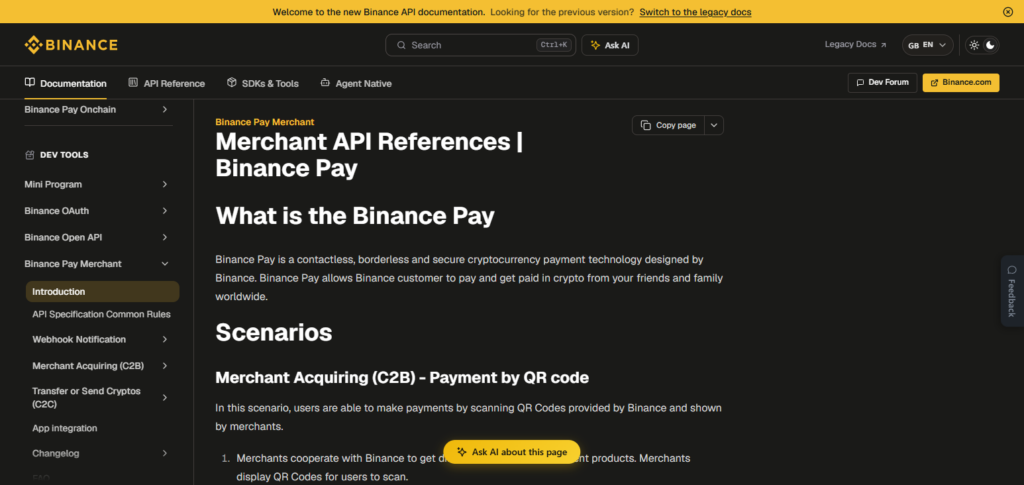
With the increase in general cryptocurrency usage, Binance Pay provides businesses the ability to expand electronic payment methods, increase customer satisfaction, and adopt the global digital payment system.
| Pros | Cons |
|---|---|
| Trusted crypto payment processor | Transaction fees may apply |
| Automatic fiat settlement available | Limited support for some cryptocurrencies |
| Easy invoice generation | Requires merchant verification |
| Strong fraud protection features | Not a full-service business bank |
| Popular e-commerce integrations | Settlement timing depends on payment method |
8. BitPay
BitPay is one of the original cryptocurrency payment processors and enables businesses the ability to accept secure digital currency payments.
With support for multiple digital currencies and the ability to automatically settle in local fiat currencies, BitPay removes volatility concerns for payment recipients.
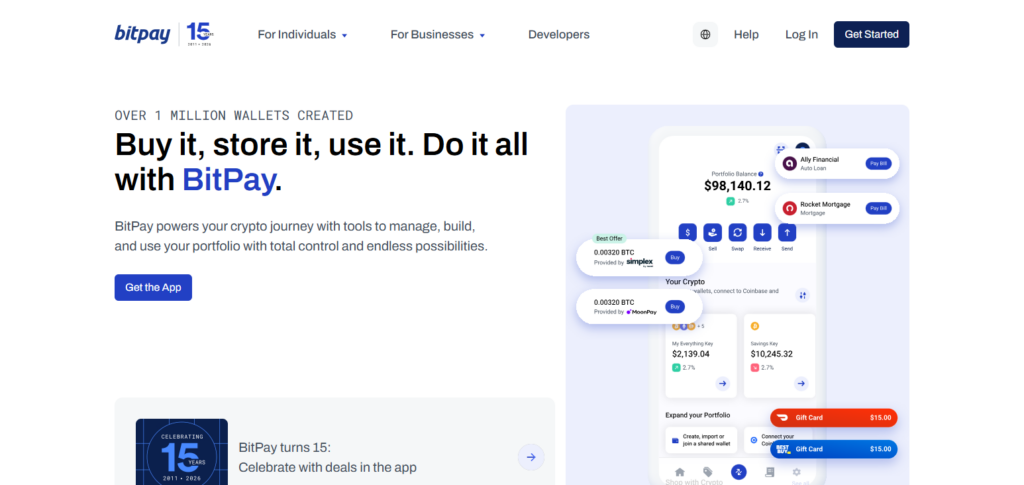
BitPay also provides an intuitive system for creating digital payment requests, embedding payment gateways, and tracking payments.
Because of its high level of security, strong fraud mitigation controls, and support for a global payment system, BitPay is an excellent crypto banking solution for all businesses.
| Pros | Cons |
|---|---|
| Accepts multiple cryptocurrency payments | Merchant services vary by country |
| Secure business wallet features | Some advanced tools require verification |
| Simple online store integration | Regulatory changes may affect services |
| Flexible payment settlement options | Limited traditional banking capabilities |
| Expanding global ecosystem | Certain features unavailable everywhere |
9. Crypto.com Business
Crypto.com Business develops merchant solutions to help all businesses across their ecosystem accept crypto payments and make use of emerging financial services across their ecosystem.
Crypto.com Business solutions enable merchants to accept payments via a range of crypto, process and fully settle those payments in either their fiat currency of choice,
or in a crypto of their choice, offer their customers a crypto digital wallet, and facilitate their customers’ crypto digital wallet to be loaded and/or topped up with crypto.
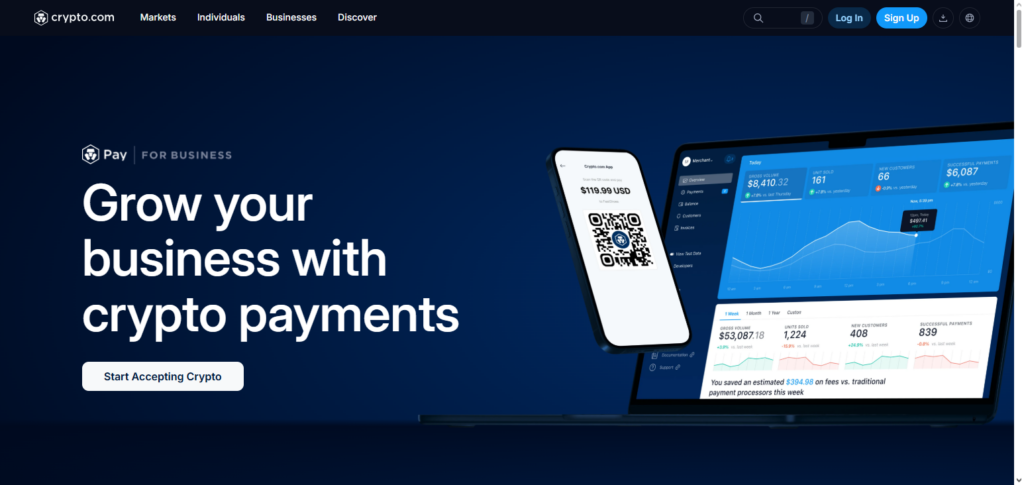
The platform provides merchants with tools, aids in the seamless management of business accounts, and eases the integration process onto online platforms.
As the number of clients who transact and hold crypto increases, Crypto.com Business solutions go beyond the modernization of business payment systems to support the advancement of international trade and the growth of digital finance.
| Pros | Cons |
|---|---|
| Accepts multiple cryptocurrency payments | Merchant services vary by country |
| Secure business wallet features | Some advanced tools require verification |
| Simple online store integration | Regulatory changes may affect services |
| Flexible payment settlement options | Limited traditional banking capabilities |
| Expanding global ecosystem | Certain features unavailable everywhere |
10. Fireblocks
Fireblocks provides an enterprise-grade digital asset framework and infrastructure utilized by banks, financial technology companies, investment firms, exchanges, and multiple institutional clients around the globe.
Fireblocks provides security for the custody of crypto and digital assets, treasury automation, transfer and management of tokens and digital assets, and utilizes state-of-the-art security technology that is multi-layered.
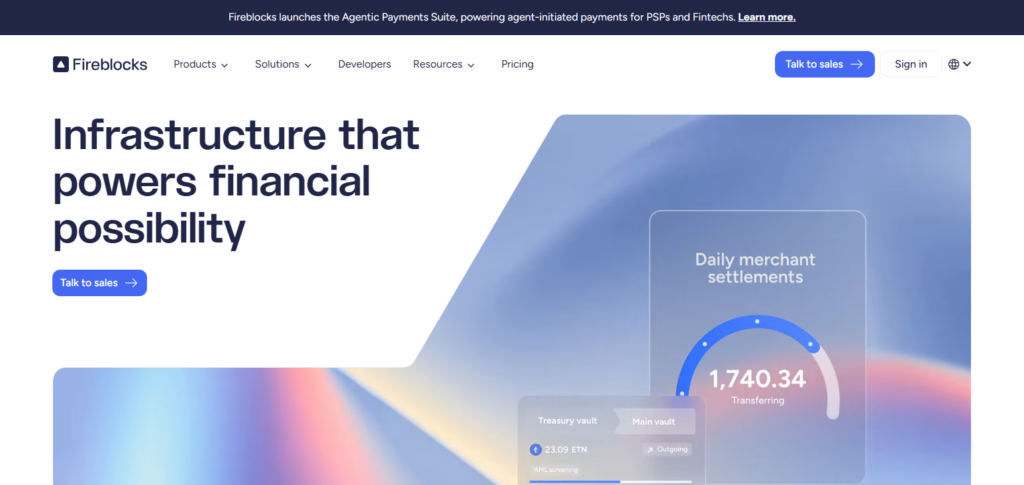
From a single platform, businesses can automate their processes, maintain control of their valuable assets, and manage crypto and digital asset transactions across numerous blockchains.
Fireblocks infrastructure further provides support for crypto compliance and offers highly scalable and easy to use APIs, making it one of the most sophisticated crypto banking infrastructures available in the market.
| Pros | Cons |
|---|---|
| Enterprise-grade digital asset security | Premium pricing for enterprise customers |
| Advanced treasury automation | Not designed for small businesses |
| Supports numerous blockchain networks | Requires technical implementation expertise |
| Strong compliance and governance tools | Complex onboarding process |
| Highly scalable API infrastructure | No consumer-focused banking services |
Conclsuion
In conclsuion Selecting The Best Crypto Banking Solutions for Businesses will require you to take into account your business dimensions and operations, and needs as they relate to security and business international transactions.
For an integration of business and crypto finances, options like Mercury, Coinbase Prime, Fireblocks, Revolut Business, and BitPay create viable and efficient options.
Consider several aspects outlined as compliance, price, growth, and securing long-term acceptance of crypto when selecting solutions.
FAQ
Which crypto banking platform is best for startups?
Mercury with crypto integrations and Revolut Business are popular choices for startups and growing businesses.
Can businesses accept cryptocurrency payments?
Yes. Platforms like Binance Pay, BitPay, and Crypto.com Business allow businesses to accept crypto payments securely.
Are crypto banking solutions safe?
Most leading providers use encryption, multi-factor authentication, cold storage, and compliance measures to protect business assets.
Do crypto banking platforms support fiat currencies?
Yes. Many platforms support both cryptocurrencies and fiat currencies for seamless financial management.
