


This article will address how tokenized assets integrate with traditional funds through blockchain technology. Tokenization enables companies to trade physically existing assets of all kinds. This enables companies to easily split ownership through units of smaller value.
Tokenized assets also have the potential for increased liquidity due to their faster settlement. As financial institutions start utilizing tokenized assets, investors get the opportunity to own previously unattainable assets and get higher transparency from financial firms in an overall structural shift of how funds are traded around the world.
What Are Tokenized Assets?
Tokenized assets are digital equivalents of assets stored on a blockchain. Investing in tokenized stocks, bonds, real estate, commodities, and other assets of interest is now easier. With tokens representing ownership, trades will occur faster and at a cheaper price than the current system.
Tokenized asset ownership is highly solvent allowing for fractional ownership meaning that people with less money can own a share of an asset that previously only the wealthiest of investors could afford to own. Transactions are completely safe on the blockchain, which encourages participants to trust each other.
Traditional funds beginning to accept tokenized assets show that one of the largest divides of our current system, the juxtaposition of finance and technology, is shrinking. Boundaries limiting participation in global markets are beginning to fall as investors can easily transfer digital assets.
Tokenized Assets Enter Traditional Funds
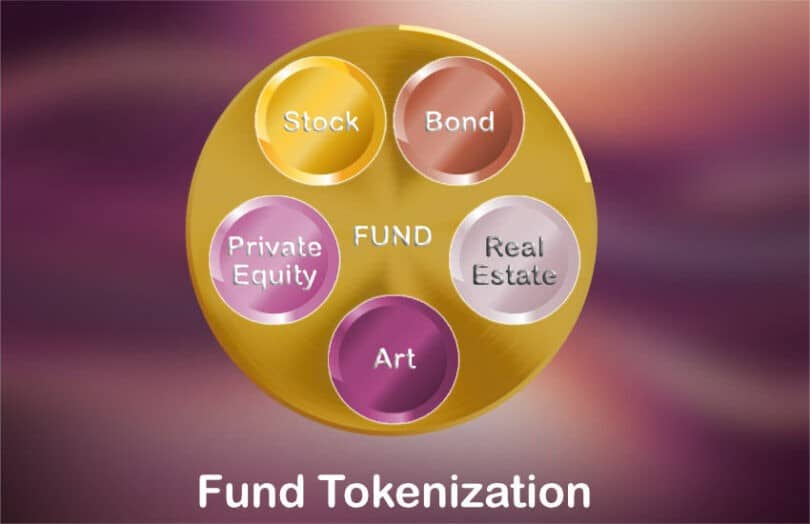
Tokenized assets are revolutionizing traditional fund structures around the world. Traditional fund managers can issue tokens for ownership rights of stocks, bonds, and real estate, which provides settlement of trades in a couple of seconds, fractional ownership, and higher liquidity compared to traditional funds.
This innovation bridges the gap between traditional finance and the digital world. Tokenization also decreases barriers to investment in previously illiquid markets. Traditional funds allow institutions to invest in an efficient and easy to access, global marketplace.
Why Traditional Funds Are Adopting Tokenization
Enhanced Operations- Blockchain relies on very little manual oversight. As a result, settlements can be regarded as nearly instantaneous.
Improved Liquidity- Fractional ownership of traditionally illiquid assets presents the opportunity for greater participation and liquidity of previously inaccessible investments.
Clarity – Clarifications regarding regulatory framework surrounding funds with tokenized structures has increasing confidence in institutions to adopt them.
Investor Access – Funds with tokenized structures provide access to a greater variety of opportunities across borders via the automation of processes and compliance as a result of innovation.
Error Reduction – Smart contracts allow for automation of previously time consuming processes, such as the virtually instant issuance of shares and product transfers.
Greater Collateral Management – Given the flexibility of tokenized fund shares, collateral reuse becomes possible across various financial transactions.
How Tokenized Funds Actually Work
Specification of Asset
A particular asset is selected to be tokenized (a stock, a bond, a piece of real estate, a commodity, etc.).
Tokenization
The asset ownership rights are tokenized on the blockchain with each token representing a fractional part of the asset.
Smart Contracts
The issuance of tokenized funds, the trading and compliance, and the ability to redeem funds are all governed by smart contracts.
Investment
To access tokenized funds (afragment of the underlying asset), potential investors buy tokens instead of fund shares.
Liquid Funds
Once tokens are liquid, peer‑to‑peer and exchange trading offers increased liquidity over the fund unit trading.
Custody and Regulation
Because of the nature of blockchain, token ownership is irrevocable. Custodians and regulators can maintain compliance through integrated systems.
Redemption
Token holders redeem for the underlying asset. Funds can also be redeemed for their cash equivalent.
Traditional Funds vs. Tokenized Funds
| Aspect | Traditional Funds | Tokenized Funds |
|---|---|---|
| Settlement | T+2 or longer | Near real‑time blockchain settlement |
| Ownership | Whole units only | Fractional ownership possible |
| Liquidity | Limited in private assets | Enhanced via fractionalization |
| Accessibility | Restricted to institutions | Broader global investor base |
| Compliance | Manual checks | Automated via smart contracts |
| Transparency | Centralized recordkeeping | Immutable blockchain ledger |
| Costs | Higher due to intermediaries | Lower with blockchain efficiency |
| Innovation | Legacy systems | Digital, programmable assets |
The Role of Blockchain Infrastructure
The foundation of blockchain technology offers a hassle-free way for traditional funds and real-world assets to exist in the digital domain and for their management and transactions to be digitized. Smart contracts facilitate the automation of processes for the transfer of ownership, checks for compliance, and settlements.
Transactions are recorded by blockchain networks. Infrastructure such as digital custody and identity and KYC systems, combined with oracles and stable-coins, along with interoperability protocols, link tokenized funds to existing financial systems.
With the increased interest from institutions, the blockchain infrastructure must meet the demands of large high volume transactions while ensuring security and regulation in order to transition tokenized funds from a novelty to a dominant funding methodology.
Where Tokenization Could Gain the Most Traction
Money-market funds: Tokenized money-market funds can provide efficient access for institutional investors as they combine yield-generating assets with blockchain based ownership and settlement.
Government bonds and treasuries: Settlement of government debt can be done more rapidly and transactions can become more programmable and efficient as well as more efficient for collateral management.
Private credit: Tokenization can enable Private Credit interests to be easily divided and owned.
Private equity: Like private credit, private equity interests could be easily tokenized for digitization and simplification of interest transfers.
Real estate: Through the use of digital tokens, ownership of property can be fractionalized. Tokenization of real estate can provide a lower investment barrier for various property structures.
Corporate bonds: With the use of blockchain technology for the issuance and settlement of corporate bonds, administrative friction within the process can be greatly reduced and post-trade processes can be significantly automated.
Public equities: While tokenized shares can potentially provide easier access to institutional investors through simplified transactions and fractional ownership, as of now complicated regulations and challenges to market structure remain.
Commodities: There can be digital representations of interests in commodities and commodity-backed assets made through the use of tokenization that greatly improves transferability and record-keeping.
Which Traditional Funds Are Most Likely to Tokenize?
Money Market Funds
These funds have the most investments in the tokenization space as evidenced by BlackRock’s BUILD, Franklin Templeton’s BENJI, and Circle’s USYC, all of which tokenize U.S. Treasuries and short-term debt using Ethereum. All these funds have high demand in the institutional treasuries and collateral markets.
Treasury and Government Debt Funds
Tokenization of government debt allows for instant or near real‑time settlement of government debt. This is of interest to institutional investors.
Real Estate Funds
There is high adoption of tokenization in real estate in Japan where close to 85% of ¥333 billion of securities tokenized is real estate. Tokenization offers real estate funds with fractional ownership and lowers the costs of fund administration.
Private Credit Funds
Private credit funds are offering tokenized loans with cash flows at high yields.
Commodity Funds
Funds that hold gold and other commodities can be represented as tokenized funds, and the physical asset can be claimed with proof on the blockchain.
The Institutional Adoption Behind the Trend

Tokenized funds are attracting large institutions as a new method to enhance the efficiency, transparency, and accessibility of traditional finance. Tokenization improves settlement time and reduces operational costs, and allows for fractional ownership, a reality previously restricted to larger cash purchases.
Some of the largest investment firms are already utilizing the model to create tokenized money market funds and treasury products. BlackRock, Franklin Templeton, and JPMorgan are some of the first adopters. With the emerging comfort of the model from the market leaders, regulatory clarity in major financial centers will begin to attract asset management institutions. Most asset management firms integrate compliance systems that function through smart contracts.
Creative digital disruption will become a focal point for firms wishing to become more liquid and flexible, and to develop new avenues for international investment in the new global economy.
What Tokenization Changes for Investors
Tokenization enables investors to access and trade assets more efficiently than ever before. Investors can buy smaller, more affordable portions of prized real estate or private credit funds. Even if you don’t have a lot of money, you can still have a diverse investment portfolio.
Transaction settlement used to be a days-long process that is now a near-instant process. Trust in the investment’s asset ownership is also greater with blockchain because records of ownership transactions cannot be altered.
Compliance and fund operations also become much more streamlined with the aid of smart contracts. Tokenized funds also allow previously specialized investment opportunities to the general public, thereby democratizing investment.
Regulatory and Compliance Challenges
Jurisdictional Fragmentation: Digital asset rules differ by country, and fund operations across borders become difficult.
Investor Protection: Regulators are responsible for the protection of tokenized fund investors by the standards of disclosures, risk management, and investor protection.
AML/KYC Requirements: Tokenized transactions must comply with AML and KYC acts. This requires a robust system for identity verification.
Custody Rules: Digital token custody creates legal issues of control and oversight.
Smart Contract Oversight: Oversight of compliance risk management by smart contracts is required to avoid gaps in compliance, and should be legally recognized and audited.
Taxation Complexity: Tokenized assets may result in new tax obligations due to fragmented ownership across borders and cross border transactions.
Market Infrastructure: Systems must be integrated with blockchain technology under regulatory oversight and adaptive technology.
Regulatory Uncertainty: Fund managers are reluctant to adopt innovations due to the nature of newly developing laws.
Liquidity: The Biggest Opportunity and Challenge
| Dimension | Opportunity | Challenge |
|---|---|---|
| Market Access | Fractional ownership opens high‑value assets to retail investors | Regulatory restrictions may limit cross‑border participation |
| Trading Hours | 24/7 blockchain trading improves flexibility | Thin liquidity in early adoption phases can cause volatility |
| Asset Classes | Illiquid assets like real estate become tradable | Valuation of illiquid assets remains complex and inconsistent |
| Settlement | Near real‑time settlement boosts efficiency | Legacy systems struggle to integrate with instant settlement |
| Investor Base | Broader participation diversifies risk | Institutional hesitation slows mass adoption |
| Collateral Use | Tokens can be reused as collateral in DeFi | Legal frameworks for collateralization are still evolving |
| Transparency | Immutable records increase trust in liquidity flows | Privacy concerns arise with fully transparent ledgers |
| Cost Efficiency | Reduced intermediaries lower transaction costs | Compliance and custody requirements add new expenses |
Risks Investors Should Understand
Tokenization adds value to investments, but investors should consider the risks tokenization poses on their portfolio and their confidence levels. For instance, uncertainty surrounding regulation poses a problem at different levels. Jurisdictions have different rules, and this could influence cross-border investments.
Liquidity risk is also a problem due to the immature nature of some of the secondary markets, as they do not guarantee exit opportunities. Guaranteeing customer rights becomes difficult due to the bugs in smart contracts and the attacks that might be facilitated by the proposed technology.
Mispricing due to the fractions of an asset can also be a problem. Market adoption risk means that institutional slow take-up poses a risk to tokenization. This means investors can be exposed to niche markets.
Tokenized Assets: Hype or Structural Shift?

It’s often said that tokenized assets are merely hype, but evidence suggests otherwise. To start, “buzz” around tokenized assets galvanized the early stage of capital formation. Now structural shifts within mainstream finance have begun with the entrance of heavyweight firms like BlackRock and Franklin Templeton.
Tokenized assets provide investors with benefits that reshape how capital markets work. These benefits include a reduction in the time and costs associated with trades, improving the efficiency of capital formation. Additionally, tokenized assets can be owned in smaller portions which enhances liquidity.
Regulatory Frameworks are providing greater clarity which signals a legitimate interest in tokenized finance. Tokenization will continue to experience growing pains as it matures, but the net result will be a structurally better way to issue, trade, and own tokens across the globe.
Expert View: Is Tokenization the Future of Traditional Funds?
Tokenization may become critical for traditional funds in the future, but experts describe tokenization as an evolution rather than a technology that will provide an immediate substitute for the existing financial infrastructure.
Tokenization of assets and funds may enhance the speed and decrease the cost of settlement, increase operational efficiency, and improve transparency and fractional ownership. Despite these improvements, challenges including compliance, liquidity, custody, cybersecurity, and protection of investors still exist.
The main challenge for 2026 is not whether blockchain can support traditional funds. The main challenge for 2026 will be how quickly asset managers and banks will be able to integrate technology used for building blockchain networks into the existing financial infrastructure with the support of the appropriate regulations.
Pros & Cons
| Pros | Cons |
|---|---|
| Faster Settlement: Blockchain can enable quicker transfer and settlement of fund interests. | Regulatory Uncertainty: Rules for tokenized funds vary across jurisdictions and continue to evolve. |
| Greater Transparency: Blockchain records can improve visibility into ownership and transactions. | Liquidity Limitations: Tokenization does not guarantee an active secondary market. |
| Fractional Ownership: Assets can potentially be divided into smaller investment units. | Technology Risk: Smart-contract bugs, blockchain failures, or integration issues can create operational risks. |
| Lower Administrative Costs: Automation may reduce certain reconciliation and back-office processes. | Custody Complexity: Investors and fund managers still need secure, compliant custody solutions. |
| 24/7 Infrastructure: Certain blockchain-based markets can operate beyond traditional market hours. | Interoperability Issues: Connecting blockchain networks with existing financial systems can be complex. |
| Programmable Compliance: Smart contracts can automate selected transfer and eligibility rules. | Cybersecurity Threats: Tokenized infrastructure introduces additional digital attack surfaces. |
| Broader Distribution: Digital fund units could potentially make some investment products easier to distribute. | Investor Adoption: Traditional investors may be unfamiliar with wallets, tokens, and blockchain-based ownership. |
| Real-Time Data: On-chain activity can provide faster access to certain transaction and ownership information. | Legal Complexity: A token’s blockchain representation may not always be identical to the underlying legal ownership rights. |
Conclusion
Tokenization is an important innovation in global finance. Using blockchain technology to digitize fund shares can benefit both funds and their investors. Funds’ operational costs and settlement times go down, while investors can purchase and sell shares easily given fractional ownership.
However, there are complexities related to valuation, uncertainty in the law, and the technology. Once these issues are resolved, tokenization will transform the entirety of money market funds, private equity, private debt, private credit, and real estate.
Tokenization will easily integrate legacy finance with modern financial technology, and new money management models will be able to operate seamlessly. Tokenization is a catalyst for may new ways financial services will be offered to the market and will change how assets and liabilities will be structured globally.
FAQ
What are tokenized assets?
Tokenized assets are digital representations of real‑world assets (stocks, bonds, real estate, commodities) recorded on a blockchain, enabling fractional ownership and faster settlement.
How do tokenized funds work?
Traditional assets are converted into blockchain tokens, governed by smart contracts, allowing investors to buy, trade, and redeem them with improved efficiency and transparency.
Why are traditional funds adopting tokenization?
Tokenization reduces costs, enhances liquidity, automates compliance, and expands investor access, making it attractive for asset managers.
Which funds are most likely to tokenize?
Money market funds, treasury funds, real estate funds, and private credit funds are leading adoption due to stable yields and high demand for liquidity.
What benefits does tokenization bring to investors?
Investors gain fractional ownership, faster settlement, global access, and transparent records, improving portfolio diversification and trust.