


In this article, I will showcase two leading blockchain ecosystems: Solana and Hyperliquid. Solana has become well recognized for its speed and scalability and is active with its services within DeFi, NFT, and tokenized assets. Hyperliquid for its proprietary technology brings unparalleled liquidity to the new and fast growing ecosystem of futures trading.
Hyperliquid and Solana each provide their own vertical and horizontal offerings to the growing blockchain environments that present opportunities for investments and development to expand and diversify.
Solana Overview
Solana was started in 2020 by Anatoly Yakovenko, and it uses the Proof of History (PoH) protocol. PoH letsValidators figure out the order of transactions and set time in advance allowing Solana to have blocks that take ~400ms. Solana also has a throughput of around 65,000 TPS and is able to do sub-cent payments.
All these factors combined make Solana a fit for the DeFi, NFT, Payments as well as developing AI-agent infrastructure. In 2025 Solana settled $2.7 trillion in volume and earned $4.2 billion in fees, which shows how much people began to use it. They also have Jupiter, Raydium, Magic Eden, and Jito in their ecosystem.
Even though Solana has had outages in the past, they have worked on it and upgrades like Firedancer and Alpenglow are trying to fix the issues. It seems by 2026 Solana is hoping to achieve more institutional involvement and will soon have tokenized RWAs (real-world assets) as well as stablecoin settlement with Mastercard supporting fully on payments.
Even though they are working to become a strong foundation of global finance, they are still competing with others and working to make sure they also have a good way to sustain all of this work.
Hyperliquid Overview
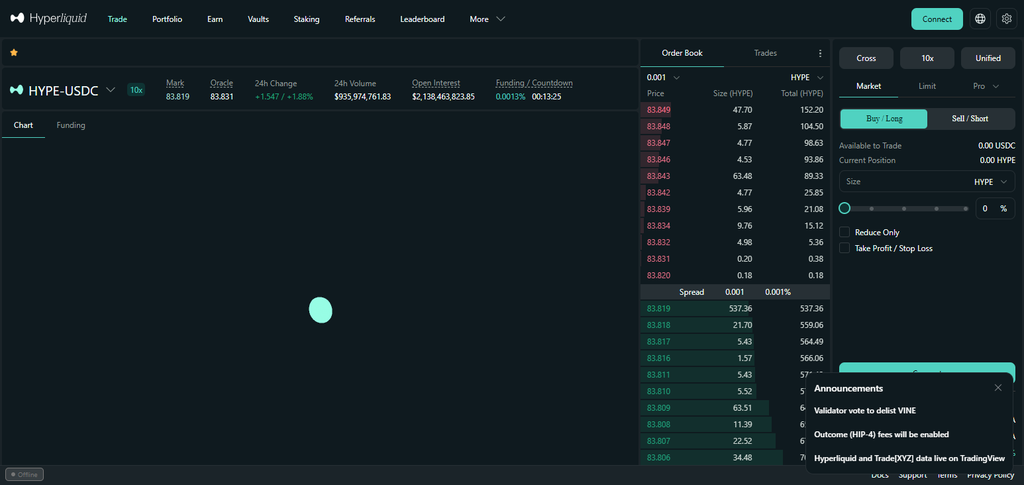
Hyperliquid started as a DEx for perpetual futures trading, but rapidly augmented its product suite with HyperEVM and smart contract functionality. Using a fully on-chain central limit order book, the exchange can execute orders with sub-second finality and speed.
The trading chain uses HyperBFT consensus and can process tens of thousands of orders a second. This makes Hyperliquid efficient for high frequency trading. To secure governance, staking, and ecosystem rewards, the platform uses the native HYPE token. To support token economics, large buybacks and burns are executed regularly.
Incremental Innovation Proposals (HIPs) significantly enhanced the product suite. In the automated market makers (AMM) space, liquidity rapidly shifted to USD Circle (USDC) from USD House (USDH), which went into solvency and shut down operations. Hyperliquid is the fastest emerging competitor to centralized trading platforms, but validator centralization and governance remain primary issues.
Publicly, Hyperliquid experienced an acrimonious liquidation in the collateral market in March 2025, which was called “JELLYJELLY.” In the trading arena, speed and liquidity coupled with transparency will likely secure its dominance until competitors emerge. By 2026, the top financially secure trading alternative to centralized exchanges will be Hyperliquid.
Comparison: Solana vs Hyperliquid
| Criteria | Solana | Hyperliquid |
|---|---|---|
| Core Focus | General‑purpose L1 for DeFi, NFTs, payments, gaming | Purpose‑built L1 for perpetual futures & trading |
| Consensus | Proof of Stake + Proof of History | HyperBFT (HotStuff‑inspired, optimized for trading) |
| Throughput | ~65,000 TPS theoretical, ~40M daily transactions | ~200,000 orders/sec, 0.07s block time, sub‑second finality |
| Ecosystem Breadth | Thousands of apps: Jupiter, Raydium, Magic Eden, Kamino | Single unified order book + HyperEVM smart contracts |
| Market Share | $5B+ TVL, strong DeFi/NFT adoption | ~70% of decentralized perpetual futures volume (~$6.5B daily) |
| Revenue Model | $4.2B annual fees, distributed to validators | $830M annualized revenue, 97–99% fees used for token buybacks |
| Tokenomics | SOL used for staking, fees, governance | HYPE token for governance, staking, buybacks, burns |
| Institutional Adoption | Backed by Goldman Sachs, BlackRock, Mastercard | Integrated with PayPal, Circle, VanEck; TradFi interest |
| Valuation | FDV ~$64B (Aug 2026), ATH $294.52 | FDV ~$78.6B (Aug 2026), ATH $83.17 |
| Risks | Past outages, competition from Ethereum & L2s | Validator centralization, governance risks, narrower scope |
Benefits of Solana & Hyperliquid
Benefits of Solana
- Speed and Scalability – 65,000 transactions per second at pennies on the dollar.
- Strong Ecosystem – DeFi, NFT, gaming, and payments projects.
- Institutional Backing – Mastercard, BlackRock, and ETF inflows.
- Innovative Tech – Proof of History and Firedancer upgrades.
- Global Finance Integration – Ready for tokenized assets and stablecoin SCFs.
Benefits of Hyperliquid
- Trading Dominance – 70% market share of DEX perpetual futures.
- Advanced Execution – Sub-second finality, order book on-chain.
- Strong Revenues – 97%-99% trading fees are used for buybacks.
- Contract Expansion – DeFi and prediction markets are supported via HyperEVM.
- Transparency and Self Custody – Decentralized security combines the speed of a CEX.
Best Altcoin Plays Today
| Altcoin | Key Strengths | Risks | Market Position |
|---|---|---|---|
| Solana (SOL) | High speed (~65k TPS), diverse ecosystem (DeFi, NFTs, RWAs), strong institutional ETF inflows | Past outages, competition from Ethereum L2s, regulatory scrutiny | Price ~$101.7, Market Cap ~$59.4B, Rank #7 |
| Hyperliquid (HYPE) | Dominates decentralized perpetual futures (~70% share), ultra‑fast execution, strong buybacks | Validator centralization, narrow ecosystem scope, regulatory exposure | Price ~$81.5, Market Cap ~$18.1B, Rank #10 |
| Ethereum (ETH) | Largest DeFi & NFT ecosystem, institutional adoption, L2 scaling solutions | High gas fees, competition from Solana & L2s | Price ~$2,900+, Market Cap ~$350B+, Rank #2 |
| Polygon (MATIC) | Leading Ethereum scaling solution, strong partnerships (Meta, Nike), low fees | Heavy reliance on Ethereum, token inflation | Price ~$0.75, Market Cap ~$7B+, Rank #20 |
| Avalanche (AVAX) | Subnets for custom chains, strong DeFi/NFT growth, institutional interest | Competition from Solana & Ethereum L2s | Price ~$35+, Market Cap ~$13B+, Rank #15 |
Technical Performance

Solana’s combination of Proof of History (PoH) and Proof of Stake resulted in ~400ms block times and a realistic transaction throughput of ~65,000 TPS, although daily activity has reached ~40 million transactions. This is Layer-1 infrastructure that combines very fast transactions with incredibly low transaction costs (around a fraction of a penny).
As compared to Ethereum, Solana has reduced the risk of outages with an upgrade known as Firedancer, which improves reliability. Hyperliquid, on the other hand, runs an on-chain Central Limit Order Book (CLOB) with HyperBFT consensus, processing up to 200,000 orders per second while obtaining finality in under a second.
This enables it to truly compete with a centralized exchange of digital assets, while maintaining transparency and self-custody. Together, Solana and Hyperliquid show that scalable highly efficient Layer-1 technology is capable of structural innovation in DeFi.
Price and market data
| Metric | Solana (SOL) | Hyperliquid (HYPE) |
|---|---|---|
| Current Price | $101.23 – $102.14 | $81.10 – $81.48 |
| 24h Change | +4.0% | +1.1% |
| 7d Change | +19.2% | +15.3% |
| 30d Change | +38.3% | +39.1% |
| Market Cap | $59.14B | $20.52B |
| Market Rank | #7 | #9 |
| 24h Trading Volume | $4.04B | $1.09B |
| Circulating Supply | 584.06M SOL | 251.87M HYPE |
| Total Supply | 632.97M SOL | 952.18M HYPE |
| Max Supply | ∞ (no cap) | 1B HYPE |
| Fully Diluted Valuation | $64.05B | $77.58B |
| 24h Low/High | $95.23 / $102.29 | $79.62 / $83.47 |
| All‑Time High | $293.31 (Jan 19, 2025) | $83.47 (Aug 26, 2026) |
| All‑Time Low | $0.50 (May 11, 2020) | $3.20 (Nov 29, 2024) |
Solana & Hyperliquid Ecosystem Growth
Solana Ecosystem Growth
- DeFi – Development of lending and liquidity protocols by Jupiter and others.
- NFTs – Magic Eden and Tensor’s NFT marketplaces serve several million active wallets.
- Liquid Staking – Jito and Marinade drive staking participation and validator decentralization.
- Integration of Institutions – Solana’s network is being used by Mastercard and Goldman Sachs for tokenized assets and payments.
- AI & Web3 – Low latency of Solana is being used to develop the smart contract automated infrastructure of Web3 and AI.
Hyperliquid Ecosystem Growth
- Dominance of Perpetual Futures – Approximately 70% of the decentralized volume of perpetual futures is on Hyperliquid.
- Expansion of HyperEVM – Smart contracts enable the deployment of DeFi, prediction markets, and derivatives applications.
- Shift in Collateral – The stabilization of the ecosystem has been primed with the shift to USDC following the wind-down of USDH.
- Governance Proposals – The scope of the ecosystem has been widened with HIP‑3 (permissionless perp markets) and HIP‑4 (prediction markets) proposals.
- TradFi Partnerships – Hyperliquid has integrated payment systems with PayPal, Circle, and VanEck and has facilitated institutional liquidity.
On-chain data Solana & Hyperliquid
| Metric | Solana | Hyperliquid |
|---|---|---|
| Daily Transactions | 171.9M non‑vote tx (record, Aug 10) | ~2.9B 24h perp futures volume |
| Monthly Transactions | 4.2B tx in July (+91% YoY) | $245.2B 30‑day perp volume (36.5% market share) |
| Stablecoin Supply | $15.7B USDC & others; $3B minted in one week | Collateral shift to USDC after USDH wind‑down |
| TVL | $5.22B DeFi TVL | $5.9B TVL (L1 + Arbitrum bridge) |
| DEX Volume | $2.79B 24h across 119 protocols | $9.8B 24h perp volume (43.5% share) |
| Fees & Revenue | $1.08M daily network fees; app fees $13.5M | $46.1M fees, $32M protocol revenue (Aug) |
| Active Addresses | ~651,869 daily active addresses | 263,666 active perpetual traders (ATH) |
| Validator Health | 689 validators, Nakamoto coefficient 18 | Top 10 validators control ~49% stake |
| Burn Activity | 87K SOL burned in one day (Aug 21) | 44.5M HYPE bought back & burned |
| ETF/Institutional | $1.22B cumulative ETF inflows | TradFi integration with PayPal, Circle, VanEck |
Risks & Challenges
Solana Risks & Challenges
- Network Reliability – Serious concerns have been raised by previous outages.
- Competition – Ethereum L2, Aptos, and Sui remain serious competition.
- Fee Sustainability – High network activity may not cover decentralization costs.
- Regulation – High probability of legal issues with tokenized assets and settlement with stablecoins.
- Centralization – Validator distribution is better than Ethereum’s, but still centralized.
Hyperliquid Risks & Challenges
- Validator Centralization – Nearly half the stake is controlled by the Top 10 Validators.
- Ecosystem Scope – There is high reliance on perpetual futures trading.
- Regulation – More exposure to derivatives may be attracting scrutiny from the SEC and CFTC.
- Liquidity – Strong control of perps, but dominant competition may innovate.
- Centralization – Governance may be at risk.
Solana & Hyperliquid Market Performance
Solana Market Performance
- Current Price: ~$101.7. Strong recovery.
- Market Cap: ~$59.4B, #7 globally
- 24HR Trading Volume: ~$4.04B. Deep liquidity.
- 24HR Change: +3.9% Bullish short term trend.
- 30 Days Change: +38.9% Strong growth in the last month.
- Service Adoption: cumulative ETF inflows of $1.22B.
- All Time High: $293.3 Price is long term potential.
Hyperliquid Market Performance
- Current Price: ~$81.5.
- Market Cap: ~$18.1B, #10 globally
- 24HR Trading Volume: ~$1.16B. Drive by perpetual futures.
- 24HR Change: -1.0% Correction after recent highs.
- 30 Days Change: +45.1% Outperforming Solana in the last month.
- Revenue Model: $830M Annualized. 97-99% of fees used for buyback.
- All Time High: $83.5 Price is rapid growth.
Institutional Interest
| Category | Solana | Hyperliquid |
|---|---|---|
| ETF Inflows | $1.22B cumulative inflows into Solana ETFs | No ETF yet, but strong TradFi lobbying |
| Financial Institutions | Goldman Sachs, BlackRock, Mastercard adoption | PayPal, Circle, VanEck partnerships |
| Tokenized Assets | Used for RWAs and stablecoin settlement | Focused on derivatives and trading markets |
| Payments Integration | Mastercard pilot for always‑on payments | PayPal integration for trading collateral |
| Regulatory Engagement | SEC‑approved ETFs, compliance frameworks | Active lobbying with SEC/CFTC on derivatives |
| Institutional Liquidity | $33.5M daily ETF inflows | $9.8B daily perp volume, institutional traders |
| Adoption Narrative | Positioned as settlement layer for finance | Positioned as decentralized alternative to CEXs |
| Risk Perception | Concerns over outages and competition | Concerns over validator centralization & regulation |
Future Potential

Solana’s technology supports global finance by enabling fast settlement and low cost transactions to facilitate transfers of real world assets and make payments with stablecoins. Solana is attracting large institutional money and has forged partnerships with two large Global banks.
Meanwhile, Hyperliquid SOL is the first fully on-chain order book for decentralized derivatives trading and uses HyperEVM for smart contracts. HYPE’s buy back policy and liquidity makes it a solid long term investment.
Of the two, Solana clearly has more of a presence across blockchain ecosystems and Hyperliquid clearly has more trading innovations, but they both have the potential to be leaders of the next major blockchain adoption.
Pros & Cons
Solana Pros & Cons
| Pros | Cons |
|---|---|
| High Speed & Scalability – ~65,000 TPS, low fees | Past Outages – Reliability concerns from downtime history |
| Ecosystem Diversity – DeFi, NFTs, gaming, RWAs | Competition Pressure – Ethereum L2s, Aptos, Sui challenge adoption |
| Institutional Adoption – ETFs, Mastercard, Goldman Sachs | Fee Sustainability – Low fees may limit validator incentives |
| Innovative Tech – Proof of History + Firedancer upgrades | Centralization Concerns – Validator distribution less robust than Ethereum |
| Global Finance Integration – Tokenized assets & stablecoin settlement | Regulatory Scrutiny – RWAs and stablecoins face compliance hurdles |
Hyperliquid Pros & Cons
| Pros | Cons |
|---|---|
| Trading Dominance – ~70% of decentralized perpetual futures volume | Validator Centralization – Top 10 validators control ~49% stake |
| Ultra‑Fast Execution – ~200,000 orders/sec, sub‑second finality | Narrow Ecosystem Scope – Heavy reliance on perps limits diversification |
| Revenue Strength – $830M annualized, 97–99% fees used for buybacks | Governance Vulnerabilities – Risks highlighted by “JELLYJELLY” liquidation |
| Smart Contract Expansion – HyperEVM enables DeFi & prediction markets | Regulatory Exposure – Derivatives trading may attract stricter oversight |
| Transparency & Self‑Custody – Combines CEX‑level speed with decentralization | Liquidity Dependence – Dominance could shift if competitors innovate |
Conclusion
Solana’s infrastructure spans DeFi, NFTs, gaming and tokenized assets, and is attracting institutional adoption through ETFs and partnerships. The infrastructure competes with major financial players. Key challenges include ensuring reliability and competition against Ethereum L2s. Solana’s broad scope is attractive to many, and positions it as a potential settlement layer for global finance.
In contrast, Hyperliquid has focused almost exclusively on trading infrastructure. Because of this, Hyperliquid is the leader in the market for decentralized perpetual futures with unmatched speed and liquidity, and has attacked the market on fees.
There are some risks related to its business model focused around validators and trading, but the innovation has been impressive. Together, they demonstrate the branching paths of blockchain and DeFi, showing infrastructure for smart contracts, settlement layers, and trading.
FAQ
What is Solana?
A high‑performance Layer‑1 blockchain designed for DeFi, NFTs, gaming, and tokenized assets.
How fast is Solana?
~65,000 TPS theoretical, ~400ms block times, with low fees.
What is Solana’s market performance?
Price ~$101.7, market cap ~$59.4B, ranked #7 globally (Aug 2026).
Who supports Solana institutionally?
Backed by Goldman Sachs, BlackRock, Mastercard, with $1.22B ETF inflows.
What is Hyperliquid’s market performance?
Price ~$81.5, market cap ~$18.1B, ranked #10 globally (Aug 2026).