

This article looks at what increasing inflows into Bitcoin ETFs mean for investors. More specifically, it looks at the confidence of institutions, greater liquidity, and the maturation of the domain. Inflows show strengthened demand for Bitcoin through legitimate offerings. However, inflows show rising macro risks and incentive for hasty outflows. Bitcoin is a complex and rapidly changing component of the global financial system.
With inflow data for Bitcoin ETFs, investors can develop a stronger understanding of how Bitcoin fits into a global financial system and make confident decisions.
What Are Bitcoin ETF Inflows?
An inflow in Bitcoin ETFs is the purchase of shares by an investor, which puts capital into the ETF. Since most U.S. spot Bitcoin ETFs are physically backed, these inflows increase the Bitcoin holdings of a particular ETF.

Inflows have traditionally been treated as signs of institutional demand, as the regulated avenue of exposing pension funds, asset managers, and wealth advisors to Bitcoin is through purchasing ETFs.
Sustained inflows tend to positively correlate with price appreciation of Bitcoin along with growing liquidity and sentiment in the market. Outflows correspond to selling pressure and/or declining confidence. Analysts monitor net flows on a daily basis; steady inflows would be indicative of greater demand, and sudden reversals may reflect demand vacuuming or profit taking.
What Bitcoin ETF Inflows Really Signal for Investors

Increasing Institutional Demand: Bitcoin ETF inflows show that pension funds, asset managers and wealth advisors are directing capital to Bitcoin through ETFs, illustrating a shift from retail speculation to institutional investment.
Growing Market Confidence: Rising Bitcoin ETF inflows highlight a belief among market participants that Bitcoin is an excellent hedge against inflation and currency debasement. Recent treasury inflows of $983 million in just three days show strong conviction.
Strengthening Market Liquidity: Activities associated with the Bitcoin ETF help to create liquid markets through tightening spreads and lower trading costs. In turn, this makes bitcoin even more attractive for large market participants.
Pricing and Market Discoveries: Bitcoin ETF inflows provide prices that support bitcoin’s upward price movement. During the 2021 August Bitcoin ETF inflow run of $1.92 billion, BTC rallied to $80,000, showing that capital flows drive price and market movement.
Regulatory Legitimization: Bitcoin ETFs provide regulated structures to hold bitcoin, and their approval changed institutional frameworks within the legal and compliance realm, allowing billions of dollars to flow into bitcoin.
Persistent Inflows vs. Short-Term Inflows
| Persistent Inflows | Short-Term Inflows |
|---|---|
| Indicate sustained institutional demand over weeks or months | Reflect temporary buying interest, often tied to news or hype |
| Strengthen long-term market confidence and adoption | Can trigger short-lived price spikes without lasting impact |
| Provide deeper liquidity and stability in ETF markets | May lead to volatility if quickly reversed |
| Often linked to strategic allocations by funds and advisors | Driven by retail speculation or opportunistic trades |
| Signal mainstream acceptance and regulatory legitimacy | Suggest momentum trading or profit-taking behavior |
Why ETF Inflows Do Not Automatically Mean Bitcoin Will Rise

Macro Factors: Inflows of institutional capital are unlikely to overcome external factors such as changes in interest rates, dollar strength, or geopolitics when considering the potential impact on Bitcoins price.
Outflow Risk: Quick reversals are likely to cancel inflows leading to a fall in price.
Lagging Impact: It takes time to translate inflows into demand. Thus, price moves are unlikely to reflect inflows in the near term.
Speculative Pricing: In comparison to ETF inflows, volatility is usually generated by derivative and leveraged trading.
Absorbed Liquidity: Markets have ample liquidity; large inflows do not impact price in deep markets.
Correlation Risk: Bitcoin has a high correlation to equity markets; thus, inflows into equity ETFs do not determine the direction of Bitcoin price.
ETF Inflows and Bitcoin Price: What Investors Should Watch
| ETF Inflows Factor | Investor Watchpoint |
|---|---|
| Persistent inflows | Signal long-term institutional adoption; monitor weekly net flows for consistency |
| Short-term spikes | May reflect hype or speculation; watch for reversals that trigger volatility |
| Liquidity impact | Inflows deepen liquidity, but sudden outflows can widen spreads and raise costs |
| Macro conditions | Fed policy, interest rates, and dollar strength can override ETF inflow effects |
| Correlation risks | Bitcoin often moves with equities; inflows alone may not drive price higher |
| Regulatory legitimacy | ETF approval boosts confidence, but policy shifts could alter demand |
The Institutional Adoption Signal
The Institutional Adoption Signal is evident in Bitcoin ETF inflows that are permanent. If large firms allocate capital through regulated ETFs, this implies that Bitcoin has moved beyond being primarily a speculative asset and is now a legitimate part of a stock portfolio.
These inflows show a move away from retail-driven speculation towards more systematic, compliance-friendly investments. This stable capital inflow improves market liquidity and creates confidence. It shows a strong preference for regulated investment frameworks.
This creates a strengthened trust in the approval of regulatory frameworks and, in turn, the capital that is currently billions of dollars investment potential. ETF inflows provide a measure of assessment towards the mainstream acceptance of Bitcoin, and show that Bitcoin is beginning to take its place in the core of the financial system.
A Better Way to Read Bitcoin ETF Flow Data
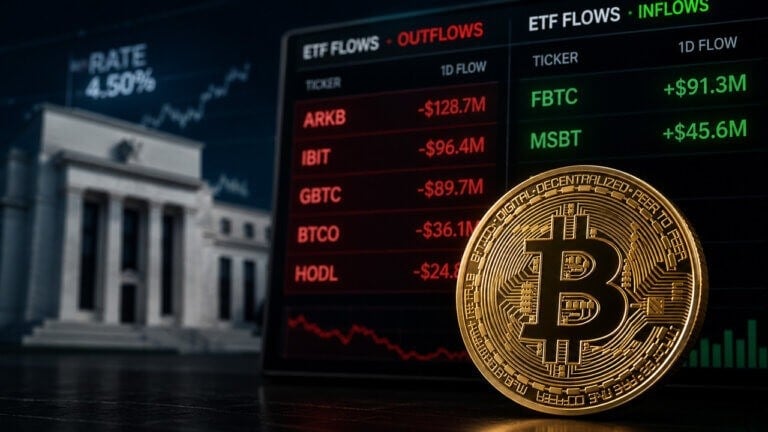
Analyzing data for the inflow of Bitcoin ETFs is somewhat more complex than the simple addition of numbers. One of the reasons for institutional adoption is persistent inflow. Short term inflows may be the result of speculative trading.
If gross inflow occurs, net inflow (assuming there is no out flow) would be equal to the gain. Taking the current macro condition into consideration (interest rates, dollar strength, etc.) would give a better idea of whether inflows would lead to an increase in price.
Finally, the impact of the flow on market liquidity would suggest whether capital is working to protect market stability or is creating short term volatililty. Using flow data in combination with market data will give investors insight into the directional movement of Bitcoin beyond inflow data.
Bitcoin ETF Inflows vs. Other Market Indicators
| Bitcoin ETF Inflows | Other Market Indicators |
|---|---|
| Signal institutional adoption and confidence | On-chain activity shows retail demand and wallet growth |
| Provide liquidity and reduce trading spreads | Trading volume highlights overall market participation |
| Can drive short-term price momentum | Macro trends (Fed policy, inflation, dollar strength) often override ETF flows |
| Reflect regulatory legitimacy and compliance | Derivatives data (futures, options) reveal leverage and sentiment |
| Useful for gauging mainstream acceptance | Correlation with equities shows Bitcoin’s risk-on/risk-off behavior |
What Large ETF Outflows Could Signal

Large ETF outflows can show sharp reversals in sentiment. These can happen because of institutional investors losing confidence, or because of bulls cashing in after major rallies. Bitcoin ETFs experience this phenomenon too, when major capital outflows occur because of a lack of interest to maintain market exposure using regulated investment vehicles.
Outflows can reflect other issues as well, such as concerns with global markets because of hawkish interest rate policies and / or a strong U.S. dollar. Outflows may also lead investors to become fearful and lead them to somewhat raise “cash.”
Large outflows usually conversely create interest for bulls. For long term HODLers, outflows can be signaling a drop in institutional interest. Outflows are not a cause for concern for bulls cashing in. Monitoring ETF outflows, and other indicators, gives investors information to determine if Bitcoin outflows are because of temporary changes in the market.
Bullish, Neutral and Bearish ETF Flow Scenarios for 2026
| Bullish Scenario | Neutral Scenario | Bearish Scenario |
|---|---|---|
| Persistent inflows above $2B weekly | Flows fluctuate around breakeven | Large outflows exceeding $1B weekly |
| Strong institutional adoption and long-term allocations | Mixed signals from institutions and retail | Institutional profit-taking and reduced confidence |
| Bitcoin price supported above $80K with momentum | Price stabilizes in $65K–$75K range | Price correction below $60K |
| Liquidity deepens, spreads tighten | Liquidity remains steady but not expanding | Liquidity weakens, volatility rises |
| Regulatory clarity boosts confidence | Regulatory stance unchanged | Policy uncertainty or restrictions dampen demand |
Key Bitcoin ETF Metrics Investors Should Track in 2026
Net Flow: Watch closely how inflows compare to outflows each week in order to gauge the market’s sentiment
and the conviction of the Institutional investors.
AUM (Assets Under Management): More AUM suggests greater demand with increased liquidity.
Total Volume: High volume suggests increased liquidity and tighter spreads.
Premium/Discount to NAV (Net Asset Value): This measures how ETF shares are trading in relation to the underlying
Bitcoin.
Institutional Participation: Long-term participation by institutional investors such as pension funds, hedge funds, and
asset managers, ensures long term stability.
Correlation with Macro Trends: Be mindful of how flows relate to inflation, Fed Policy, and the overall strength of
the dollar.
Liquidity Impact: Deep, liquid markets are the result of positive inflows; large outflows heighten market volatility.
Regulatory Climate: The prevalence of demand for ETFs relies on favorable regulation.
Common Mistakes When Interpreting ETF Inflows

Assuming inflows mean price increases: There are several factors that can counteract theeffects of inflows. Macro conditions are a good example.
Ignoring net flows: They give a distorted view of the market.
Assuming inflows show adoption: Hype and temporary spikes can be misread as demand.
Liquidity absorption: Large inflows will not increase the market price if there is sufficient market liquidity.
Macro correlation: Bitcoin tends to move in line with stocks regardless of ETF inflows.
Ignoring derivatives: Futures and options trading can cause a lot of volume.
Forgetting regulatory context: There can be swift and unexpected changes in inflows due to regulations.
Pros & Cons
| Pros | Cons |
|---|---|
| Signal strong institutional adoption and confidence | Inflows don’t guarantee price appreciation |
| Provide deeper liquidity and tighter spreads | Sudden outflows can trigger volatility |
| Enhance regulatory legitimacy and mainstream acceptance | Overreliance on ETF flows may distort sentiment |
| Offer a compliant, custody‑safe way to invest | Macro factors (rates, dollar strength) can override inflows |
| Support long‑term stability and adoption | Short‑term spikes may reflect speculation, not adoption |
Conclusion
Days of analyzing Bitcoin ETF inflows and outflows to determine levels of adoption and legal tendencies are behind us, but that doesn’t make consequences any less significant.
Long-term inflows show confidence, but short-term inflows signify a speculative market. While there are other outside factors that can drive Bitcoin’s price, investors have to understand that having active inflows doesn’t necessarily mean price increases are imminent.
For 2026 investors, they need to understand how to analyze Bitcoin ETF flows along with other macro findings and market indicators. When reading into Bitcoin ETF flows, hype is reflected in a lot of flows, but there is usually nothing behind the hype. For smart investment practices, Bitcoin ETF flows have to be taken in context.
FAQ
What are Bitcoin ETF inflows?
Inflows represent new capital entering Bitcoin ETFs, signaling investor demand and institutional adoption.
Do ETF inflows guarantee Bitcoin’s price will rise?
No. While inflows show confidence, macroeconomic factors, outflows, and market correlations can offset their impact.
Why are persistent inflows important?
They indicate long‑term institutional conviction, deeper liquidity, and mainstream acceptance of Bitcoin.
What risks do large ETF outflows pose?
Outflows can weaken liquidity, trigger volatility, and signal reduced institutional confidence.
Which metrics should investors track in 2026?
Net flows, AUM, trading volume, NAV premium/discount, institutional participation, and macro correlations.