


In this article, I will review distributed database management systems that work best with high frequency applications with ultra-low latency, high availability, and high scalability. For the fintech, gaming, and large-scale enterprise applications that demand the processing of millions
of transactions a second, distributed database management systems that are able to scale to meet user demand and deliver near real-time performance are best. I will provide the features and advantages that make these systems the best distributed database systems.
Key Points & Best Distributed Database Management Systems for High-Frequency Apps
| Distributed Database Management System | Explanation |
|---|---|
| Apache Cassandra | Delivers high scalability and fault tolerance for massive data workloads. |
| CockroachDB | Provides strong consistency and automatic scaling across multiple regions globally. |
| Google Cloud Spanner | Combines SQL capabilities with global distribution and horizontal scalability efficiently. |
| Amazon DynamoDB | Offers millisecond performance and serverless scaling for demanding applications worldwide. |
| ScyllaDB | Delivers extremely low latency using efficient shard-per-core architecture design principles. |
| TiDB | Supports hybrid transactional workloads with seamless horizontal scaling capabilities everywhere. |
| MongoDB | Enables flexible schemas and distributed clusters for real-time applications efficiently. |
| Redis Enterprise | Provides ultra-fast in-memory processing for high-frequency transactional systems globally. |
| YugabyteDB | Delivers PostgreSQL compatibility with resilient, globally distributed database architecture solutions. |
| VoltDB | Optimized for high-frequency transactions requiring ultra-low latency processing performance. |
10 Best Distributed Database Management Systems for High-Frequency Apps
1. Apache Cassandra
Apache Cassandra is a distributed database known for its availability, durability, and speed of data handling and retrieval. Because of its peer-to-peer structure, it is the ideal choice for IoT systems and real-time analytics.
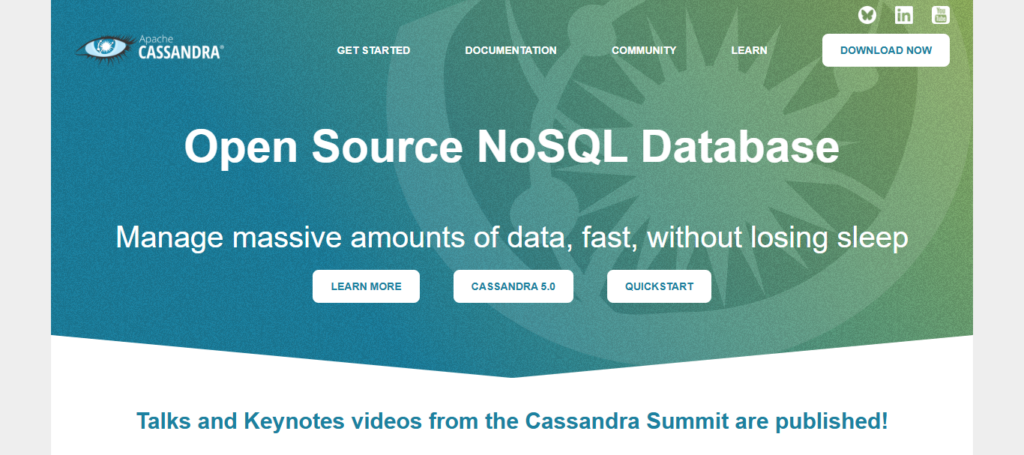
Cassandra can manage petabytes of data, while simultaneously keeping latency low. Latest versions have better management of data storage as well as the Cassandra OpsCenter™. This enables businesses to handle millions of transactions with little to no degradation in performance.
Apache Cassandra – Pros & Cons
| Pros | Cons |
|---|---|
| Exceptional horizontal scalability across multiple data centers. | Complex setup and cluster management for beginners. |
| No single point of failure ensures high availability. | Limited support for complex SQL queries and joins. |
| Handles petabytes of data with low latency. | Data modeling requires careful planning and expertise. |
| Excellent for write-heavy workloads and real-time applications. | Eventual consistency may not suit all applications. |
| Strong replication capabilities for disaster recovery. | Higher infrastructure requirements for large deployments. |
2. CockroachDB
CockroachDB was created for distributed SQL systems that need strong consistency and global availability at once. An automatic data replication and a self-healing feature of CockroachDB make it appealing to high-frequency trading systems and use cases where ACID transactions are a must.
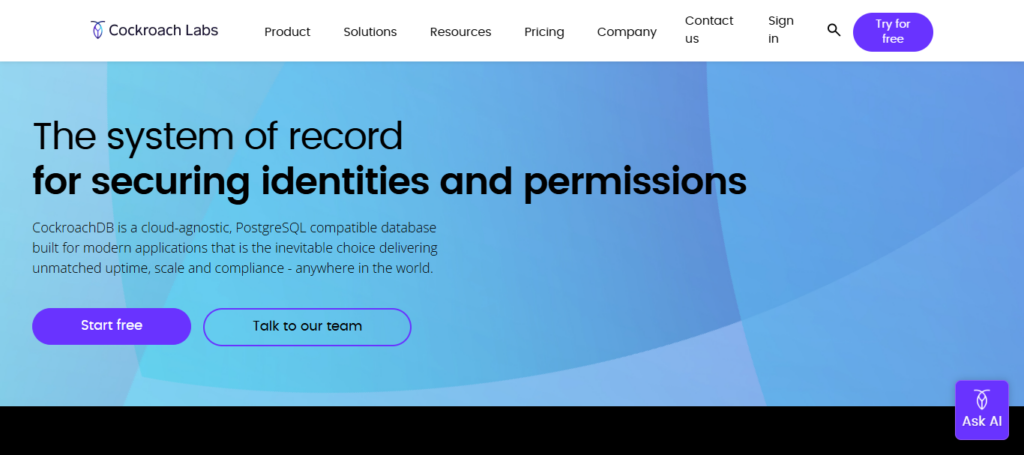
The latest version of CockroachDB has feature improvements for multi-region support and will likely become a top choice for businesses that require a distributed SQL system in the cloud.
CockroachDB – Pros & Cons
| Pros | Cons |
|---|---|
| Provides strong ACID transactions across distributed environments. | Can become expensive at large-scale deployments. |
| Automatic failover and self-healing capabilities. | Higher latency than some specialized NoSQL databases. |
| Supports multi-region deployments with consistency. | Resource-intensive for smaller workloads. |
| PostgreSQL compatibility simplifies migration processes. | Operational complexity increases with advanced configurations. |
| Excellent for cloud-native applications and SaaS platforms. | Fewer third-party tools compared to mature databases. |
3. Google Cloud Spanner
Google Cloud Spanner is at the intersection of traditional and distributed database systems, as it is a relational database that supports the scalability of a distributed system. With the help of the
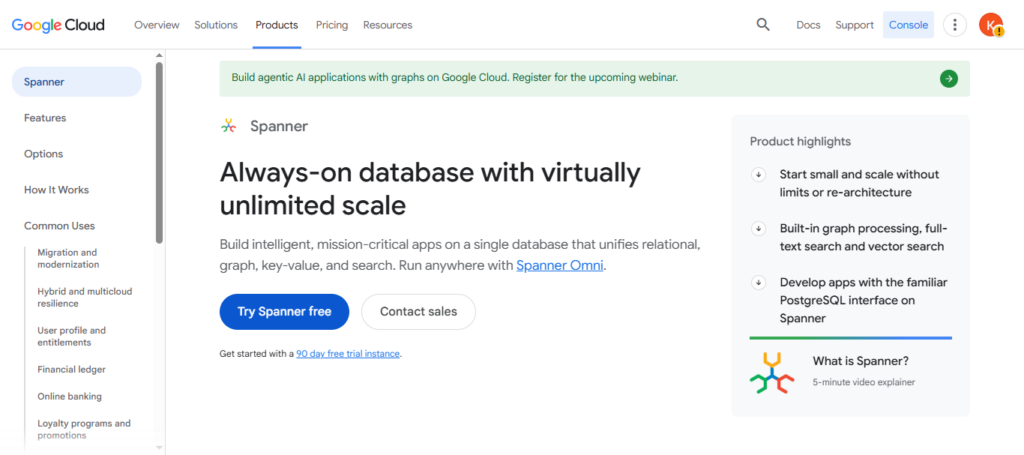
TrueTime technology, Cloud Spanner provides customers with consistent and accurate data, no matter where they are in the world. Spanner has all the capabilities to run mission-critical applications and can handle the needs of an enterprise.
Google Cloud Spanner – Pros & Cons
| Pros | Cons |
|---|---|
| Delivers global consistency with horizontal scalability. | Expensive compared to traditional relational databases. |
| Fully managed service reduces administration efforts. | Vendor lock-in with Google Cloud ecosystem. |
| Supports SQL and ACID transactions. | Limited customization and infrastructure control. |
| Automatic replication across regions enhances reliability. | Requires understanding of distributed database concepts. |
| Excellent for mission-critical enterprise applications. | Not ideal for small projects with limited budgets. |
4. Amazon DynamoDB
Amazon DynamoDB is an excellent option for demanding applications for which single-digit millisecond performance is critical.
It has great, automatic scaling features, which is ideal for applications that are subject to sudden and varying levels of traffic such as gaming applications, eCommerce applications, and financial applications.
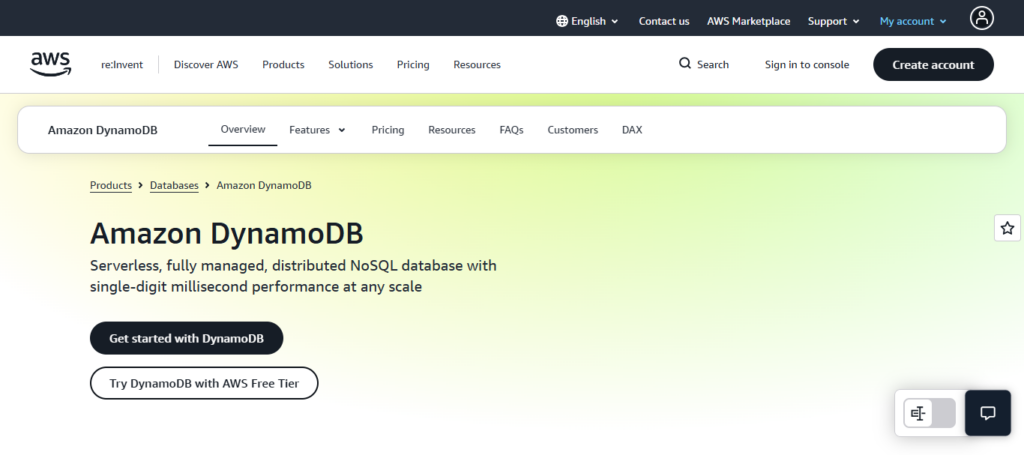
Being fully serverless, DynamoDB does away with the need for its users to specifically manage the underlying compute resources. It includes security and backup features as part of the service.
With new and improved global tables and zero-ETL, DynamoDB continues to innovate and maintain its competitive lead as the database service of choice for modern-day, high-frequency applications.
Amazon DynamoDB – Pros & Cons
| Pros | Cons |
|---|---|
| Single-digit millisecond performance at massive scale. | Query flexibility is limited compared to SQL databases. |
| Fully managed and serverless architecture. | Costs can rise significantly with heavy traffic. |
| Automatic scaling handles sudden traffic spikes efficiently. | Complex data modeling for relational workloads. |
| Built-in backup and security features. | Vendor dependency within AWS ecosystem. |
| Global tables enable worldwide application deployment. | Limited support for complex transactions. |
5. ScyllaDB
ScyllaDB can, and does, efficiently serve ultra low latency workloads. It also outperforms traditional NoSQL databases. ScyllaDB is used often to meet the real-time processing needs of financial applications, telecommunications, and streaming services.
ScyllaDB does fully utilize modern hardware features and has benefits associated with its use of tablet based architectures and improved operational tooling. These new features offer great performance for companies that need to serve billions of requests for data daily.
ScyllaDB – Pros & Cons
| Pros | Cons |
|---|---|
| Extremely low latency and high throughput performance. | Smaller community compared to Cassandra and MongoDB. |
| Efficient hardware utilization reduces infrastructure costs. | Advanced tuning may require specialized expertise. |
| Compatible with Cassandra applications and drivers. | Enterprise features may involve licensing costs. |
| Excellent for real-time and high-frequency applications. | Fewer integrations than larger database ecosystems. |
| Handles billions of operations efficiently. | Documentation can be challenging for beginners. |
6. TiDB
TiDB offers a great balance transactional and analytical processing. It is a fully managed NoSQL service. Its architecture supports the separation of compute and storage, which enables tunable scaling.
TiDB is a great option for real-time analytics and transactional processing, which is why it is favored by many in the fintech and eCommerce industries. Alternatives lack the performance and optimizations seen in TiDB, particularly for large data sets and high traffic.
TiDB – Pros & Cons
| Pros | Cons |
|---|---|
| Supports both transactional and analytical workloads. | More complex architecture than traditional databases. |
| MySQL compatibility eases migration efforts. | Requires multiple components for full deployment. |
| Independent scaling of compute and storage resources. | Operational management can be demanding. |
| Strong consistency and distributed SQL capabilities. | Smaller ecosystem than PostgreSQL and MySQL. |
| Suitable for real-time analytics applications. | Higher learning curve for administrators. |
7. MongoDB
MongoDB is applauded for its flexible document structure and accommodating infrastructure. With MongoDB, businesses can build high-frequency applications with very few rigid schema. MongoDB, for example, is a good option for content platforms, mobile apps, and customer data applications.
The distributed clusters of MongoDB allow users to horizontally scale across a network. With the new additions of vector search, AI, and Analytics, MongoDB has become a flexible option for applications with rapidly changing needs.
MongoDB – Pros & Cons
| Pros | Cons |
|---|---|
| Flexible document model accelerates development processes. | Data duplication can increase storage requirements. |
| Easy horizontal scaling with sharding support. | Complex transactions may impact performance. |
| Excellent support for rapidly changing data structures. | Memory usage can become relatively high. |
| Large community and extensive documentation. | Relational queries are less efficient than SQL databases. |
| Supports modern AI and vector search capabilities. | Schema flexibility can create data inconsistencies. |
8. Redis Enterprise
Redis Enterprise boasts speed with an in-memory database. Financial applications, gaming applications, and leaderboards all benefit from the sub millisecond latency that Redis Enterprise offers.
With Redis Enterprise, there are tradeoffs with multiple data models and the active-active replication that span the regions.
With the new vector database architecture and AI-ready features, the value of Redis Enterprise for rapidly-changing needs and high-velocity applications continues to grow.
Redis Enterprise – Pros & Cons
| Pros | Cons |
|---|---|
| Sub-millisecond performance for ultra-fast applications. | In-memory architecture increases infrastructure costs. |
| Supports multiple data models and use cases. | Not ideal for storing massive datasets permanently. |
| Active-active replication improves global availability. | Memory limitations may restrict scalability. |
| Excellent for caching and real-time analytics. | Enterprise licensing can be expensive. |
| Integrates well with AI and vector databases. | Persistence configuration requires careful planning. |
9. YugabyteDB
YugabyteDB offers the comfort of SQL along with a distributed, fault tolerant, and sharded system. With the ease of SQL, developers are able to layer complex queries, furthering the utility of YugabyteDB. Many banks and telecommunications and logistic service providers choose YugabyteDB to upgrade their older systems.
The latest YugabyteDB design enhancements have fostered greater elasticity and efficiency in operations, allowing businesses to construct globally distributed, mission-critical applications with high transaction volumes and complete confidence in reliability.
YugabyteDB – Pros & Cons
| Pros | Cons |
|---|---|
| PostgreSQL compatibility simplifies developer adoption. | Deployment complexity higher than traditional databases. |
| Automatic sharding and fault tolerance features. | Requires significant infrastructure resources. |
| Strong consistency across distributed environments. | Community ecosystem still growing rapidly. |
| Ideal for globally distributed applications. | Advanced troubleshooting may require expertise. |
| High availability with minimal downtime. | Performance tuning can be complex initially. |
10. VoltDB
VoltDB provides high speed and low latency for fraud detection, telecom billing, and high-frequency trading. In-memory databases provide processing power for millions of transactions per second.
Positive changes have been made for integration of streaming data as well as real-time analytics. Companies that need immediate decisions are relying on VoltDB for fast processing of critical workloads.
VoltDB – Pros & Cons
| Pros | Cons |
|---|---|
| Processes millions of transactions per second efficiently. | Best suited primarily for transactional workloads. |
| Extremely low latency for real-time systems. | Limited flexibility for complex analytical queries. |
| Excellent for fraud detection and trading platforms. | Smaller user community and ecosystem. |
| In-memory processing enables instant decision-making. | Requires significant RAM for large datasets. |
| Strong support for streaming data applications. | Not ideal for general-purpose database requirements. |
Conclusuion
In conclusuion, Spay and distributed database management systems have increased the availability of high-performance systems to design, develop, and deploy applications that are available and scalable to a worldwide market.
Such systems are used by eBay, Amazon, and Google, and examples of these systems are Microsoft SQL Server, Oracle, Spanner, and Cassandra.
FAQ
Why are distributed databases important for high-frequency applications?
They provide low latency, high availability, and horizontal scalability for handling millions of transactions.
Which database is best for high-frequency trading applications?
VoltDB and ScyllaDB are popular due to their ultra-low latency.
Is Apache Cassandra suitable for real-time applications?
Yes, Apache Cassandra excels in handling massive write workloads and real-time data processing.
Which distributed database offers the strongest consistency?
CockroachDB and Google Cloud Spanner provide strong ACID consistency.
