


This article reviews the Top BitGo Competitors for Crypto Custody. We discuss the top providers of secure digital asset storage, institutional-grade protection, and cryptocurrency management solutions.
We’ll take a look at their key features, supported assets, pricing models, security technologies, and institutional services to help businesses, investors and financial institutions compare alternatives and choose the right crypto custody provider for their specific needs.
Key Points & Top BitGo Competitors for Crypto Custody
Coinbase Prime Custody: Provides institutional-grade cryptocurrency custody, secure asset storage, advanced trading tools, and compliance-focused services for institutional investors.
Fireblocks: Offers digital asset custody infrastructure, secure wallet technology, transaction management, and blockchain connectivity for financial institutions and businesses.
Anchorage Digital: Delivers federally chartered digital asset custody, institutional staking, governance, and security-focused services for cryptocurrency investors and institutions.
Fidelity Digital Assets: Provides institutional cryptocurrency custody and trading services, emphasizing secure storage, operational controls, and established financial industry expertise.
Gemini Custody: Offers institutional cryptocurrency storage with strong security controls, regulatory compliance, and asset protection services for businesses and investors.
Copper: Specializes in institutional digital asset custody, collateral management, and secure trading infrastructure through its integrated cryptocurrency settlement solutions.
Komainu: Provides regulated digital asset custody services designed for institutional investors, asset managers, and financial organizations requiring robust security and governance.
Zodia Custody: Delivers institutional-grade digital asset custody backed by banking expertise, focusing on security, regulatory compliance, and operational risk management.
Cobo: Offers digital asset custody, wallet infrastructure, and MPC-based security solutions for institutions, exchanges, and Web3 businesses managing cryptocurrencies.
Taurus: Provides institutional digital asset custody, tokenization, and blockchain infrastructure, helping banks and financial institutions manage digital assets securely.
10 Top BitGo Competitors for Crypto Custody
1. Coinbase Prime Custody
Coinbase Prime Custody is a big competitor to BitGo for institutions looking for regulated digital asset storage as well as trading and settlement services. Its custody platform has more than 470 Pricing and fees Coinbase does not have a single public custody rate that applies to all institutional clients.

The fees vary depending on the services and assets selected and the commercial agreement. Its institutional clients include investment advisers, asset managers, family offices and active traders that require qualified custody.
Coinbase is particularly important for organizations looking for custody, trading liquidity, financing and cash-management capabilities integrated in one institutional platform, unlike BitGo.electronic assets across 52 different blockchains, subject to jurisdiction and contracting entity.
Coinbase Prime Custody Feature
| Feature | Explanation |
|---|---|
| Regulated Custody | Provides institutional custody through Coinbase Custody Trust Company, a New York-regulated qualified custodian. |
| Broad Asset Support | Supports 470+ digital assets across 52 blockchain networks, subject to jurisdiction and account eligibility. |
| Integrated Trading | Enables institutions to trade through connected liquidity venues while assets remain within the qualified custody arrangement. |
| Staking and Governance | Offers staking for eligible assets through supported custody solutions and participation in selected blockchain governance proposals. |
2. Fireblocks
Fireblocks competes with BitGo in digital asset infrastructure, wallet technology, transaction security and connectivity to custody providers. It provides a platform with thousands of digital currencies including cryptocurrencies, stablecoins and tokens, with over 150 blockchain integrations.
Pricing and fees are usually customized to the customer’s needs (e.g., transaction volumes, wallet infrastructure, integrations, and services chosen); prospective customers should ask for a direct quote and not assume a standard custody fee.

Fireblocks is built for exchanges, banks, fintechs, asset managers, payment providers and Web3 companies. But unlike a custodian-only model, its infrastructure can connect organizations with licensed custodians while providing transaction controls and wallet-management technology. That makes it a useful BitGo alternative for businesses building digital asset operations.
Fireblocks Feature
| Feature | Explanation |
|---|---|
| MPC Wallet Security | Uses multi-party computation technology to secure digital asset transactions and manage wallet access. |
| Transaction Policy Controls | Supports approval workflows, role-based permissions, and configurable transaction policies for organizational security. |
| Blockchain Connectivity | Provides infrastructure for managing digital assets across supported blockchain networks and token ecosystems. |
| Institutional Integrations | Connects businesses with exchanges, custodians, DeFi applications, and payment infrastructure through supported integrations. |
3. Anchorage Digital
Anchorage Digital is a strong competitor to BitGo for institutions looking for regulated custody, governance and access to blockchain services. Its custody platform supports eligible electronic assets, subject to availability by asset, network, jurisdiction and account arrangement. Anchorage is focused on segregated custody, approvals of institutional transactions, staking and governance participation.
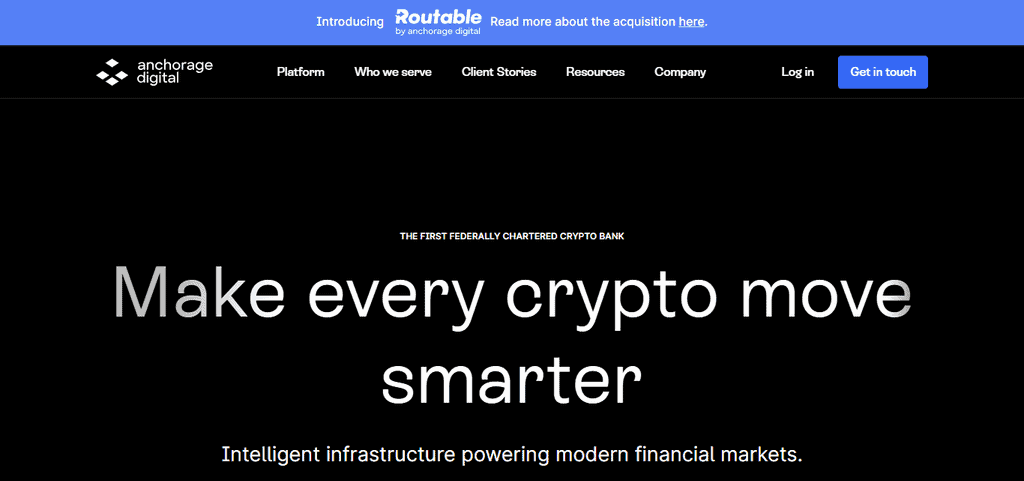
Institutional custody pricing is not published as a universal flat rate and clients are therefore advised to obtain a quote that reflects custody fees, supported assets, transaction costs and any fees associated with staking. Anchorage also offers a separate self-custody product called Porto, which has a published Starter plan costing $750 per month or $7,650 per year, but is not the same as its institutional custody pricing.
Its target clients include investment funds, financial institutions, crypto-native companies and organizations that need a federally chartered, SEC-qualified custodian. Anchorage is particularly relevant in relation to BitGo when regulated custody and integrated banking capabilities are important selection criteria.
Anchorage Digital Feature
| Feature | Explanation |
|---|---|
| Regulated Custody | Provides institutional digital asset custody through its regulated custody business, subject to applicable eligibility requirements. |
| Secure Asset Management | Uses institutional security controls and governance procedures to manage digital asset holdings. |
| Staking Services | Supports staking for eligible assets, enabling institutions to participate in supported blockchain networks. |
| Governance Participation | Provides governance-related capabilities for eligible assets, subject to network rules and service availability. |
4. Fidelity Digital Assets
Fidelity Digital Asset Management offers institutional cryptocurrency custody and trading, with a focus on offline storage, physical and cybersecurity controls, operational governance and integrated execution.
The assets supported depend on the particular institutional service; it should not be confused with the broader digital asset offering, and the narrower list available through consumer-facing Fidelity Crypto accounts Organizations should ask for custom terms based on their assets, trading activity and service needs because institutional custody pricing and transaction fees are not provided in a single public schedule.

Fidelity serves registered investment advisers, wealth managers, family offices, corporate treasurers, pension funds, endowments, hedge funds, asset managers, banks and broker-dealers. Fidelity, as a BitGo alternative, is particularly well-suited for institutions that value conventional financial services experience, institutional reporting, integrated trading, and established operational controls.
Fidelity Digital Assets Feature
| Feature | Explanation |
|---|---|
| Cold Storage | Uses offline storage and physical security controls to protect supported digital assets. |
| Institutional Trading | Provides trading execution and liquidity access through its institutional digital asset platform. |
| Approval Controls | Uses multi-tier approval structures and operational controls to govern asset transfers. |
| Institutional Reporting | Serves asset managers, advisers, family offices, pensions, endowments, and other eligible financial institutions. |
5. Gemini Custody
Gemini Custody provides institutional-grade digital asset custody with offline security, account governance and asset addresses that are segregated and can be independently verified on supported blockchains.
Supported asset classes will vary depending on custody eligibility and account requirements, so clients should verify the specific cryptocurrencies and networks prior to transferring funds. Gemini’s published custody fee schedule lists an annual custody fee of 0.40%, or $30 per month per asset, whichever is higher, and a $125 administrative withdrawal fee; check Gemini’s current contractual schedule before relying on these figures.

There’s no required minimum balance, although minimum monthly fees do apply, the company says. Its institutional clients include asset managers, hedge funds, mutual funds, exchange-traded funds and wealth management firms.
BitGo may not be as attractive to organizations seeking a published baseline for custody pricing, regulated custody and institutional account-management tools, as Gemini.
Gemini Custody Feature
| Feature | Explanation |
|---|---|
| Offline Storage | Stores most custody assets in offline, air-gapped systems with strict physical access controls. |
| MPC Technology | Uses multi-party technology, role-based governance, and layered security procedures to protect assets. |
| Segregated Addresses | Provides unique digital addresses for custody assets, supporting independent on-chain verification. |
| Trading Integration | Integrates with Gemini’s exchange interface and supports eligible trading transfers from custody. |
6. Copper
Copper is an institutional digital asset custody provider and competes with BitGo by offering multi-party computation (MPC) security, off-exchange settlement, collateral management and trading infrastructure. The custody service supports a variety of cryptocurrencies and tokens on several blockchain networks; see its supported-assets directory for the full list.
There is no single, universal institutional custody fee for copper that applies to all customers, so you should check pricing directly, including custody charges, settlement costs, withdrawal fees and other service charges. Its customers include institutional investors, trading firms, asset managers and organizations active across a range of digital asset exchanges.

Copper’s ClearLoop infrastructure enables qualified clients to trade on associated exchanges while assets remain in the relevant custodial arrangements. Copper is especially appealing relative to BitGo for institutions looking for capital efficiency across trading venues, collateral mobility and off-exchange settlement.
Copper Feature
| Feature | Explanation |
|---|---|
| MPC Security | Uses MPC-based wallet infrastructure to manage private-key security and institutional access controls. |
| Off-Exchange Settlement | ClearLoop enables eligible institutions to trade on connected exchanges while assets remain within designated custody arrangements. |
| Collateral Management | Supports institutional workflows for managing digital assets used in trading and collateral arrangements. |
| Trading Connectivity | Connects institutional clients to supported exchanges and digital asset trading venues. |
7. Komainu
Komainu is an institutional cryptocurrency custodian with segregated, on-chain wallets, governed controls and regulated operations in multiple jurisdictions. Its custody services are designed to keep client assets separate from the company’s own balance sheet, where applicable.
The assets supported and the eligibility for services depend on the relevant custody entity and account arrangements. Komainu does not publish a full public price list for institutional custody services. Potential clients should request a quote that covers custody, transfers and staking (where available), and any other operational services.

Its target clients include financial institutions, hedge funds, asset managers, exchanges and other professional investors requiring institutional custody arrangements.
Komainu is an alternative to BitGo with a unique independent custody model, on-chain segregation of assets and institutional focus on governance. Businesses should compare eligible assets, jurisdictional coverage, contractual protections and the total cost of service before choosing one.
Komainu Feature
| Feature | Explanation |
|---|---|
| Institutional Custody | Provides digital asset safekeeping services designed for professional investors and financial institutions. |
| Asset Segregation | Uses custody arrangements designed to separate client assets from the custodian’s own assets. |
| Governance Controls | Supports institutional operating procedures and controls for managing access to digital assets. |
| Additional Services | Offers selected institutional services such as staking and collateral-related solutions, subject to eligibility and availability. |
8. Zodia Custody
Zodia Custody is a digital asset custodian for institutional investors focused on security, compliance and custody infrastructure for professional financial markets. The company says it supports more than 75 crypto assets and operates in multiple jurisdictions, though availability of individual assets and services depends on the client’s location and account eligibility.
There is no single public institutional custody tariff, so interested customers must request specific terms for custody, deposits, withdrawals, staking and other selected services. Its target institutional clients include banks, asset managers, hedge funds, trading firms and other financial organizations that demand controlled access to electronic assets.

Zodia Custody is worth looking at in comparison with BitGo if you are an institution looking for a custody provider with strong links to conventional financial services and institutional risk management. Buyers should consider supported networks, settlement integrations, regulatory coverage and contractual service commitments in their decision making.
Zodia Custody Feature
| Feature | Explanation |
|---|---|
| Institutional Security | Focuses on secure digital asset storage and controlled operational processes for institutional clients. |
| Regulatory Focus | Operates through relevant entities and jurisdictions, with applicable regulatory status depending on the service. |
| Asset Segregation | Provides institutional custody arrangements designed to distinguish client assets from corporate assets. |
| Institutional Connectivity | Supports digital asset transfer and operational workflows for eligible financial institutions and trading firms. |
9. Cobo
Cobo competes with BitGo, offering institutional digital asset custody, MPC wallets, smart-contract wallets, exchange wallets, and wallet-as-a-service infrastructure. Its platform supports 3,000+ tokens across 80+ blockchains networks, making it relevant to exchanges, fintech businesses, crypto funds and web3 companies with multi-chain operations.
Cobo announced pricing for its Wallet-as-a-Service products, with Starter plans costing $299/month, Standard plans priced at $999/month, and Enterprise pricing being custom.

The costs reflected here are for the wallet infrastructure plans described and are not universal institutional custody rates. Transfer volume limits, API usage and other services may affect the overall price.
It offers flexible wallet infrastructure to institutional clients such as exchanges, fintechs and digital asset businesses. Compared to BitGo, Cobo is particularly relevant for businesses looking for broad token support, multiple wallet models and API-driven wallet operations.
Cobo Feature
| Feature | Explanation |
|---|---|
| Multiple Wallet Models | Offers MPC wallets, smart-contract wallets, exchange wallets, and wallet infrastructure for different business needs. |
| Multi-Chain Support | Supports a broad range of tokens and blockchain networks, subject to the selected product and network availability. |
| Wallet-as-a-Service | Provides APIs and infrastructure for businesses building digital asset wallet capabilities into their applications. |
| Institutional Operations | Supports exchanges, fintech businesses, Web3 platforms, and other organizations requiring programmable wallet management. |
10. Taurus
Taurus provides institutional digital asset custody and blockchain infrastructure through products supporting cryptocurrency custody, staking, trading, and tokenization. Its Taurus-PROTECT platform supports hot, warm, and cold storage
While its wider infrastructure can support tokenized securities, stablecoins, and other digital assets, subject to product and jurisdictional eligibilit Taurus does not publish one universal custody fee applicable to all institutional customers, so businesses should request a quote covering implementation, custody, transaction processing, integrations, and any tokenization or trading services.

Its target clients include banks, securities firms, asset managers, and other financial institutions that want to integrate digital assets into established financial operations. Compared with BitGo,
Taurus is particularly relevant for organizations seeking a combination of secure custody and tokenization infrastructure rather than cryptocurrency storage alone. Institutions should compare supported blockchains, deployment options, regulatory requirements, integration costs, and ongoing service fees before selecting a provider.
Taurus Feature
| Feature | Explanation |
|---|---|
| Institutional Custody | Taurus-PROTECT supports digital asset safekeeping with institutional security and access controls. |
| Multiple Storage Options | Supports hot, warm, and cold storage configurations for different operational and security requirements. |
| Tokenization Infrastructure | Provides technology for issuing and managing tokenized assets, subject to applicable legal and technical requirements. |
| Blockchain Services | Offers additional capabilities such as staking and digital asset infrastructure integrations, depending on the selected product. |
Conclusion
To summarize, the top BitGo alternatives for cryptocurrency custody provide various solutions for the safekeeping and management of digital currencies. Providers like Coinbase Prime Custody, Fireblocks, Anchorage Digital and Fidelity e- Assets cater to various institutional needs.
Check for supported cryptocurrencies, security features, regulatory compliance, pricing, and integrations before choosing a provider. Selecting the right custody partner helps businesses protect assets, streamline operations, and move forward with long-term digital asset management goals.
FAQ
Which BitGo competitor is best for institutional crypto custody?
Coinbase Prime Custody, Anchorage Digital, Fidelity Digital Assets, and Gemini Custody are worth comparing for institutional custody, depending on regulatory requirements, supported assets, security controls, and service availability.
Which crypto custody providers support multiple blockchain networks?
Fireblocks, Cobo, Coinbase Prime Custody, and Taurus offer infrastructure supporting multiple blockchain networks. Supported assets and network availability vary by product and jurisdiction.
Are BitGo competitors suitable for banks and financial institutions?
Yes. Providers such as Anchorage Digital, Fidelity Digital Assets, Coinbase Prime Custody, and Zodia Custody offer services designed for eligible institutional and financial-sector clients.
How much do BitGo competitors charge for crypto custody?
Pricing varies by provider, assets under custody, transaction volume, and additional services. Some providers publish selected fees, while others negotiate institutional pricing directly with clients.
What security features should businesses compare when choosing a BitGo alternative?
Businesses should evaluate MPC or multisignature technology, cold storage, access permissions, transaction approval workflows, asset segregation, insurance terms, and incident-response procedures.
