


In this article, I will cover the Best Tokenized Asset Platforms Like Ondo Finance, including Securitize, Centrifuge, Maple Finance, Backed Finance, Superstate, OpenEden, Tokeny, RealT, tZERO, and Franklin Templeton.
We’ll look at their tokenized assets, blockchain support, yield models, accessibility, liquidity, regulatory features, and core platform features to help readers understand how these top real-world asset platforms differ.
Key Points & Best Tokenized Asset Platforms Like Ondo Finance
- Securitize — Institutional platform for issuing and managing tokenized real-world assets.
- Centrifuge — Brings real-world assets onchain through structured financing and tokenization infrastructure.
- Maple Finance — Institutional lending platform offering credit markets and tokenized yield opportunities.
- Backed Finance — Tokenizes traditional financial assets, creating blockchain-based representations of securities.
- Superstate — Develops regulated onchain investment products focused on tokenized Treasury assets.
- OpenEden — Provides tokenized Treasury products designed to deliver transparent, blockchain-based yield.
- Tokeny — Enterprise tokenization infrastructure supporting compliant issuance and lifecycle management.
- RealT — Tokenizes fractional real estate ownership, enabling blockchain-based property investment and income.
- tZERO — Digital securities platform providing regulated trading and tokenization infrastructure for assets.
- Franklin Templeton — Offers blockchain-enabled investment products, including tokenized money market funds.
10 Best Tokenized Asset Platforms Like Ondo Finance
1. Securitize
Securitize is an institutional platform for tokenizing funds, U.S. Treasuries, private credit, equities and other real-world assets. It offers issuance, transfer agent, fund administration, compliance and distribution infrastructure, while transforming traditional investment products into blockchain-based securities.
Securitize supports various blockchain networks and has expanded its multichain infrastructure to include Ethereum, Solana and TRON. Typically investors are economically exposed to the underlying fund or security, rather than simply holding a cryptocurrency, with product-specific rules governing income, redemption and transfer.

Access requirements can include KYC and investor suitability requirements depending on the individual offering. Liquidity can be achieved through onchain transfers and building of secondary-market infrastructure, but each underlying product will have its own redemption process.
Its regulatory framework includes SEC registered transfer-agent capabilities and regulated securities infrastructure. Securitize said it had $4.3 billion in tokenized AUM as of June 30, 2026, and $5.3 billion in second quarter transaction volume.
Securitize Pros & Cons
| Pros | Cons |
|---|---|
| Regulated platform with strong compliance and investor onboarding processes | Primarily focused on regulated offerings, which can limit flexibility |
| Supports tokenization of multiple real-world asset classes | Higher setup and compliance costs for issuers |
| Large institutional network and distribution capabilities | Access restrictions for retail investors in some jurisdictions |
| End-to-end issuance, management, and transfer services | Complex regulatory requirements can slow deployment |
| Strong reputation and partnerships in the RWA sector | Less suitable for experimental or highly decentralized projects |
2. Centrifuge
Centrifuge is focused on bringing real world assets onto blockchain infrastructure. These assets include private credit, invoices, real estate, structured credit and other financial assets.
Its tokenization model lets asset managers and originators express offchain assets or cash flows through onchain structures that can plug into DeFi liquidity.
It’s a multichain deployment and institutional asset management platform, not a single tokenized product. An investor can get exposure to a particular pool or structured asset . The returns will vary depending on the underlying asset , the financing structure and risks involved .

There is no universal Centrifuge rule on access, minimum investment, liquidity, and redemption terms – these are determined by individual pools and offerings. Asset management process integrated with compliance and institutional infrastructure.
Centrifuge’s current figures of more than $1.8 billion of total value locked and 1,768 tokenized assets make for useful up-to-date data points to compare.
Centrifuge Pros & Cons
| Pros | Cons |
|---|---|
| Enables businesses to finance real-world assets through DeFi liquidity | Requires understanding of both DeFi and traditional finance |
| Provides on-chain transparency for asset pools | Pool performance depends on asset quality |
| Integrates with major DeFi ecosystems | Smart contract risks remain present |
| Diversifies yield opportunities beyond crypto-native assets | Liquidity may vary across asset pools |
| Supports a wide range of asset types | Regulatory uncertainty around RWA lending |
3. Maple Finance
Maple Finance is a little different from Ondo in that it is more focused on institutional lending and private credit and onchain yield strategies instead of mainly tokenized Treasury products. Its current asset management model includes direct lending secured by institutional credit and rated securities, asset-backed securitization and other yield strategies.
Maple builds lending positions, deposits, collateral and yield strategies on onchain markets using a blockchain infrastructure. The primary driver of returns is the interest earned from institutional lending and other strategies .
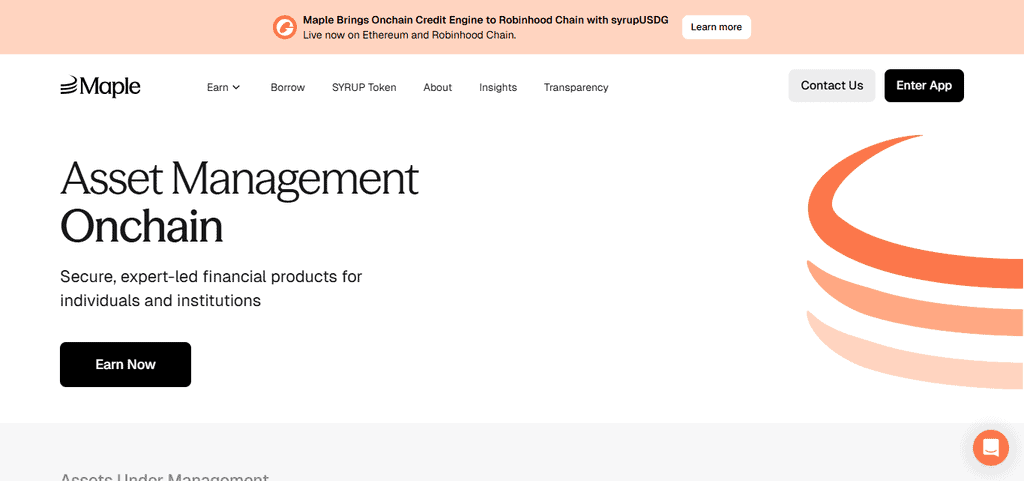
There are products like syrupUSD that help gain additional exposure to the Maple yield . Access requirements and minimums are subject to the specific pool, product, and jurisdiction.
Liquidity is not guarantyd for instant redemption but is dependent on withdrawals, pool conditions and market infrastructure and is product specific.
Maple focuses on collateralization, internal underwriting and institutional counterparty assessment. Maple reported AUM of approximately $4.8 billion in September and $1.7 billion in loans outstanding in August.
Maple Finance Pros & Cons
| Pros | Cons |
|---|---|
| Institutional-focused lending marketplace | Primarily targets accredited and institutional participants |
| Offers attractive yield opportunities | Exposure to borrower default risk |
| Professional credit underwriting processes | Loan performance can be affected by market downturns |
| Strong reputation in institutional DeFi lending | Limited accessibility for smaller investors |
| Transparent on-chain lending infrastructure | Regulatory oversight may evolve over time |
4. Backed Finance
Backed Finance focuses on tokenized equities, ETFs, bonds and other financial security products. Its xStocks products provide blockchain exposure to publicly traded assets.
Tokenization is managed via tracker certificates. Each xStock is designed to follow its underlying security and is backed 1:1 by the underlying asset with a third party custodian.
The tokens can be found on a number of EVM and other supported blockchain networks including Ethereum, Solana, Arbitrum, BNB Smart Chain,
Base, and more. Investors are exposed to the price of the underlying asset rather than owning the original security in the traditional sense of a brokerage.

xStocks are built for transferability and DeFi composability, with redemption based on the terms of issuance and redemption of the product. Availability is subject to geographic and investor restrictions
Backed says its products are not available to U.S. persons. Backed’s legal documentation currently lists approval in Liechtenstein by the FMA as of May 8, 2026 with xStocks backed across multiple blockchains.
Backed Finance Pros & Cons
| Pros | Cons |
|---|---|
| Provides tokenized exposure to real-world securities | Availability depends on jurisdictional restrictions |
| Asset-backed structure improves transparency | Limited product range compared to traditional brokers |
| Allows blockchain-based transferability | Regulatory requirements may affect usability |
| Bridges traditional finance and digital assets | Secondary market liquidity can be limited |
| Simplifies access to tokenized financial products | Reliance on custodial and issuing entities |
5. Superstate
Superstate is focused on tokenized investment funds and on-chain securities, with a specific emphasis on short-duration government securities and other yield generating financial products. It has a USTB product that gives exposure to short-duration U.S. government securities.
Other products provide various types of investment exposure. Fund shares are tokenized on supported blockchain networks, allowing investors to hold a tokenized representation of fund interests on the blockchain.

The yield is a function of the underlying portfolio and is reflected through the NAV or distribution structure of the relevant fund, not a fixed reward in cryptocurrency. Availability and eligibility to investors is subject to the fund and applicable securities laws.
Tokenization does not mean that a product will automatically have unlimited secondary liquidity, as transferability and redemption are governed by the legal structure and offering documents of each product. As per Superstate’s current asset page, USTB has AUM of around $743.1 million, USCC is around $168.9 million and CUSHY is around $25.2 million.
Superstate Pros & Cons
| Pros | Cons |
|---|---|
| Focuses on bringing regulated investment funds on-chain | Product availability is still developing |
| Managed by experienced traditional finance professionals | Limited operating history compared to established asset managers |
| Emphasizes regulatory compliance | Investor eligibility restrictions may apply |
| Potential for improved settlement efficiency | Fund offerings may not be globally accessible |
| Strong institutional appeal | Dependent on evolving tokenization regulations |
6. OpenEden
OpenEden is best known for tokenized U.S. Treasury Bills and other regulated fixed income real-world assets, with TBILL providing exposure to short-dated Treasury Bills on the blockchain.
Investors deposit USDC into the TBILL Vault and receive TBILL tokens that represent their economic interest in the underlying fund which is backed 1:1 by short-term U.S. Treasury Bills and USD.
The underlying assets are managed and custodied through regulated financial institutions, including BNY. TBILL has been deployed across multiple blockchain environments and expanded to BNB Chain in September 2026.

The returns are linked to the performance of the underlying Treasury portfolio. Access requires onboarding and whitelisting through OpenEden. According to the docs, the first deposit to TBILL is $100,000 USDC and subsequent deposits can be as little as $1.
Redemptions are queued and are typically completed on the next U.S. business day. The issuer is regulated by the BVI Financial Services Commission and the portfolio is managed by BNY Investment Management.
OpenEden Pros & Cons
| Pros | Cons |
|---|---|
| Provides access to tokenized treasury and yield products | Product offering is relatively specialized |
| Generates yield from real-world government assets | Regulatory eligibility requirements may apply |
| On-chain transparency and reporting | Treasury yields fluctuate with interest-rate environments |
| Suitable for conservative crypto treasury strategies | Limited diversification beyond treasury-focused products |
| Bridges traditional fixed-income assets with DeFi | Counterparty and operational risks still exist |
7. Tokeny
Tokeny is different from Ondo in that it is more focused on providing tokenization infrastructure to institutions and asset issuers rather than being a single investment-product platform. Its technology tokenizes real estate, securities, funds, debt and other real world assets.
Tokeny uses its permissioned token infrastructure based on ERC-3643 to embed investor eligibility, identity, transfer limitations and compliance rules directly into tokenized assets.
It supports EVM-compatible blockchain networks and provides APIs, intelligent contracts, lifecycle-management tools and white-label interfaces for issuers.

Investors get ownership or economic rights related to the tokenized security and the yield or income comes from the underlying asset. Access may require KYC/AML verification and permissioned transfers, so liquidity depends on the asset and marketplace.
Tokeny states that its infrastructure has supported over 120 customers/use cases and approximately $32 billion in assets have been tokenized through its ecosystem.
Tokeny Pros & Cons
| Pros | Cons |
|---|---|
| Comprehensive tokenization infrastructure platform | Requires technical implementation for issuers |
| Supports compliance and transfer restrictions | Enterprise pricing may be expensive for smaller projects |
| Strong interoperability standards support | Dependent on adoption by issuers and investors |
| Suitable for institutional-grade tokenized securities | Not primarily designed for retail-focused projects |
| Flexible issuance and lifecycle management tools | Regulatory complexity remains a challenge |
8. RealT
RealT specializes in tokenized residential and other types of real estate properties, enabling investors to purchase fractional interests in the form of RealTokens.
Investors do not buy the entire property, but tokens linked to a property’s legal ownership scheme and the rental income is distributed according to the property scheme in question. RealT leverages blockchain infrastructure like Ethereum and Gnosis Chain for token delivery and investor portfolios.
So the ownership model is linked to real estate, not to a Treasury or corporate security index, and investors’ returns are based primarily on rental income, and on variations in the value of the property. Individual tokens can start at about $50, but actual minimums may vary by property, says RealT.

Investors verify their identity before buying and receive documents showing how the token relates to the legal ownership structure of the property. Liquidity is a function of the presence of buyers and a proper mechanism
for the secondary market and thus tokenization should not be understood as a promise of immediate redemption. RealT’s published investor documentation also includes country-level eligibility restrictions.
RealT Pros & Cons
| Pros | Cons |
|---|---|
| Enables fractional ownership of real estate through tokenization | Property investments remain subject to market risks |
| Generates rental income distributions | Liquidity may be lower than traditional public securities |
| Low entry barriers for real estate exposure | Geographic property concentration risk |
| Transparent ownership structure on blockchain | Regulatory restrictions apply in certain jurisdictions |
| Accessible to a global investor audience where permitted | Property management performance affects returns |
9. tZERO
tZERO offers regulated infrastructure for tokenized equities, private securities, debt, funds, real world assets and alternative assets. It tokenizes eligible securities into programmable, blockchain-based securities, including ownership, transfer, compliance and corporate-action rules.
The platform combines issuance infrastructure with investor onboarding, custody, trading and settlement, enabling tokenized assets to potentially access regulated secondary markets.

Investors may also gain fractionalized exposure to asset classes that usually require a greater capital commitment, but minimum investments and eligibility vary by offering. Liquidity is a key element of tZERO’s model, as its ecosystem features secondary trading within a regulated
Alternative Trading System that offers continuous order-book, block-trading and auction mechanisms. Compliance includes KYC/AML, accredited investor verification where applicable and regulated broker dealer infrastructure.
tZERO launched a next generation platform in August 2026 that combines onboarding, primary offerings, secondary trading, custody and payments for tokenized securities.
tZERO Pros & Cons
| Pros | Cons |
|---|---|
| Regulated platform for digital securities trading | Trading activity can be lower than major exchanges |
| Provides secondary market liquidity for tokenized assets | Limited number of listed digital securities |
| Strong focus on security token compliance | Investor eligibility requirements may apply |
| Supports institutional and regulated investment products | Regulatory processes may increase operational complexity |
| Established brand in the security token sector | Geographic restrictions can limit participation |
10. Franklin Templeton
A perhaps more known example of traditional asset managers using blockchain for tokenized money-market fund exposure is Franklin Templeton, with the Franklin OnChain U.S. Government Money Fund, represented by the BENJI token. 1 share of the fund is 1 BENJI token.
Blockchain infrastructure is used as part of the fund’s shareholder record and transaction system. Underlying portfolio invested in government securities and related short-term instruments. Income is reflected through the fund’s yield and tokenized distribution mechanism.

BENJI supports peer-to-peer transfers on enabled public blockchains and daily yield accrual, subject to applicable investor and network requirements for availability and transferability.
Redemptions and fund transactions are still subject to the underlying regulated fund structure and are not unrestricted cryptocurrency withdrawals.
Franklin Templeton reported BENJI at over $650 million on Stellar and the broader BENJI suite at approximately $1.98 billion AUM as of April 29, 2026.
Franklin Templeton Pros & Cons
| Pros | Cons |
|---|---|
| Globally recognized asset management company | More centralized than crypto-native alternatives |
| Offers institutional-grade investment products | Fund access may depend on investor eligibility |
| Strong regulatory and compliance framework | Product fees may be higher than some DeFi solutions |
| Active participant in blockchain-based fund innovation | Innovation pace may be slower than startups |
| High credibility among traditional investors | Limited exposure to decentralized governance models |
Conclusion
Conclusions Tokenized asset platforms are leveraging blockchain technology to make traditional investments more accessible.
Securitize, Centrifuge, Maple Finance, Backed Finance, Superstate, OpenEden, Tokeny, RealT, tZERO and Franklin Templeton offer various solutions for tokenized securities, Treasuries, credit, funds and real estate.
By comparing their assets, yields, accessibility, liquidity, blockchain support and compliance requirements, investors can better understand the growing real-world asset ecosystem.
FAQ
What are tokenized asset platforms like Ondo Finance?
Platforms that bring traditional assets onto blockchain through tokenization.
Which platforms are similar to Ondo Finance?
Securitize, Centrifuge, Superstate, OpenEden, and Backed offer similar solutions.
What assets can these platforms tokenize?
They tokenize Treasuries, funds, securities, credit, equities, and real estate.
How do tokenized assets generate investor returns?
Returns generally come from interest, dividends, rental income, or appreciation.
