


This article presents the top Polymarket alternatives for prediction markets, including Kalshi, PredictIt, Manifold Markets, Robinhood, Crypto.com, Limitless Exchange, Myriad Markets, Seer, Zeitgeist, and Novig.
The discussion will cover markets represented on the platforms, accessibility, strengths, and weaknesses. With this information, readers will be able to distinguish prediction market differences for various types of events and trading.
Key Points & Top Polymarket Alternatives for Prediction Markets
- Kalshi: Regulated prediction market offering contracts on real-world events and outcomes.
- PredictIt: Political prediction platform focused primarily on election and political event contracts.
- Manifold Markets: Community-driven platform featuring play-money prediction markets and diverse questions.
- Robinhood: Trading platform offering event contracts alongside stocks, options, and other investments.
- Crypto.com: Crypto-focused platform providing event-based trading and prediction market opportunities.
- Limitless Exchange: Decentralized prediction platform offering markets on various financial and real-world events.
- Myriad Markets: Prediction market platform supporting diverse event-based contracts and community participation.
- Seer: Decentralized prediction protocol enabling users to create and trade event predictions.
- Zeitgeist: Polkadot-based prediction market platform supporting decentralized event forecasting and governance.
- Novig: Sports-focused prediction market platform offering event contracts for various sporting outcomes.
10 Top Polymarket Alternatives for Prediction Markets
1. Kalshi
Kalshi is a U.S.-based Prediction Exchange, fully compliant with CFTC rules and regulations. They offer customers the opportunity to exchange funds based on the outcome of economic and social events.
Of all the compliance-bound prediction exchanges, Kalshi is one of the few that focus on event contracts for economic and social events. key competitive advantage is their regulatory framework. Traders can transact event contracts with the same confidence and security as financial derivatives.
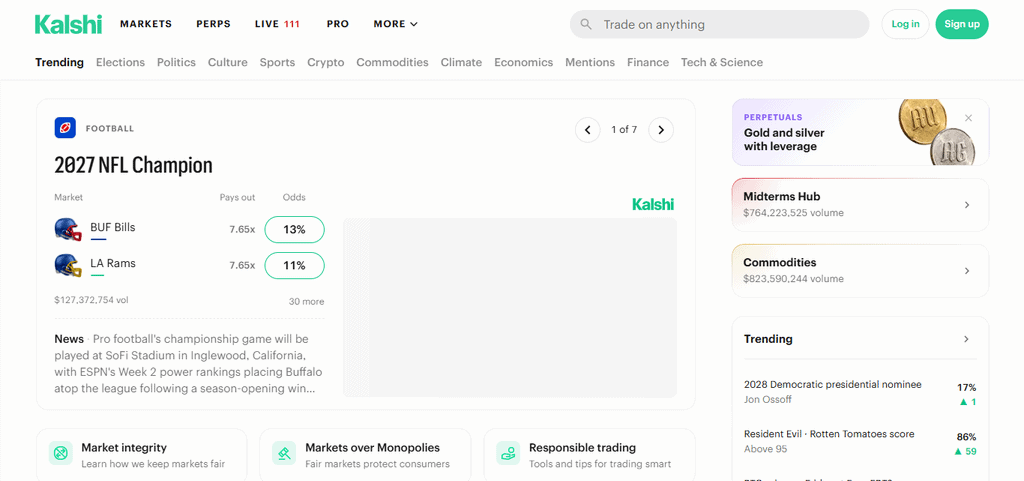
Event contracts offered by Kalshi provide regulatory certainty for events with an economic outcome. Kalshi is one of the only compliant exchanges to focus on event contracts for economic and social events.
Kalshi Pros & Cons
| Pros | Cons |
|---|---|
| Regulated event-contract marketplace | Availability depends on jurisdiction |
| Covers politics, economics, and other events | Contract selection can vary |
| Straightforward contract-based trading | Fees can reduce returns |
| Focuses on event outcomes | Regulatory restrictions may apply |
2. PredictIt
PredictIt is a political prediction market which allows customers to trade event contracts based on the outcome of political events. To comply with the CFTC, PredictIt restricts trading to academic customers and limits the dollar value of each trade.

PredictIt offers a web-based interface and focuses on the U.S. political market, including presidential and midterm elections and proposed and enacted legislation. PredictIt retains a loyal customer base and a highly developed market for political event contracts because of the academic exception to CFTC’s no action letters.
PredictIt Pros & Cons
| Pros | Cons |
|---|---|
| Focuses heavily on political markets | Primarily centered on politics |
| Simple prediction-market format | Market availability can be limited |
| Useful for election forecasting | Geographic restrictions may apply |
| Established prediction-market platform | Trading rules can change |
3. Manifold Markets
Manifold markets uses play-money prediction by using a virtual currency (Mana) and operates in 100 countries and regions due to its legal status. Manifold markets focus on community created markets.
Forecasters are free to create markets on various subject matters (ex. Politics, crypto, science, arts and culture, etc.). What distinguishes Manifold from other prediction markets is its “Do It Yourself (DIY)” prediction market creation.
Any forecaster can create a prediction market. Due to the lack of regulations and financial risks, forecasters, analysts and influencers are attracted to the platform. Manifold offers a variety of features and resources for its users.
Manifold Markets Pros & Cons
| Pros | Cons |
|---|---|
| Large variety of community-created markets | Uses play-money rather than traditional cash trading |
| Users can create their own questions | Results depend heavily on community participation |
| Strong social and discussion features | Less suitable for direct financial speculation |
| Supports diverse prediction topics | Market liquidity varies significantly |
4. Robinhood
Robinhood is not a true prediction market, but a legitimate and U.S. based broker-dealer (registered with FINRA and SEC) that allows its customers to trade stocks, options, and crypto.
Obviously Polymarket customers are not actually buying and selling prediction contracts, but for Robinhood customers, they are actually doing just that.

Therefore, in many ways Robinhood is more of a Polymarket alternative than Polymarket itself. This is because a large portion of Polymarket customers and Robinhood customers are speculating the outcome of future events, i.e.
forecasting earnings and macro-economic events. For individuals wanting to speculate on future events through traditional and regulated markets and financial instruments, Robinhood is probably a better alternative than Polymarket.
Robinhood Pros & Cons
| Pros | Cons |
|---|---|
| Familiar interface for existing users | Prediction products may have regional limitations |
| Integrates event contracts with broader trading | Availability depends on regulatory conditions |
| Accessible mobile trading experience | Product selection may change |
| Multiple financial products in one platform | Not exclusively focused on prediction markets |
5. Crypto.com
Crypto.com is a licensed crypto exchange located in the EU and Singapore. While it isn’t a native prediction market, users can participate in speculative events through derivatives and futures.
The platform has a large ecosystem including staking and NFTs. Users of the platform can speculate events through economic activity.
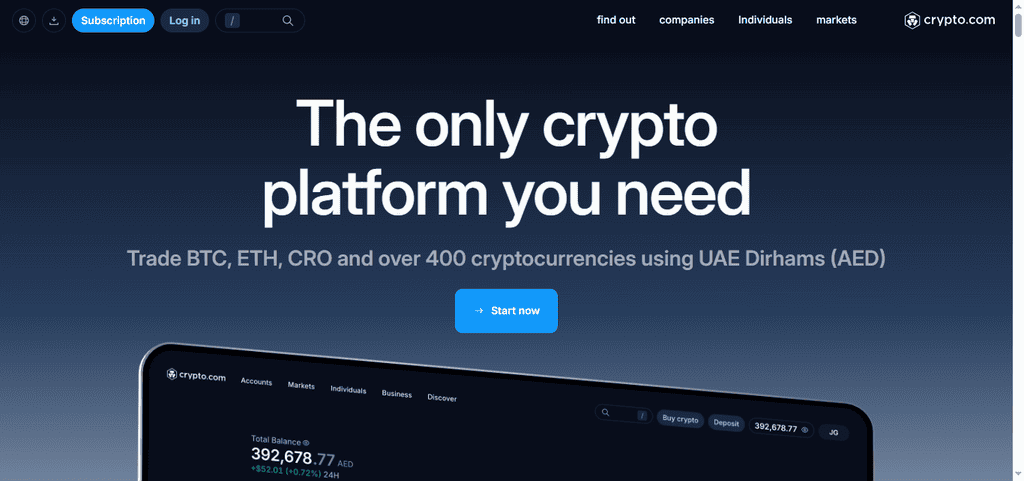
Users of the platform are generally speculators of macro events through cryptocurrencies. Compared to a decentralized prediction market, Crypto.com provides more regulations and a larger selection of cryptocurrencies.
Crypto.com Pros & Cons
| Pros | Cons |
|---|---|
| Established cryptocurrency ecosystem | Availability varies by jurisdiction |
| Broad digital-asset infrastructure | Users may face regulatory restrictions |
| Familiar platform for crypto users | Prediction offerings may be limited |
| Integrates multiple crypto-related services | Product availability can change |
6. Limitless Exchange
Limitless is a decentralized prediction market funded by cryptocurrency. It is a zero-trust platform and Regulation varies by jurisdiction. Limitless focuses on major events such as politics, finance, sports, and other current events.
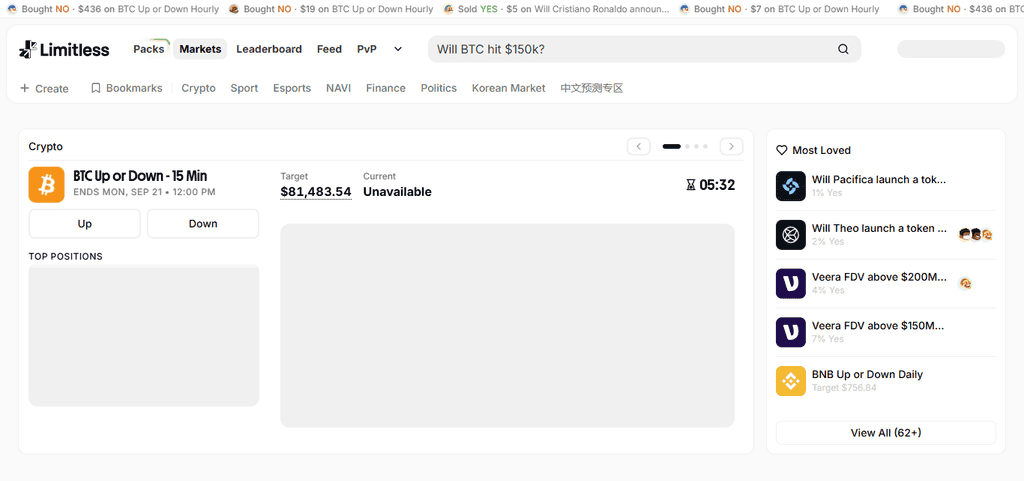
Limitless provides liquidity for most of its markets. Unlike other prediction markets, Limitless offers zero-fee trades. Prediction markets require a central authority to clearn and settle bets. Limitless uses smart contracts to settle bets, providing a faster and more transparent alternative to Polymarket.
Limitless Exchange Pros & Cons
| Pros | Cons |
|---|---|
| Focuses on event-based prediction markets | Market availability can vary |
| Designed around crypto-native users | Requires understanding of digital assets |
| Offers diverse event contracts | Regulatory considerations may apply |
| Supports blockchain-based market participation | Liquidity can differ between markets |
8. Seer
Seer is a prediction market protocol built on Qtum which allows users to create fully on-chain event outcomes. Seer operates in a similar decentralized fashion as other prediction markets, meaning it is permissionless and international.
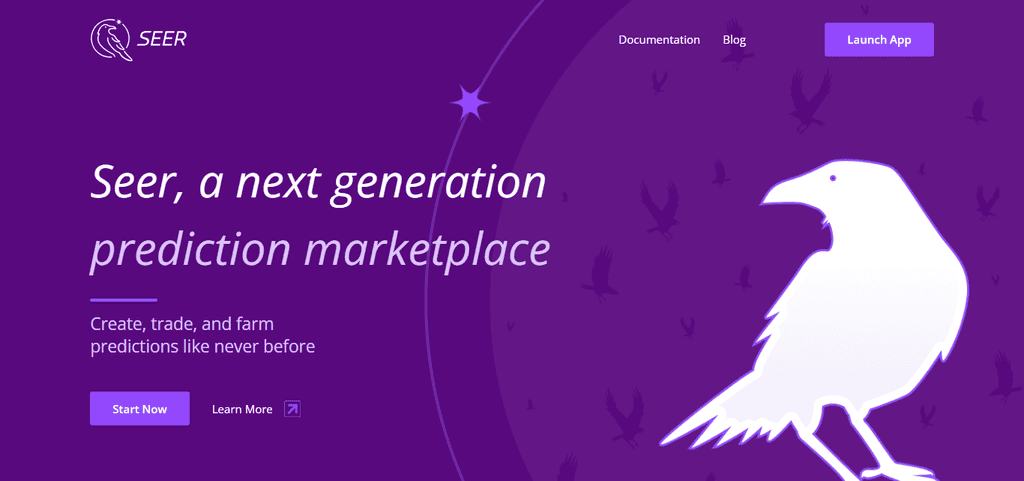
Like other prediction markets, Seer offers users the opportunity to create and trade on outcomes for events in entertainment, politics and sports. Seer’s main point of difference is it’s use of a DAO to allow users to determine how the market functions and to arbitrate outcome disputes.
Seer Pros & Cons
| Pros | Cons |
|---|---|
| Decentralized prediction-market infrastructure | Blockchain knowledge may be required |
| Supports user-created prediction markets | Liquidity depends on participation |
| Community-driven ecosystem | Regulatory treatment can vary |
| Enables decentralized forecasting | User experience may be less familiar |
7. Myriad Markets
Myriad Markets is a prediction platform that is creating a decentralized marketplace for a number of real-world outcomes including sports, finance and other events. Myriad is uniquely positioning itself to offer events at the lowest possible resolution, including events at the player level.
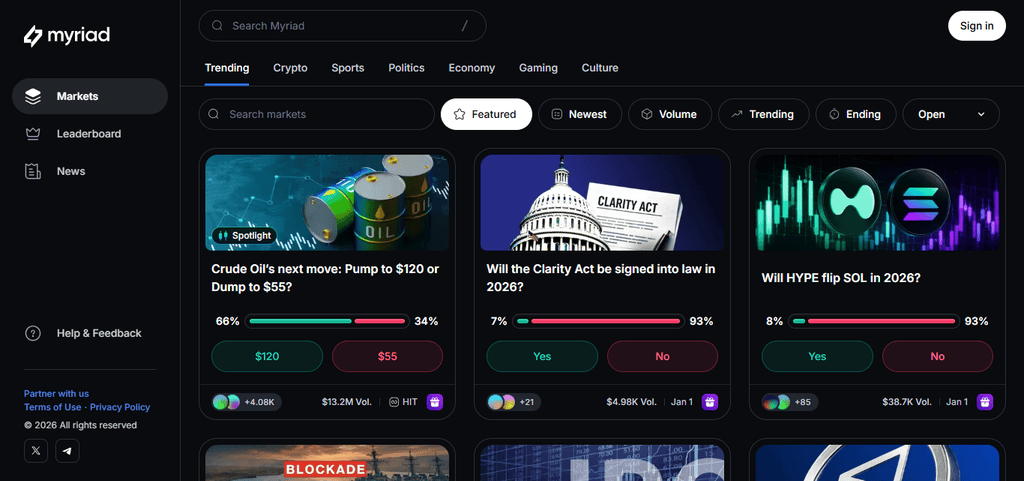
Myriad will support multiple blockchain networks, and provide users the ability to trade on any blockchain network that supports it, thus improving the speed and reducing the costs of trades. Myriad Markets focuses on providing a broad set of markets across geographies and allowing users to settle markets using cryptocurrencies.
Myriad Markets Pros & Cons
| Pros | Cons |
|---|---|
| Provides varied prediction-market opportunities | Platform coverage may be narrower |
| Supports different event categories | Liquidity varies across markets |
| Community-oriented market participation | Availability depends on supported regions |
| Offers an alternative prediction-market structure | Users should review individual market rules |
9. Zeitgeist
Zeitgeist is a protocol that lets users create prediction markets across many different blockchains using Polkadot. This protocol allows for trustless,- crossing, and instant settlement of predictions. This protocol is completely unregulated, meaning, that in theory, any kind of market is allowed to be created on it.
Zeitgeist’s main focus is on markets for events happening in the sports and politics worlds, as well as the crypto market. Zeitgeist also allows its users to experiment with different prediction markets.
One of the coolest features of Zeitgeist is that it implements on-chain dispute resolution. This means that, for example, a prediction market can be created to decide which way a DAO should vote. Users of this protocol are greeted with a lot of freedom and power.
Zeitgeist Pros & Cons
| Pros | Cons |
|---|---|
| Built around decentralized prediction markets | Requires familiarity with blockchain ecosystems |
| Supports diverse prediction questions | Market liquidity can vary |
| Uses Polkadot ecosystem infrastructure | Network-related factors may affect usage |
| Community governance supports participation | Regional access may differ |
10. Novig
Novig is a real-money prediction market, located in the United States. Like Polymarket, Novig is regulated. Unlike Polymarket, and other prediction markets, Novig does not operate like a sportsbook.
This means that instead of Novig taking one side of the bet and setting the line, a peer-to-peer market will be created. This creates an edge for the users of the market, and reduces the fees charged by Novig. Novig, at the moment, only supports prediction markets for sports events.
Novig Pros & Cons
| Pros | Cons |
|---|---|
| Focuses strongly on sports prediction markets | Primarily sports-oriented |
| Designed for event-based sports trading | Market coverage varies |
| Provides an alternative to traditional sportsbooks | Availability depends on jurisdiction |
| Offers prediction-style sports contracts | Users should understand contract settlement rules |
Conclusion
In this Conclusion: As for the best alternatives, top options forevent prediction markets, trading, and communities are plentiful. Including options like Kalshi, PredictIt, Manifold Markets, and Robinhood.
Look at all available market offerings and see which one has the best accessibility, features, and structure for you. Also look into fees, regulations and see which one has the liquidity and order books most aligned with your interests.
FAQ
What are Polymarket alternatives?
Platforms offering event-based prediction markets beyond Polymarket.
Which platforms compete with Polymarket?
Kalshi, PredictIt, Manifold Markets, and others provide alternatives.
Is Kalshi similar to Polymarket?
Kalshi offers event contracts covering politics, economics, sports, and events.
What is PredictIt used for?
PredictIt primarily focuses on political and election-related prediction markets.
Is Manifold Markets free to use?
Manifold primarily uses play-money for community-driven prediction markets.
