

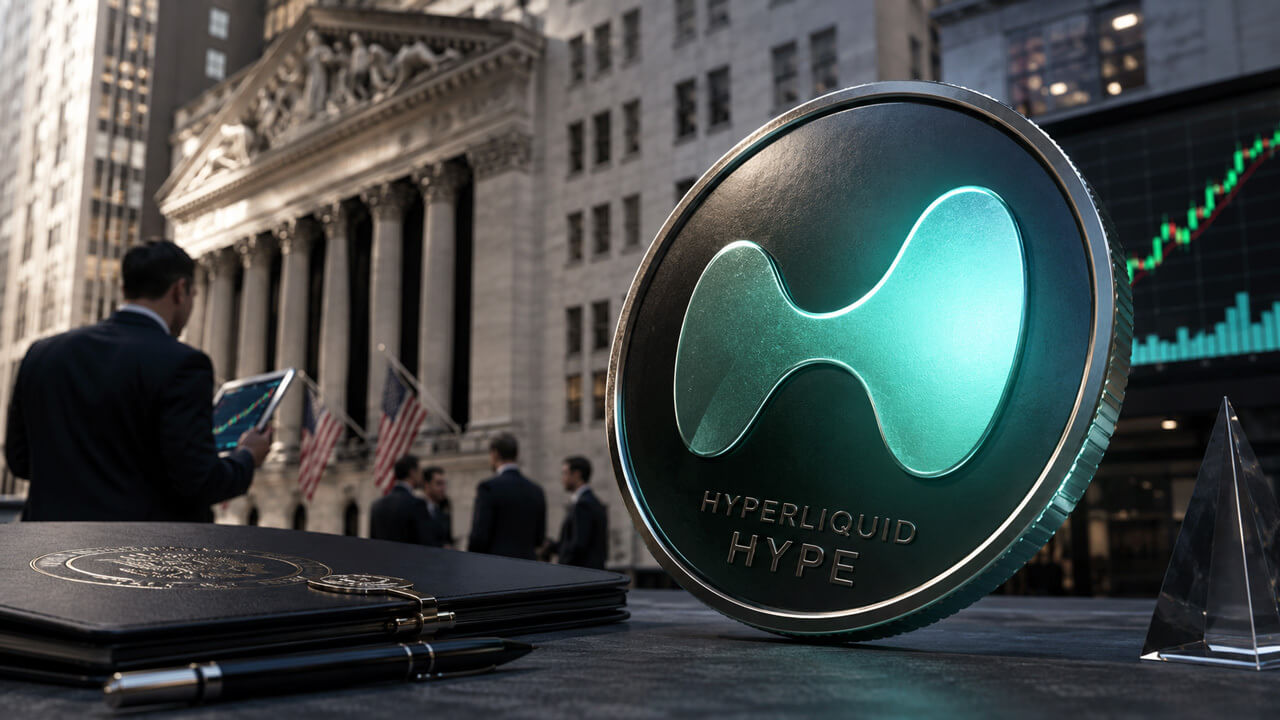
This article covers Hyperliquid’s Rise as an innovative DeFi derivatives protocol that has revolutionized on-chain trading. High-speed Layer 1 blockchain, HYPE buyback protocol, and rapidly expanding institutional custody of Rise, have placed Hyperliquid at the center of the market for perpetual futures. This is an example of infrastructure that is fast, liquid, and transparent, challenging centralized exchanges.
What Is Hyperliquid?
Hyperliquid developed the first of its kind decentralized exchange (DEX) for trading futures perpetuals on chain. Most DeFi Protocols are built on top of Ethereum or Layer 2s, which results in slow and costly transactions. Hyperliquid built a Layer 1 to offer its users fast transactions in as low as 0.07 seconds with the ability to execute more than 100,000 transactions per second.
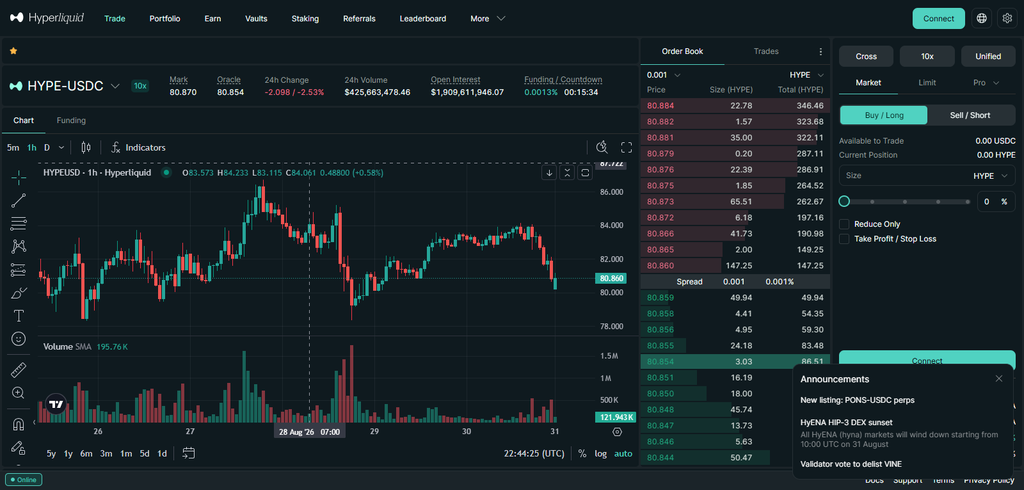
Hyperliquid’s trading system uses a CLOB (Central Limit Order Book) and offers traders direct on-chain settlement for better transparency and auditability. Unlike other centralized crypto exchanges, traders connect their custodial wallets to the platform, eliminating the need for users to deposit funds. HYPE, the platform’s utility token, supports the staking, governance, and security of the network.
The HLP Vault is Hyperliquid’s liquidity pool which performs market making and provides fee benefits, but has exposure to market direction. Hyperliquid launched to the public in 2023 and rapidly scaled to be one of the largest DEXs for Perpetual Futures in DeFi. The platform offers speed, deep liquidity, and community-focused token distribution, which has disrupted the DeFi derivatives sector.
What Are DeFi Derivatives?
DeFi derivatives used to replicate perpetual futures, options, and synthetic assets. Like most things in DeFi, they are built on top of smart contracts. This automates all trade execution, clearing, and delivery. Brokers, and centralized exchanges, aren’t needed. A big part of the derivatives DeFi has built is perpetual futures.
These futures provide continuous exposure and do not have a fixed expiration. Generally, options provide a user the right to buy or sell an asset at a certain price. Finally, synthetics are built to mirror some real-world asset, such as gold or stocks.
DeFi derivatives settled on-chain and are available all the time, unlike traditional finance. They have an added risk of security vulnerabilities in the smart contracts. Nevertheless, DeFi derivatives will mature the market and grow the interest of decentralized entities.
Who Is Hyperliquid Best For?
Who Hyperliquid Is Best For
- Active derivatives traders: Speed and performance make Hyperliquid stand out for traders taking multiple positions at once, scalpers, or momentum traders.
- DeFi-native users: Traders who want to retain self custody and transact on-chain while still having CEX performance.
- Scalpers and momentum traders: An order book on-chain that is performant with competitive spreads makes Hyperliquid an option.
- Migrants from CEXs: Users who are leaving Bybit or Binance perpetuals have tools similar to limit orders, stop orders, and reduce only orders but have moved custody of their assets to themselves.
- Institutional style traders: Traders looking for cross margin trading and deep liquidity for BTC, ETH, SOL, and other major perpetuals.
Who Hyperliquid Is Not Best For
- Beginners with little knowledge on derivatives trading.
- Casual investors who prefer simple buy and hold or spot markets.
- Users who need direct fiat on-ramps – Hyperliquid does not allow direct fiat deposits.
- Those in search of maximal decentralization – concentration among validators is still a major concern.
How Hyperliquid’s Perpetual Trading Works
On-chain Order Book
Hyperliquid builds a Central Limit Order Book (CLOB) like a centralized exchange, but records orders and executes trades on its own Layer 1 blockchain.
Ultra-fast Execution
Block time on Hyperliquid is on average 0.07 seconds and with a block processing speed that can handle 100,000 orders per second, trades execute almost instantaneously.
Perpetual Futures
Traders can hold positions open indefinitely with no expiration, as long as the position is sufficiently funded.
Funding Mechanism
Funding rates drive price convergence of perpetual contracts with the underlying asset, making it cost neutral to both long and short markets.
Cross-margin System
Increases capital efficiency and decreases liquidation risk as collateral is pooled and can be used across multiple trading positions.
Self-custody Wallets
Users execute trades directly from their own custodied wallets, eliminating the need for funds to be sent to a centralized wallet.
Liquidity Vault (HLP)
The HLP pool provides market making liquidity, and in return market makers are exposed to the market risk, but are compensated for their efforts.
Governance Token (HYPE)
Staking HYPE allows a user to secure the network and provides the user with governance rights and upgradability of the protocol.
Why Hyperliquid Has Grown So Quickly
Aggressive HYPE buybacks
Almost 100% of trading fees go to the Assistance Fund, which uses the funds to buy back HYPE tokens. This causes constant demand while lowering supply, which increases the price.
Huge trading revenue
Hyperliquid had more than $1.16 billion in cumulative revenue by May 2026 and buybacks were greater than $300M per quarter. This is the largest scale of revenue recycling in DeFi.
Market control
Hyperliquid has more than 54% of the on-chain perpetual futures market and is processing trillions of dollars of trading volume and competing against centralized behemoths such as Binance and Bybit.
Fast Layer 1 blockchain
With the use of HyperBFT consensus, it has near instantaneous finality and can process up to 200,000 orders per second. This offers speed similar to centralized exchanges while retaining the transparency of DeFi.
Hyperliquid vs. Centralized Derivatives Exchanges
| Feature | Hyperliquid | Centralized Exchanges |
|---|---|---|
| Custody | Self‑custody wallets — users trade directly from wallets | Funds held by the exchange, requiring deposits |
| Speed | Ultra‑fast Layer 1 with ~0.07s block times | High speed but dependent on centralized servers |
| Transparency | On‑chain order book, every trade recorded publicly | Limited transparency, internal matching engine |
| Access | Global, no KYC required | Often requires KYC/AML compliance |
| Products | Focused on perpetual futures | Wide range: spot, futures, options, margin |
| Liquidity | Deep liquidity via HLP vault and active traders | Liquidity concentrated in exchange pools |
| Revenue Model | Fees recycled into HYPE buybacks | Exchange profits retained by company |
| Governance | Community‑driven via HYPE token | Centralized corporate governance |
| Risks | Smart contract bugs, validator concentration | Custodial risk, regulatory crackdowns, hacks |
Hyperliquid’s Trading Infrastructure
Hyperliquid builds on the model of centralized exchanges, but uses a CLOB and settles all orders on-chain. Hyperliquid’s consensus protocol, HyperBFT, achieves sub-second block times of ~0.07s and can handle 100,000 orders per second, effectively enabling execution of orders in milliseconds.
It is equipped with cross-margin trading, where the user can share capital from different positions. HLP vaults provide market making liquidity and receive trading fees. Users transact with the exchange via self-custody wallets to eliminate counterparty risk.
The exchange through HYPE governance and staking, builds its treasury and underwriter protection system. Hyperliquid combines the speed of centralized exchanges with full transparency of decentralized finance (DeFi).
Understanding HYPE and the Hyperliquid Ecosystem
The HYPE token is specific to Hyperliquid. Almost all trading fees are automatically used to buy back HYPE. This creates a constant demand for tokens and makes the circulating supply decrease. Holders can stake HYPE to secure the network and help make decisions about upgrades to the service.
Governance deals with the direction the protocol can take. The HLP vault is another feature of the ecosystem. This is a liquidity pool that provides an additional way to market make (remove directional risk), and distributes trading fees to participants. Combined with the features of HYPE and HLP, there is a self-activity generating ecosystem.
Trading fees result in HYPE buybacks which increase the value of HYPE. This creates more incentive for both liquidity and trading. The combination of Hyperliquid’s High Speed Layer 1 and this feedback cycle makes the ecosystem one of the best in Decentralized Finance (DeFi) Derivatives.
Hyperliquid’s Revenue & Trading Activity
| Metric | Hyperliquid | Details |
|---|---|---|
| Annualized Fees | $945M – $1.26B | Value accrued to ecosystem in FY 2026, fueling HYPE buybacks |
| Cumulative Perp Volume | $4.40T+ | Total historical trading volume across perpetual futures |
| 30‑Day Perp Volume | $172.63B | Leading DEX with ~31.9% market share of global perp trading |
| Open Interest | $9.13B | Live derivative exposure, up 580% YTD in 2026 |
| Weekly Volume | $47.54B | Reflects deep liquidity and active trader participation |
| Daily Trading Volume | Billions USD | Consistently high throughput, supporting perpetual futures and RWAs |
| HYPE Market Cap | $10.66B | Token value supported by buybacks and staking |
| Quarterly Buybacks | $300M+ | Programmatic buybacks drive token appreciation and ecosystem growth |
Key Risks of Trading Hyperliquid Derivatives
Smart contract risks: Like any DeFi protocol, there is a risk of smart contract bugs and loss of funds.
Validator centralization: With the current model, there are concerns of how centralized consensus may be and how resistant to censorship the network is with such a low number of validators.
Liquidity risks: Although Hyperliquid has liquidity, market shocks or suddenly low/no participation in the HLP Vault can negatively affect trade execution.
Funding rate volatility: Perpetual futures rely on funding payments and very quick changes in the market can bring losses or increase funding costs.
Leverage risk: High leverage risks liquidation, but also offers greater potential returns.
Regulatory risk: Regulatory frameworks are still developing for DeFi derivatives, and current uncertainties create risk of operations and compliance.
Token risks: Hyperliquid’s growth is heavily dependent on HYPE buybacks. Decreased trading volume can decrease token demand and incentive for the ecosystem.
Oracle risks: Manipulation or failure of price feeds for perpetual contracts can lead to mispricing and liquidation.
Hyperliquid’s Biggest Challenges in 2026
Validator centralization
A number of validators that is so small that there is a fear of losing censorship resistance and of not being able to fully achieve long-term decentralization.
Regulatory uncertainty
There is increasing optimism in the US, but DeFi derivatives are still under scrutiny, and compliance frameworks are developing.
Revenue dependency
Hyperliquid is growing largely due to trading fees on perpetual futures; if the trading volume decreases, this could negatively affect HYPE buybacks and ecosystem incentives.
Liquidity concentration
The HLP vault is the liquidity provider, although using a single liquidity pool exposes traders to directional risk and liquidity fragmentation.
Competition from CEXs
Over-the-counter derivatives exchanges are dominating the market, and including Centralized Exchanges (CEXs) like Binance and Bybit will make it even more difficult for Hyperliquid to grow.
Smart contract risks
DeFi protocols have a risk of smart contract code that can be exploited and lead to the loss of assets.
Market volatility
Unstable crypto markets can lead to cascading liquidations and depleted liquidity.
Token dependency
The value of the token will decrease if token demand decreases or if regulations are implemented that restrict token value.
Hyperliquid vs. Other DeFi Derivatives Platforms
| Feature | Hyperliquid | dYdX | GMX | Perpetual Protocol |
|---|---|---|---|---|
| Infrastructure | Custom Layer 1 blockchain with HyperBFT consensus | Layer 2 (Cosmos chain migration) | Arbitrum & Avalanche | Ethereum & Optimism |
| Execution Model | On‑chain CLOB | Off‑chain order book, on‑chain settlement | AMM model | Virtual AMM (vAMM) |
| Speed | ~0.07s block times, 100k+ orders/sec | Fast, but limited by L2 throughput | AMM execution, slower in high volatility | Optimism scaling, moderate speed |
| Liquidity Source | HLP vault (market making pool) | Professional market makers | GLP liquidity pool | Liquidity providers in vAMM |
| Products | Perpetual futures only | Perpetual futures | Perpetual futures | Perpetual futures |
| Custody | Self‑custody wallets | Self‑custody | Self‑custody | Self‑custody |
| Revenue Model | Fees recycled into HYPE buybacks | Fees shared with stakers | Fees shared with GLP holders | Fees shared with stakers |
| Governance Token | HYPE | DYDX | GMX | PERP |
| Strengths | CEX‑like speed + DeFi transparency | Large liquidity, institutional adoption | Simple UX, strong retail base | Innovative vAMM design |
| Weaknesses | Validator centralization risk | Regulatory exposure in US | Slippage in AMM model | Liquidity fragmentation |
The Future of DeFi Derivatives
Institutions, regulatory certainty and more advanced technology will move DeFi derivatives closer to the mainstream financial system. Hyperliquid and similar platforms draw even retail traders because they provide CEX-like speed with DeFi’s transparency.
Institutional investors are now putting capital into DeFi to trade perpetual futures as legal frameworks for compliant participation in Asia and Europe emerge. Improved Layer-1 networks speed and efficiency make DeFi derivatives competitive with centralized platforms. Further, technologically advanced portfolio margin and cross-asset collateral systems will allow DeFi derivatives to reach par with centralized trading.
The future will open new avenues in DeFi such as trading tokenized real-world assets and prediction markets. Validator centralization and regional regulatory variations will continue to affect DeFi derivatives in the near future. However, DeFi derivatives will develop from experimental niche protocols to a developed, global, professional trading system.
What’s Next for Hyperliquid in 2026 and Beyond?
Expansion Beyond Crypto Derivatives: Hyperliquid’s plans to include other markets such as stocks and commodities and provide more on-chain financial market infrastructure.
Growth of Permissionless Markets: Frameworks such as HIP-3 have the potential to allow more on-chain trading opportunities and can permit the inclusion of more markets and assets.
Prediction Markets and New Financial Products: Broader product range through the inclusion of outcome and prediction markets (through HIP-4) to attract users and engage them beyond traditional derivatives.
HyperEVM Ecosystem Expansion: Hyperliquid’s talented developers have built a powerful EVM environment resulting in a designated space for the lending, trading, asset issuance, and a range of DeFi applications.
More Institutional Adoption: Maintaining a reputation for high execution speeds and liquidity will attract a new professional and institutional customer segment to Hyperliquid’s on-chain trading infrastructure.
Increased Utility of HYPE: HYPE has a range of use including staking, governance, gas fee offsets, trading and asset deployment. As the ecosystem expands, the utility of HYPE will grow.
Focus on Scalability and Performance: Hyperliquid describes its platform as supporting up to 200,000 orders per second. (hyperliquid.xyz) Dramatically higher trading activity, and the addition of more applications will put Hyperliquid’s performance to the test.
Greater Competition: More centralized exchanges and DeFi derivatives networks will create steeper competition for Hyperliquid. They will need to retain all market participants to survive the new on-chain trading environment.
Growth Could Be Constrained Faced With Regulatory Challenges: Complexities that will arise for decentralized platforms moving closer to traditional financial products may include higher regulatory burden for equities, commodities, foreign exchange, and prediction markets.
A Bigger Goal – Building On-Chain Financial Infrastructure: Beyond perpetual futures, opportunities are even bigger. Hyperliquid is building its L1 and HyperEVM so that users can trade, borrow, lend, issue, and move more financial assets on-chain.
Expert View: Is Hyperliquid Changing DeFi Derivatives?
Hyperliquid is changing DeFi derivatives due to its combination of self-custody and blockchain transparency with a familiar centralized exchange trading experience.
Most automated market maker (AMM) based derivatives protocols prioritize self-custody and transparency while reducing the trading experience. Hyperliquid allows traders to leverage on-chain order execution. Controlling orders, trade execution, funding, and liquidations get done on-chain. Traders can self-custody their orders and be transparent about their books.
Professional derivatives trading with a high degree of custody can be scaled without relying on centralized intermediaries, which suggests there is growing on-chain open interest of perpetual swaps .
However, the risks of trading derivatives such as price speculation, liquidations, liquidity shocks, uncertain regulation, oracle-based pricing, and market volatility remain. Rather than competitive displacement, the innovation may be more architectural as Hyperliquid demonstrates a faster order book for derivatives settlements with DeFi.
Pros & Cons
| Pros | Cons |
|---|---|
| Fully on-chain order book: Orders, trades, liquidations, and funding payments are recorded on-chain, improving transparency. | High leverage risk: Perpetual derivatives can produce large losses quickly, especially when positions are highly leveraged. |
| Fast execution: Hyperliquid is designed for high-throughput trading with sub-second finality. | Liquidation risk: Rapid market movements can trigger forced liquidations before traders can adjust positions. |
| Self-custody: Users can trade without placing funds in a traditional centralized exchange omnibus account. | Oracle dependency: Oracle problems or manipulation could affect mark prices and liquidation calculations. |
| Professional-style trading: Its central limit order book provides an experience closer to traditional exchanges than many AMM-based DeFi platforms. | Smart-contract and infrastructure risk: Bugs in bridges, contracts, or the underlying L1 could potentially result in losses or downtime. |
| 24/7 derivatives access: Traders can access perpetual markets continuously without traditional market-hour restrictions. | Liquidity risk: Less-liquid markets can experience wider spreads and greater slippage, particularly during volatile conditions. |
| No expiration on perpetuals: Traders do not need to roll contracts because perpetual futures have no fixed expiry date. | Funding costs: Positions can incur recurring funding payments, which may become expensive when held for long periods. |
| Growing DeFi ecosystem: Hyperliquid combines its trading infrastructure with a broader blockchain ecosystem, creating opportunities for additional financial applications. | Regulatory uncertainty: Decentralized derivatives remain subject to evolving regulatory frameworks across different jurisdictions. |
| Transparent market data: On-chain activity allows researchers and traders to analyze trading and market behavior directly from blockchain data. | Complex for beginners: Understanding margin, funding rates, liquidation prices, and order-book mechanics can be difficult for inexperienced traders. |
Final Verdict
Hyperliquid has made DeFi derivatives a new frontier by combining the best features of both centralized and decentralized finance. Centralized exchanges have speed and liquidity, while DeFi offers transparency and self custody.
Hyperliquid has the potential to be the top choice for on-chain perpetual futures trading because of its unique HYPE contract buyback model and advanced Layer 1 architecture, as well as its increasing institutional client base.
There are serious issues of validator centralization, unclear regulations, and market liquidity that must also be considered. With the rapid integration of DeFi derivatives into the financial market, Hyperliquid illustrates the advantages and challenges of DeFi in offering competition to traditional finance.
FAQ
What is Hyperliquid?
A Layer 1 blockchain‑based decentralized exchange (DEX) focused on perpetual futures, offering CEX‑like speed with DeFi transparency.
How does Hyperliquid’s trading work?
It uses an on‑chain Central Limit Order Book (CLOB), ultra‑fast execution (~0.07s block times), and perpetual futures with funding rates.
What is the HYPE token?
Hyperliquid’s native token, used for governance, staking, and supported by continuous buybacks funded by trading fees.
What is the HLP vault?
A liquidity pool that supports market making and distributes fees to participants, though it carries directional risk.