


Here in this article, I will discuss on Decentralized Compute Marketplaces for Training Private AI Models — The Best. Read on for a deeper understanding of how these platforms offer distributed GPU power ideal for AI training, streamlining infrastructure costs
While also enhancing scalability and privacy. I will discuss the leading marketplaces that are paving the future of decentralized AI computing and model creation.
Key Points & Best Decentralized Compute Marketplaces for Training Private AI Models
Render Network Provides decentralized GPU rendering and AI training, leveraging idle GPUs globally for scalable, affordable compute.
io.net Offers distributed GPU clusters optimized for AI workloads, ensuring privacy, scalability, and reduced infrastructure costs.
Akash Network Decentralized cloud marketplace enabling AI training with flexible pricing, strong privacy, and open-source infrastructure.
ReGraph Marketplace delivering AI compute at 80% lower cost, with continuous model updates and reliability.
TuneGrid Blockchain-powered GPU sharing platform, lowering AI training costs by 70% while monetizing idle hardware.
Golem Network Peer-to-peer compute marketplace allowing distributed AI training tasks, emphasizing openness, affordability, and developer accessibility.
DeepBrain Chain Blockchain-based AI compute platform offering secure, low-cost GPU resources for private model training globally.
Bittensor Decentralized AI network incentivizing compute contributions, enabling collaborative model training with tokenized rewards system.
Cudos Network Provides decentralized cloud compute for AI workloads, integrating blockchain transparency with scalable GPU resources.
Phala Network Confidential cloud marketplace using trusted execution environments, ensuring privacy-preserving AI model training at scale.
10 Best Decentralized Compute Marketplaces for Training Private AI Models
1. Render Network
Its decentralized GPU rendering & compute network lets users access idle GPU power all over the world. Initially and primarily designed for 3D rendering and visual effects, it has branched out into the AI workloads and model training.
It matches GPU providers with developers who want high-performance compute at a lower price than they might pay to traditional cloud vendors. Its peer-to-peer architecture supports scalability and makes it efficient enough for private AI training jobs.
But it is still better tuned for graphics workloads than large-scale AI training. Render is gradually embedding these AI tools with the aim of being a hybrid site for both creative expertise and machine learning.
| Pros | Cons |
|---|---|
| Global distributed GPU network reduces cost of compute | Originally optimized for 3D rendering, not AI-first |
| High scalability due to peer-to-peer architecture | Limited support for large-scale deep learning workflows |
| Expanding AI tooling and integrations | Performance consistency can vary across nodes |
| Good for hybrid workloads (AI + graphics) | Less control compared to dedicated AI cloud platforms |
| Strong existing ecosystem and adoption | Still evolving AI-specific infrastructure |
2. io.net
io. net — a decentralized GPU aggregation network optimized for AI and ML workloads. It pulls GPU ready resources from data centers to crypto mining farms into a single compute layer.
On-demand GPU clusters for training large AI models more flexibly and cheaply than centralised clouds developers. Its infrastructure is designed for distributed ML training, inference, and scaling workloads.
As a result, io. net eliminates bloat with data; it bills itself as being less dependent on AWS-style middleware providers. It also stresses matched performance, GPU verification and workload optimisation which makes it one of the most powerful AI focus decentralized compute networks.
| Pros | Cons |
|---|---|
| AI-native decentralized GPU aggregation network | Relatively new, still proving long-term stability |
| Strong optimization for ML training workloads | Dependent on external GPU supply sources |
| Access to large-scale GPU clusters on demand | Network complexity can increase setup difficulty |
| Lower cost than centralized cloud providers | Performance variation across distributed nodes |
| Built specifically for AI scalability | Still developing enterprise-grade maturity |
3. Akash Network
A global cloud computing marketplace, Akash Network enables anyone to rent and lease compute resources in a decentralized manner using a blockchain-based reverse auction process.
It is flexible enough to support AI model training, web hosting, and data processing, and the last two are reliant on CPUs, GPUs, and storage. These workloads need not depend on any centralized cloud provider, so developers can deploy directly as a containerized workload.
Its primary benefit is cost-effectiveness and universal access to dormant hardware. Akash can be a particularly good fit for private AI training, as users are able to dynamically spin up resources but still retain governance over their environments. I guess this is the most powerful general-purpose decentralized cloud for AI infrastructure.
| Pros | Cons |
|---|---|
| Highly flexible decentralized cloud marketplace | Not exclusively optimized for AI workloads |
| Supports GPU, CPU, and storage resources | Requires technical knowledge for deployment |
| Cost-efficient reverse auction pricing model | Performance depends on available providers |
| Strong container-based deployment system | Limited built-in AI training optimization tools |
| Good scalability for private AI environments | Can be less predictable than centralized clouds |
4. ReGraph
ReGraph — an early stage idea around decentralized compute, which prioritizes a truly distributed and graph-based approach to computation on AI workloads. The initiative wants to optimize the training of AI models by subdividing complex tasks into graph-structured compute components that can be executed across distributed nodes.
This offers better parallelization of training pipelines and enables improved resource utilization. Not yet as mature as larger chordal networks, ReGraph targets AI researchers requiring modular compute environments and privacy.
Its structure is designed to enable collaborative AI training while allowing data ownership. If fully realized it serves as an additional layer specialized in optimizing the computation workflows of decentralized AI.
| Pros | Cons |
|---|---|
| Designed for graph-based distributed AI computation | Still in early or conceptual stage |
| Improves parallel processing efficiency | Limited real-world adoption |
| Supports modular AI training pipelines | Infrastructure maturity is unclear |
| Focus on optimization of complex workloads | Lack of standardized tooling |
| Strong theoretical scalability potential | Not yet widely tested at scale |
5. TuneGrid
TuneGrid — a decentralized compute marketplace for fine-tuning and training AI models on large distributed GPU networks. Its mission is to create scalable infrastructure and tools for developers to build large language models and custom AI applications.
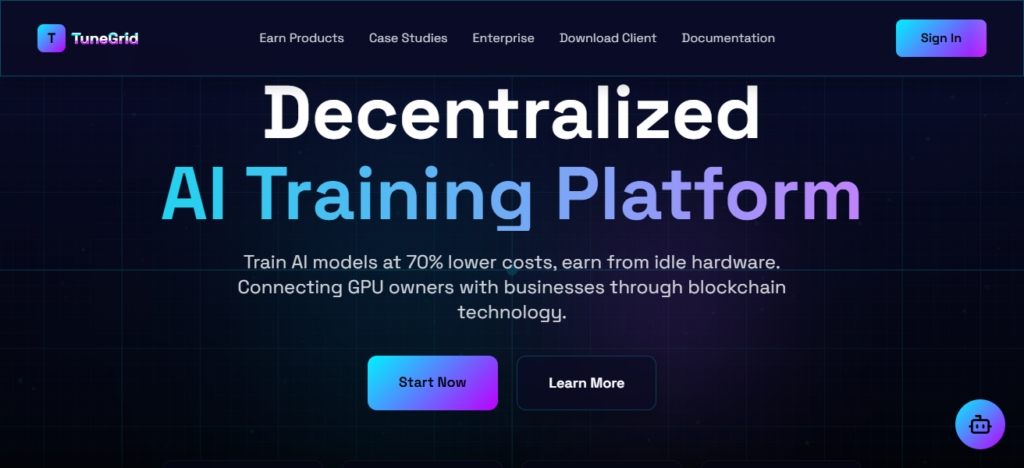
The platform allows users to connect with clustered GPUs for cost-effective computation while securing privacy and ownership of their datasets. A final mention goes to TuneGrid, which focuses on allowing efficient model tuning workflows and is well-suited as an environment for iteration for startups and researchers.
This alleviates reliance on central cloud APIs with an ability to distribute workload flexible. It’s still early days yet — also a bit niche from the looks of it — but TuneGrid aims to make AI training pipelines in decentralized environments easier while drastically reducing compute costs.
| Pros | Cons |
|---|---|
| Optimized for AI fine-tuning workflows | Smaller ecosystem compared to major platforms |
| Affordable distributed GPU access | Limited global node availability |
| Good for iterative model training | Still gaining enterprise trust |
| Supports privacy-focused AI training | May face performance inconsistency |
| Reduces dependency on centralized APIs | Early-stage platform maturity |
6. Golem Network
Golem Network is one of the first decentralized compute platforms that allows users to rent out idle computer memory and processing for purposes like training an AI, rendering images, or simulating molecules.
The platform is a peer-to-peer marketplace that allows providers to earn tokens by utilizing CPU and GPU resources. Golem’s architecture is conducive to distributed task execution, which can help splitting AI workloads across multiple nodes.

It was initially targeted at general-computing tasks, but is now drifting towards more AI-relevant applications. It benefits from its intermediate maturity and broad adoption in the community but lacks the specialisation for modern large scale deep learning that newer AI native networks have.
| Pros | Cons |
|---|---|
| One of the earliest decentralized compute networks | Not AI-specialized compared to newer platforms |
| Large existing community and ecosystem | Limited GPU-focused optimization |
| Supports wide range of compute tasks | Slower adaptation to modern deep learning needs |
| Strong decentralization and maturity | Performance not always competitive with cloud GPUs |
| Good for distributed task splitting | Less suitable for large-scale LLM training |
7. DeepBrain Chain
DeepBrain Chain – is a blockchain-based artificial intelligence (AI) computing platform that aims to drive down the cost of AI training. It does this by providing secure and privacy-preserving computation for enterprise and researchers over decentralized GPU nodes.
By supporting encrypted AI training, the network highlights data security as sensitive datasets stay private. DeepBrain Chain targets enterprise AI with scalable infrastructure for model training, inference and data processing.
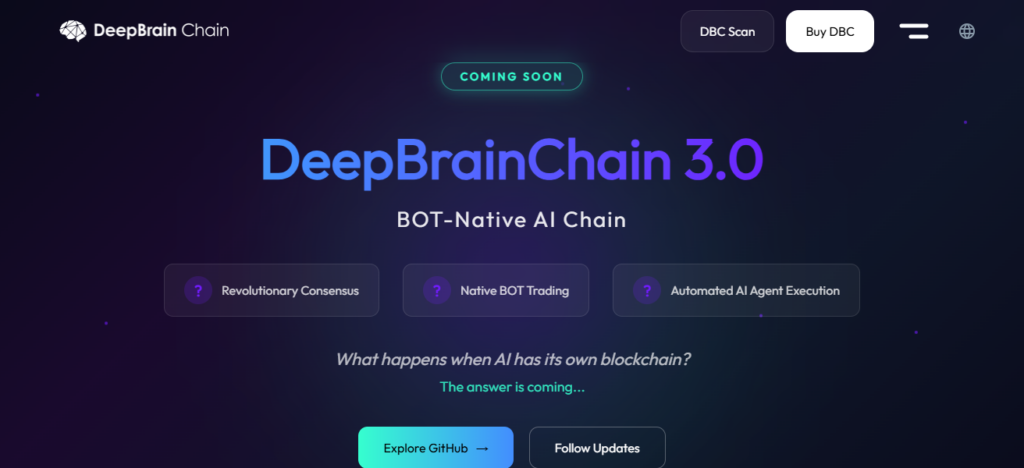
Its token based ecosystem incentivizes GPU providers worldwide. Despite the rise of competitors, it was one of the first projects to offer good solutions for decentralised AI compute with an emphasis on privacy and cost-efficient training of neural networks.
| Pros | Cons |
|---|---|
| Designed specifically for AI compute cost reduction | Network adoption lower than major competitors |
| Strong focus on data privacy and encryption | Infrastructure scalability limitations |
| Incentivized GPU provider ecosystem | Slower innovation compared to newer AI networks |
| Supports enterprise AI training workloads | Hardware quality can vary |
| Early pioneer in decentralized AI computing | Market relevance has declined slightly |
8. Bittensor
Bittensor, a decentralized machine learning network in which AI models are miners in their own blockchain ecosystem. Participants aren’t just renting compute power; they add intelligence and are rewarded according to how useful their model outputs.
This forms a “proof-of-intelligence” layer driving continuous model improvements. This is particularly interesting for distributed AI training, as it introduces the idea of learning together across subnets with differing specializations.
Bittensor is not just compute infrastructure, but an AI market for exchanging intelligence. This decentralized AI model for training and tuning is one of the most sophisticated due to its distinct architecture.
| Pros | Cons |
|---|---|
| Unique “proof-of-intelligence” AI network | Highly complex system architecture |
| Rewards useful AI model outputs directly | Difficult onboarding for beginners |
| Enables collaborative AI model training | Not traditional compute marketplace |
| Strong innovation in decentralized AI learning | Requires advanced understanding of ML systems |
| Encourages continuous model improvement | Ecosystem still evolving and experimental |
9. Cudos Network
Cudos Network Decentralized cloud computing from Cudos delivering performance and scalability for AI training, renders and Enterprise workloads.
This connects blockchain infrastructure to cloud computing and allows users to deploy virtual machines and containerized AI workloads efficiently on the platform.
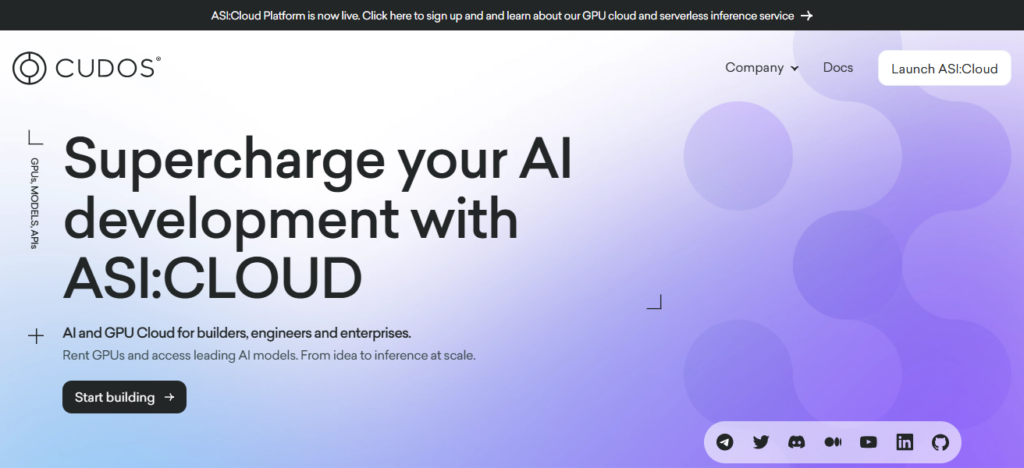
Cudos affordability drives global accessibility, enabling those with underutilized hardware the art of monetization. Its architecture enables interoperability with existing cloud systems, facilitating the migration of AI training workloads by developers.
Cudos is not yet at the cloud scale, but focuses on truly decentralized alternatives to provide affordable machine learning training and high-performance distributed computing in competition with traditional cloud providers.
| Pros | Cons |
|---|---|
| Affordable decentralized cloud infrastructure | Still building strong AI-specific tooling |
| Supports GPU, CPU, and virtual machines | Adoption not as large as competitors |
| Interoperability with traditional cloud systems | Performance varies by node quality |
| Good for scalable AI workloads | Limited enterprise-grade AI optimization |
| Monetizes idle global computing power | Ecosystem still growing |
10. Phala Network
Phala Network is a decentralized, confidential computing platform for privacy-preserving AI computation. It utilizes secure enclaves to keep the data encrypted, even when it is being processed — making it particularly well-suited for training sensitive AI models in this way.
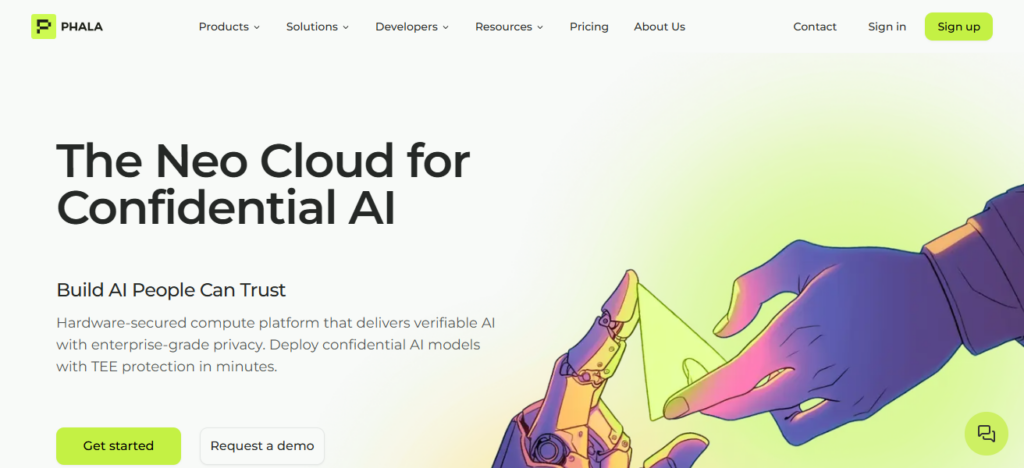
This solves a major privacy issue with the distributed computation model: Developers can run their proprietary AI workloads without revealing raw data to node operators. Phala can run smart contracts and execute off-chain compute, facilitating secure AI inference & training pipelines.
It is especially beneficial for enterprises dealing with sensitive datasets. Phala leverages both blockchain and secure environments to deliver a trusted location for distributed AI compute, privacy-centric ML, and more.
| Pros | Cons |
|---|---|
| Strong privacy via secure enclave technology | Not primarily focused on raw GPU scaling |
| Ideal for confidential AI model training | Performance overhead from encryption |
| Enables encrypted computation | More complex architecture to implement |
| Supports smart contracts + off-chain compute | Limited large-scale training optimization |
| Strong enterprise use-case for sensitive data | Smaller AI compute ecosystem compared to others |
Why use decentralized compute for AI model training?
More Affordable: Access to idle GPUs around the world will make AI model training much cheaper than AWS, Google Cloud or Azure.
Global GPU Availability: Unlike single-provider or region specific services like AWS, access a distributed set of GPUs across providers.
Scale on Demand: Dynamically scale compute power up or down based on the size of the model and training requirements.
More Efficient Use of resources: utilize idle computing power from datacenters, miners, and individuals
Enhanced Privacy: Most platforms have a support for encryption or containerized environments to ensure training data are protected.
Less Vendor Lock-in: Prevent being dependent on one single centralized cloud vendor
Quicker Deployment: Spin up distributed compute clusters for AI training quickly, with no long provisioning lead times.
Flexibility: as it can handle different workloads (LLM training, fine-tuning, inference and research experiments).
Conclusion
The future of private AI model training is being reshaped by decentralized compute marketplaces that provide low-cost, on-demand, privacy-centric access to GPU resources.
Platforms like io. net and Akash Network are taking the lead on this initiative by decentralizing cloud infrastructure. Networks that provide access to these machines will be critical in driving AI demand, and enabling advanced model training on a global scale.
FAQ
Which is the best decentralized compute network for AI training?
Platforms like io.net, Akash Network, and Bittensor are considered strong choices due to their AI-focused infrastructure and scalability.
Is Render Network good for AI workloads?
Yes, but it is primarily designed for rendering. It is expanding into AI, but still not fully optimized for large-scale model training.
Is decentralized compute secure for private AI models?
Yes, many platforms use encryption, secure containers, and blockchain validation to protect data and model privacy.
Can I train large language models on these networks?
Yes, but performance depends on the platform. io.net, Akash, and Bittensor are more suitable for large-scale AI workloads.
