


Best AI Legal Research Tools That Are Replacing Law Library, So Lawyers And Paralegals Can Work Faster And Smarter. This type of technology is utilizing artificial intelligence and tehcnological processes to diminish the need for physical law libraries
Providing lawyers with the ability to expeditiously conduct case research, automate document analysis, and arrive at accurate insights from the insights they extract from their documents almost instantaneously all while allowing them focus on driving efficiencies and productivity in elgal decision making in modern legal practices.
Key Points & Best AI Legal Research Tools That Are Replacing Traditional Law Libraries
| Tool | Explanation (15 words) |
|---|---|
| CoCounsel by Thomson Reuters | AI assistant automates legal research, drafting, and document review with reliable, citation-backed answers for lawyers. |
| Lexis+ AI | Combines legal database with generative AI to deliver summaries, case insights, and faster research workflows. |
| Harvey AI | Built for law firms, uses generative AI to assist contracts, litigation, and complex legal analysis tasks. |
| Westlaw Precision | Provides advanced legal research with AI-driven insights, key numbers, and precise case law recommendations quickly. |
| Everlaw | Cloud-based litigation platform using AI for e-discovery, document analysis, and case preparation efficiently. |
| Spellbook | AI-powered contract drafting tool integrated with Word, suggesting clauses and improving legal document accuracy. |
| vLex Vincent AI | Uses global legal data and AI to deliver intelligent legal research and multilingual case insights. |
| Kira Systems (Litera) | Machine learning software extracts clauses and data from contracts, speeding due diligence and compliance reviews. |
| Clio Duo / Clio Work | Legal practice management tool with AI features streamlining case management, client communication, and workflows efficiently. |
| Luminance | AI-powered document review platform leveraging machine learning to detect anomalies and streamline legal due diligence processes. |
10 Best AI Legal Research Tools That Are Replacing Traditional Law Libraries
1. CoCounsel by Thomson Reuters
With Westlaw than CoCounsel is a very robust and dependable AI legal assistant for research that is tracked by footnotes. Automates tedious, complex legal workflows such as document review, case law analysis, and drafting of legal memos.
Through its “Deep Research” functionality, it can independently plan and conduct all steps of legal research, saving lawyers tremendous amounts of time. It is built for correctness because it has an understanding of the law by leveraging authoritative legal databases.
| Pros | Cons |
|---|---|
| Highly accurate, citation-backed legal research using trusted Westlaw database | Expensive for small firms and individual lawyers |
| Automates complex workflows like document review and legal drafting efficiently | Primarily focused on US legal data and jurisdictions |
| Strong natural language understanding for conversational legal queries | Requires subscription to Thomson Reuters ecosystem |
| Handles multi-step legal research tasks with AI-driven planning | May require verification despite high accuracy |
2. Lexis+ AI
Lexis+ AILexis introduced Lexis+ AI to integrate generative AI with LexisNexis big legal database, which allows lawyers the ability to do research in natural language instead of Boolean search.
It provides accurate case summaries, legal arguments, and insights in a timely manner, which enhances productivity. With drafting, analysis, and legal research all in one platform, everything flows.
They combine the conviction of trusted legal content with AI capabilities to reduce reliance on brick-and-mortar law libraries, shaping traditional research much faster for a contemporary law firm.
| Pros | Cons |
|---|---|
| Extremely accurate search results with real-time citation validation | High pricing makes it less accessible for beginners |
| Massive legal database covering multiple jurisdictions globally | Complex interface for new users |
| Supports drafting, summaries, and predictive legal analytics | Requires training to fully utilize advanced features |
| Natural language queries simplify legal research process | Heavy system requirements in some environments |
3. Harvey AI
Introduction to Harvey As its name suggests, Harvey AI is an Advanced generative AI platform for large law firms & Enterprise legal teams. It can assist with contract drafting, litigation analysis, and regulatory research.
Harvey is popular for its collaborative side, allowing teams to tackle complicated legal issues quickly. It is designed to integrate with massive legal data sets for more accurate and insightful results.

The most obvious example is that Harvey and many others reduce reliance on conducting manual research for knowledge-intensive work, allowing lawyers to be more focused on where their time should be spent, making strategic decisions.
| Pros | Cons |
|---|---|
| Powerful generative AI for drafting, litigation, and legal analysis | Premium pricing targeted at large law firms |
| Enhances team collaboration on complex legal workflows | Limited access for individual practitioners |
| Integrates with enterprise legal systems and datasets | Still evolving compared to traditional platforms |
| Reduces manual workload and boosts productivity significantly | Requires human verification for high-stakes tasks |
4. Westlaw Precision
Westlaw Precision is an innovative legal research tool that combines traditional Westlaw feature sets with enhanced analytics, precision search tools, and artificial intelligence technology designed to improve on-the-ground decision-making.
It enables lawyers to filter results by outcomes, fact patterns, and legal issues and provides relevant case results almost instantly. Functions such as KeyCite and litigation analytics help confirm accuracy and credibility.
Westlaw Precision minimizes the problem of manually searching for case law in physical law libraries by simplifying legal research and offering better context.
| Pros | Cons |
|---|---|
| Industry-leading legal database with highly reliable case law content | Expensive subscription model for full features |
| Advanced filtering and citation tools like KeyCite for accuracy | Can be complex for beginners to navigate |
| AI-driven insights and litigation analytics improve decision-making | Requires training for effective use |
| Trusted by large law firms for high-stakes legal research | Limited flexibility outside Westlaw ecosystem |
5. Everlaw
Everlaw, a litigation and e-discovery document review and case preparation platform using AI There is also an ability to analyze large volumes of data and it allows legal teams to identify relevant documents and patterns quickly.
Everlaw enhances collaboration through real time access and intuitive tools to simplify complex litigation workflows. This makes it suitable for modern legal practice as it automates document-heavy jobs, thereby replacing conventional manual review processes while improving productivity tremendously.
| Pros | Cons |
|---|---|
| Excellent AI-powered e-discovery and document review capabilities | Not primarily focused on legal research tasks |
| Cloud-based platform enables easy collaboration and accessibility | Pricing can be high for smaller teams |
| Handles large datasets efficiently for litigation preparation | Requires training for advanced features |
| Improves case preparation speed and workflow efficiency | Limited use outside litigation-focused scenarios |
6. Spellbook
Spellbook is an AI contract drafting and review tool that takes place directly in Microsoft Word, which makes it quite useful for lawyers. In particular, Spellbook uses machine learning to draft contracts via templates and clauses found in existing documents
The more data you have the better it becomes over time since as we learn in existence-in-practice — practice makes perfect! It helps to draft clauses, review contracts and recommend improvements without ever leaving the real-time data.
Faster Contracts: Lawyers can draft contracts quicker, with added accuracy and compliance. Spellbook embeds AI into workflows that most lawyers are already familiar with, allowing for less reliance on manual drafting and traditional legal research — reshaping contract generation and review in the modern law firm.
| Pros | Cons |
|---|---|
| Seamless integration with Microsoft Word for contract drafting | Focused mainly on contracts, not full legal research |
| AI suggests clauses and improves document accuracy in real-time | Limited litigation or case law research features |
| Saves time in drafting and reviewing legal agreements | Requires subscription for full functionality |
| Uses real-time legal data for better contract insights | May not suit all legal practice areas |
7. vLex Vincent AI
vLex Vincent AI vLex Vincent: a global legal research tool based on the largest database of international legal information, to deliver insights and insights across jurisdictions. With its conversational interface, lawyers can ask detailed legal inquiries and have a structured response.

Its strength lies in comparative law research, allowing users to conduct efficient cross-jurisdictional legal analysis. Vincent AI takes the place of conventional law libraries for international mediation cases, providing multilingual abilities and worldwide coverage.
| Pros | Cons |
|---|---|
| Strong global legal database covering multiple jurisdictions | May be less strong in US-specific research compared to Westlaw |
| Excellent for comparative and international legal research | Pricing can be high for premium features |
| Conversational AI simplifies complex legal queries | Interface may require learning curve |
| Multilingual support enhances global usability | Not as widely adopted as legacy platforms |
8. Kira Systems (Litera)
Kira Systems: A Due Diligence & Contract Analysis Platform Powered by Machine Learning Kira Systems is the leading provider of high-performance contract analysis and due diligence capabilities, using machine learning to speed-up the important functions of reviewing and analyzing contracts.
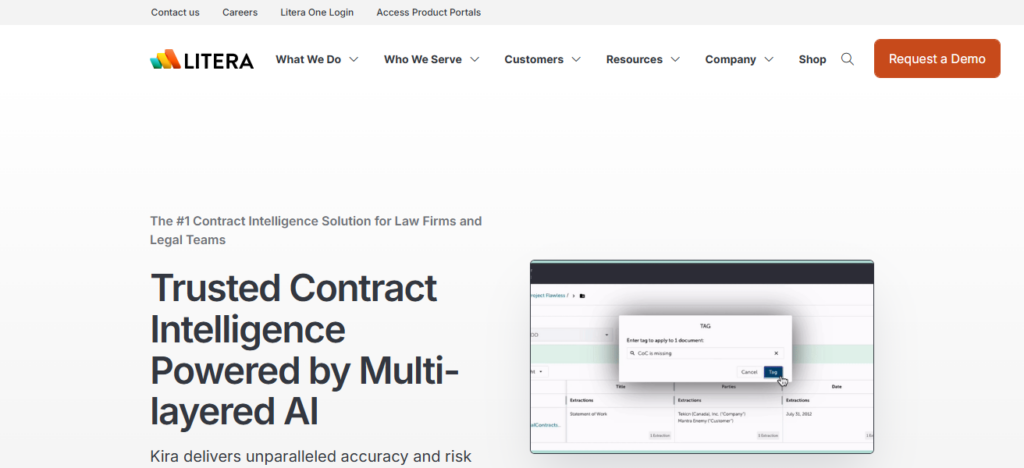
It is capable of automatically identifying essential clauses, risks and structuring legal data over volumes of documents. Kira is a contract analysis software, often used for mergers and acquisitions (M&A), that allows users to quickly identify synergies through reduced time taken in reviewing contracts compared with manual review.
With its remarkable accuracy and speed, it has become a popular replacement for traditional methods of legal document analysis, freeing lawyers to concentrate on strategic decision-making instead of repetitive tasks.
| Pros | Cons |
|---|---|
| Industry-leading contract analysis and clause extraction tool | Focused mainly on due diligence, not full research |
| Highly accurate machine learning for document review | Expensive for smaller firms |
| Saves time in mergers, acquisitions, and compliance reviews | Requires training for optimal use |
| Reduces manual errors in large contract datasets | Limited litigation research capabilities |
9. Clio Duo / Clio Work
Clio provides legal practice management solutions that leverage AI to improve workflows, client communication, and case management. More of an operational tool with some research aspects, it incorporates AI capability to enhance legal operations productivity.

Lawyers can handle their cases, automate admin work and find information from a single source. Clio hopes to assist with the process by digitizing and automating everyday processes, thereby decreasing dependence upon old-world systems and supporting a modern legal practice in the digital age.
| Pros | Cons |
|---|---|
| Comprehensive legal practice management with AI automation | Not a dedicated legal research platform |
| Streamlines case management and client communication | Limited advanced research capabilities |
| Improves workflow efficiency and administrative tasks | Requires integration with other research tools |
| Cloud-based access enhances flexibility and productivity | Subscription costs may add up |
10. Luminance
LuminanceLuminance is an AI platform practice specifically for document review and due diligence in mergers. It leverages proprietary machine learning trained on millions of legal documents to detect risks, anomalies, and other key information.
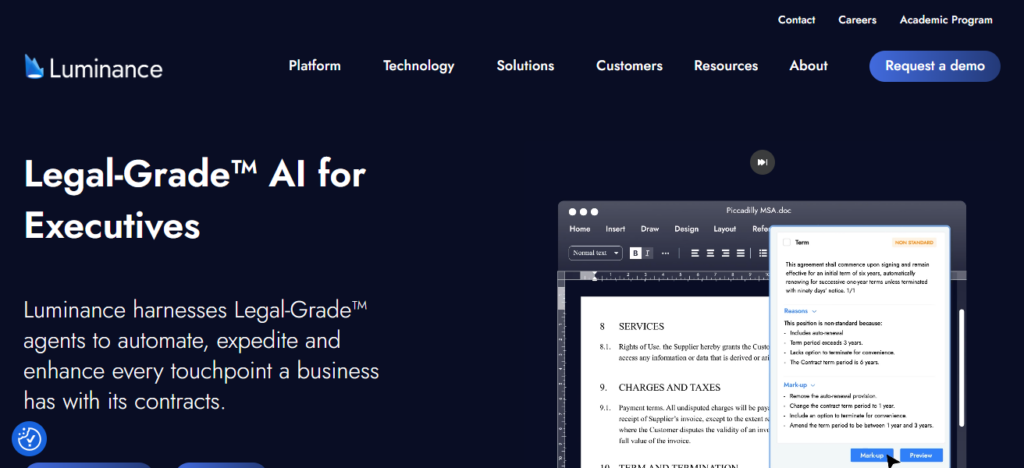
Automation in contract analysis and risk visualization improves efficiency and accuracy. Luminance takes over those lengthy manual reviews, allowing legal teams to quickly process large volumes of data and make informed decisions on complex legal transactions. (viewspectra. com)
| Pros | Cons |
|---|---|
| Advanced AI for document review, due diligence, and risk detection | Focused more on document analysis than research |
| Learns from legal documents using machine learning algorithms | High cost for enterprise-level usage |
| Detects anomalies and risks quickly in large datasets | Requires onboarding and training |
| Ideal for M&A and compliance-heavy legal work | Limited general legal research functionality |
Conclusion
Finally, AI legal research tools are revolutionizing the way lawyers find and interpret information. This way, these tools are replacing old law libraries by automating researches; improving accuracy and ultimately saving time.
As we move deeper into the age of technological advancement, the adoption of AI-powered platforms will be imperative to remain competitive and realize greater productivity through faster, more informed legal decisions in an increasingly digital legal environment.
FAQ
What are AI legal research tools?
They are software platforms that use artificial intelligence to automate legal research and analysis tasks.
How do AI tools replace traditional law libraries?
They provide instant digital access to legal data, eliminating the need for physical books.
Are AI legal research tools accurate?
Yes, most tools use trusted databases and advanced algorithms to deliver highly accurate results.
Do lawyers still need law libraries?
Physical libraries are becoming less necessary due to efficient AI-powered digital alternatives.
