


In this article, the goal is to investigate if the recent Bitcoin surge is genuine, probable, if institutional demand is real, or if temporary demand may be liquidation-related. Using on-chain signals, ETF flows, and macro triggers, we will try to determine if these rallies are sustainable or if the respective peaks on the crypto markets volatility chart will once again be fleeting.
What Is a Short Squeeze in Bitcoin?
A short squeeze in Bitcoin happens when traders who bet against the price (short sellers) are forced to buy back their positions as the price goes up unexpectedly. In the crypto space, this is often the result of a sudden increase in demand or an increase in a bullish trend that pushes the price of the market up.

As Bitcoin prices increase, exchanges begin to issue margin calls or perform liquidations, forcing the short sellers to buy Bitcoin and increasing the price of Bitcoin. Short squeezes gain momentum and have sudden sound and sharp upward price movements that make it look like the price of the market is fundamentally better than it really is.
Bitcoin markets experience short squeezes very intensely because of the high levels of leverage involved. Short squeezes add volatility to the market and cause dramatic price increases. This attracts traders and institutions to the markets.
Is Bitcoin’s Rally Real?

Price Rally
Bitcoin is on track to have its best year ever with a price exceeding $105,000 and an over 150% increase this year, compared to the low returns of other asset classes.
Price Spike
The price increased 23% in 5 days, the largest price movement since the end of 2025. The spike was the result of the buyback of Treasury bonds and a weakening dollar.
Structural Demand
Spot ETFs (Exchange Traded Fund) create demand 12x greater than the daily supply of Bitcoin, resulting in a price increase.
Confidence
Long-term retail investors are confident with an increase of 10% of their investment this year (January 2026).
Structural Factors
There is an increase of institutional participation due to the passing of the CLARITY Act and Trump’s favorable position on cryptocurrency.
Hedge Factors
At an inflation rate of 3.2%, the U.S. dollar is being viewed as a stable hedge of uncertainty by the market, including Bitcoin.
Bitcoin Price Action: Organic Demand or Liquidation-Driven?
Here’s a clear comparison table breaking down whether Bitcoin’s recent rally is driven by organic demand or by liquidation pressure:
| Factor | Organic Demand | Liquidation Driven |
|---|---|---|
| Price Drivers | Institutional inflows via ETFs, long-term holder accumulation, regulatory optimism | Forced buybacks from short sellers, margin calls, leveraged liquidations |
| Market Sentiment | Confidence from long-term investors, hedge against inflation, adoption growth | Panic among shorts, sudden spikes, fear of missing out (FOMO) |
| Sustainability | More durable, supported by structural demand and policy clarity | Short-lived, often followed by sharp corrections |
| Liquidity Impact | Steady absorption of supply, reduced selling pressure | Thin liquidity amplifies volatility, rapid swings |
| Examples | ETF inflows exceeding mining supply, wallets accumulating | 23% surge in 5 days due to Treasury bond buybacks triggering squeezes |
Key Data That Can Confirm a Real Bitcoin Rally
Bitcoin ETF spot inflows: Large persistent inflows into Bitcoin ETFs in excess of daily mining production demonstrate a strong organic institutional buying interest.
Long term holder accumulation: Increasing wallets of Bitcoin held for a period of time greater than one year demonstrate capital allocation beyond short term price movements.
On Chain metrics activity: Passing speculative price spikes, strong fundamentals are evidenced by consistent network usage, demonstrated by elevated transaction volume, active addresses and elevated network fees.
Exchange reserves: Investors withdrawing Bitcoin to cold storage by reducing balances on exchanges indicate a reduction in selling pressure.
Macro correlation: Bitcoin’s ability to decouple from equity markets and strengthen during dollar cost-carry trade is a strong sign in the hedging capability of Bitcoin.
Derivatives data: Low funding rates and low forced liquidations indicate a healthier, less leveraged market.
Positive regulatory developments: The CLARITY Act is a positive development in policy and brings certainty to the industry attracting institutional investment.
The Role of Bitcoin Futures and Leverage
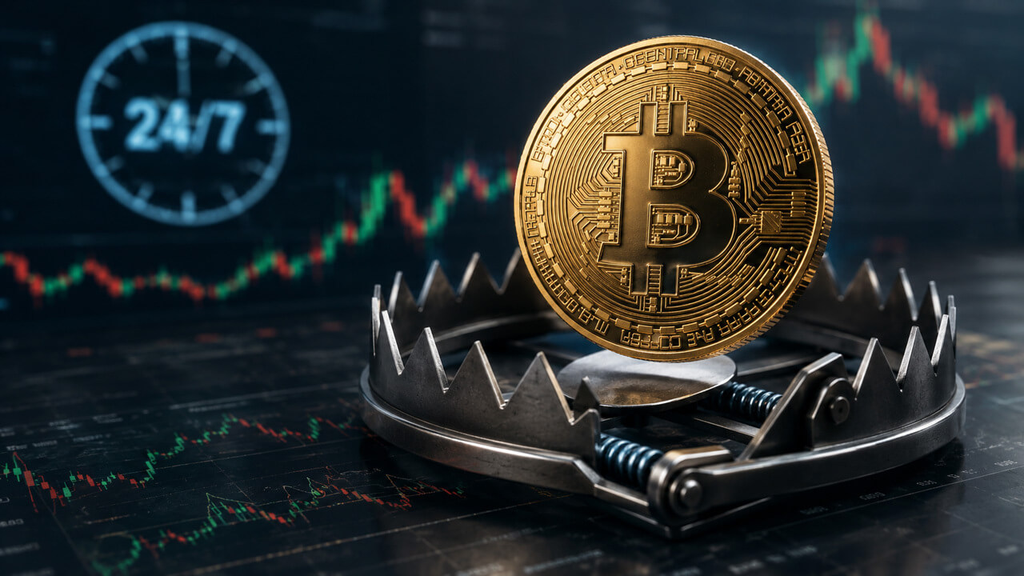
Bitcoin futures are financial instruments that facilitate betting on the future price of Bitcoin without requiring the owner to hold Bitcoin.
Futures can be used to hedge, speculate, or arbitrage. Because of the flexible nature of futures, investors of all sizes use them. Futures contracts have the ability to be leveraged, which means a small amount of money is able to control a large amount of money in the market.
Using the previous example, a $1,000 margin can purchase a Bitcoin futures contract with a value of $10,000. While leveraged contracts can generate high profits, they also increase the risk of losing money if the price of the underlying asset moves against the position.
At 100x leverage, liquidations can, and will, occur faster than most people can transact. With leverage, stopping losses are difficult to control. Bitcoin futures trading accounts for most of the trading volume in the futures markets.
Because futures contracts have such a high level of activity compared to cash markets, the price that is discovered in the futures market dictates the price of Bitcoin. Losing control of your risk management in this market will lead to high and continuous losses.
Key Bitcoin Price Levels to Watch
| Level Type | Price Zone | Significance |
|---|---|---|
| Immediate Support | $77,808 | Strong near‑term support; buyers defended this level during pullbacks. |
| Pivot Point | $80,233 | Critical intraday pivot; holding above signals continuation, below suggests exhaustion. |
| Resistance Band | $81,103 | Upper Bollinger Band; breakout above confirms bullish continuation. |
| Next Resistance | $82,000 | Psychological barrier; traders eye this as the next breakout target. |
| Major Resistance | $97,000 | Historical supply zone; could trigger profit‑taking if reached. |
| Long‑Term Target | $115,000 | Projected Fibonacci extension; long‑term bullish target if momentum sustains. |
Institutional Demand: Is Smart Money Supporting Bitcoin?
Spot Bitcoin ETFs
Spot Bitcoin ETFs are constantly seeing record inflows, well above the daily mining supply, signaling structural demand.
BlackRock and Fidelity
Two of the largest asset managers are now heavily involved in the inflows, signaling that traditional finance is now heavily allocating capital into Bitcoin.
Inflation and Currency Debasement
Wealth Managers and RIAs are using Bitcoin ETFs to hedge against inflation and currency debasement.
Regulated Crypto Custody
Traditional finance is inherently more risk averse than retail finance. For this reason, regulated custody lowers the risks associated with being in direct contact with crypto.
Undeniably Liquid
Deep liquidity is available for large allocations as trading volume and ETFs rival major equity index funds.
Regulatory Clarity
The CLARITY Act is pro-crypto, and accompanied by compliant regulation, is an increasingly large incentive for institutional adoption.
Macroeconomic Conditions
Lowering interest rates and Treasury bond buybacks have driven capital into risk assets like Bitcoin.
On-Chain Signals Behind the Bitcoin Rally
Strong on-chain signals help illustrate the current Bitcoin rally. Indicators show that there’s increasing real-world transaction volume, and that it’s not just speculative volume.
More active addresses and wallets, combined with decreased exchange reserves, and higher network fees, means Bitcoin has a lot of demand. Bitcoins are also getting withdrawn from exchanges and put into “cold storage” or offline wallets, which reduces selling pressure.
Since people are moving Bitcoins into longer-term storage, the demand is building. Because of this, and many more on-chain indicators, it’s clear that the reason for the rally is strong organic demand, and not liquidations.
It also shows that money is flowing into Bitcoin, and that the market is stable enough for big companies to adopt Bitcoin as a form of payment.
Short Squeeze vs Sustainable Bull Rally
| Aspect | Short Squeeze | Sustainable Bull Rally |
|---|---|---|
| Drivers | Forced liquidations, margin calls, leveraged shorts covering | Institutional inflows, long‑term holder accumulation, organic demand |
| Duration | Short‑lived, often days to weeks | Longer‑term, months to years |
| Market Sentiment | Panic among shorts, FOMO buying | Confidence from investors, adoption growth |
| On‑Chain Signals | Spikes in liquidations, high funding rates | Rising active addresses, declining exchange reserves |
| Liquidity Impact | Thin liquidity amplifies volatility | Steady absorption of supply, reduced sell pressure |
| Risk Profile | High volatility, sharp corrections likely | More stable growth, supported by fundamentals |
What Traders Should Watch Next
Key Support and Resistance: $77,800 and $82,000 – $97,000.
ETF Demand: Observe spot ETF inflows and focus on the weekly data.
On-Chain: Increased demand with decreasing exchange reserves and actually increasing transaction fees.
Derivatives: Funding, volatility, liquidations, and open interest provide insight on the level of leverage.
Macro Backdrop: U.S. Treasury dynamics, Fed policy, and the U.S. dollar all impact Bitcoin.
Regulation: The CLARITY Act and the evolving global crypto frameworks affect institutional buying conditions.
Altcoin Flows: Especially Ethereum and Solana. Capital flow shifts can show changes for Bitcoin.
Expert View: Is Bitcoin’s Rally Real?
Experts suggest Bitcoin is currently experiencing a real rally with both structural demand and short-term catalysts. Supply is being blown away by institutional spot ETF inflows, and Bitcoin is in a buy and hold mood, whereas long-term holders are comfortably holding Bitcoin without selling.
There are real fundamental signs of Bitcoin demand, and on-chain metrics provide real network activity, including recent increases in active addresses, transaction fees, and decreases in centralized Bitcoin exchange balances. There’s also increased speculation and market activity resulting from short squeezes and liquidations.
Regulatory certainty and Treasury bond buybacks are fueling the rally. While this rally appears to be sustainable and more real than previous speculative rallies, traders should expect large market sell-offs if there is a reversal of flows or decrease in liquidity.
Conclusion
While previous bitcoin hype cycles have been more speculative, this rally has bought some insight into institutional trading. There is strong evidence of organic demand through spot ETF inflows, increased accumulation of bitcoin by long-term holders, and decreasing exchange reserves.
Though there are stable macro factors of demand with Treasury bond buybacks and dollar weakness, some factors like volatility from leverage and sharp upward spikes have been caused by short squeezes. Regulatory clarity has potential to continue the rally.
The rally is not purely down to speculation, as long as stable factors of organic demand remain. Traders must remain cautious because bitcoin’s price will still experience dramatic growth due to organic activity and liquidation.
FAQ
What is driving Bitcoin’s rally?
Institutional inflows via spot ETFs, long‑term holder accumulation, and macro factors like Treasury bond buybacks.
Is the rally sustainable or just a short squeeze?
While short squeezes amplify spikes, strong on‑chain signals and ETF demand suggest deeper sustainability.
What on‑chain signals confirm the rally?
Rising active addresses, declining exchange reserves, and higher transaction fees point to organic demand.
What risks should traders watch?
High leverage, thin liquidity above $100K, and potential reversal of ETF inflows could trigger corrections.
How do futures and leverage impact Bitcoin?
They magnify gains but also fuel liquidations, often causing short‑term volatility spikes.