


Embedded finance is changing the way Software-as-a-Service (SaaS) companies offer financial services from within their business applications.
This article features some of the best B2B Embedded Finance APIs for SaaS, explaining their most significant features, capabilities, use cases, and benefits.
These APIs incorporate payments, banking, lending, accounting, and money movement and help SaaS companies make financial services seamless.
Key Points & Top B2B Embedded Finance APIs for SaaS
- Stripe (Payments & Treasury): Best for developer-first global payments, multi-currency payouts, and embedded financial accounts worldwide.
- Unit (BaaS): Best for embedded banking enabling SaaS platforms to offer ledgers, ACH transfers.
- Marqeta (Card Issuing): Best for real-time transaction controls and physical or virtual corporate card issuing.
- Kanmon (B2B Lending): Best for vertical SaaS offering loans, lines of credit, and invoice financing.
- Parafin (Embedded Capital): Best for marketplaces providing merchant advances underwritten using transaction sales data automatically.
- Airwallex (Cross-Border): Best for global multi-currency accounts, low-cost foreign exchange, and international payouts efficiently.
- Adyen (Global Payments): Best for enterprise-grade unified commerce and multinational acquiring capabilities at scale.
- Plaid (Data Connectivity): Best for linking bank accounts, verifying balances, and retrieving real-time transaction data.
- Finix (Payments-as-a-Service): Best for SaaS platforms wanting PayFac capabilities with flexible white-label fee settings.
- Moov Financial (Money Movement): Best for developer-first APIs supporting ACH, real-time payments, RTP, and push-to-card payouts.
- GoCardless (Bank-to-Bank): Best for recurring B2B collections, direct debit, and open banking payments globally.
- Treasury Prime (BaaS): Best for connecting software platforms directly with regional bank partners through APIs.
- Pipe (Recurring Revenue Capital): Best for turning recurring SaaS subscription cash flows into upfront working capital.
- Monite (AP/AR Automation): Best for embedding invoicing, payables, and collections workflows directly into B2B products.
- Apideck (Unified Accounting APIs): Best for normalizing accounting and ERP connections across over 40 tools seamlessly.
15 Top B2B Embedded Finance APIs for SaaS
1. Stripe (Payments & Treasury)
Stripe is an embedded finance solution that builds developer-focused financial infrastructure for embedded payments and payouts. Its suite of APIs offer embedded financial accounts, multi-currency payouts, and bank transfers.
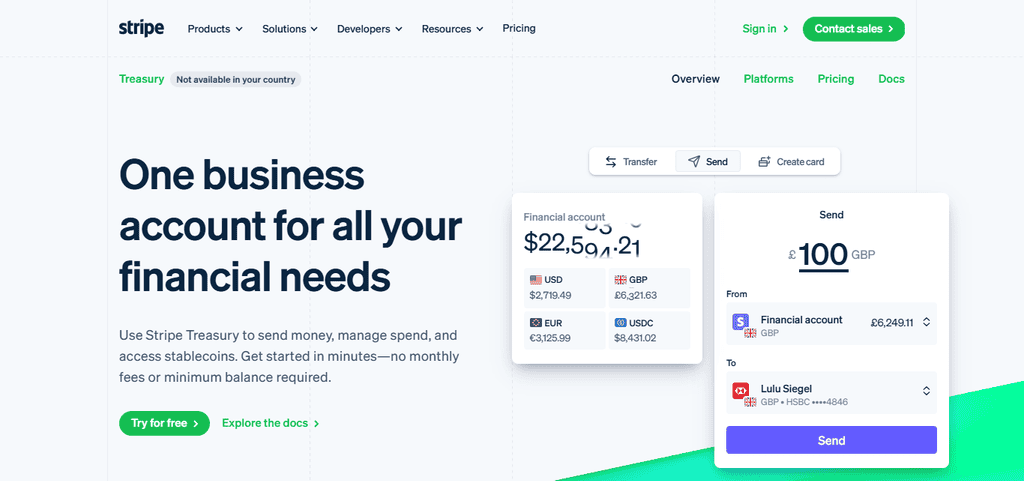
Stripe Treasury can allow eligible companies to offer financial accounts. Stripe Connect helps platforms and marketplaces manage financial flows.
Founded in 2010, Stripe has become a global financial infrastructure provider to internet customers. Stripe is a good option for SaaS companies building flexible API-based solutions for international payments and integrations with Stripe.
Feature Stripe (Payments & Treasury)
| Feature | Explanation |
|---|---|
| Global Payments | Accept payments across multiple countries, currencies, and payment methods through APIs. |
| Multi-Currency Payouts | Send funds to connected businesses or users in supported currencies. |
| Embedded Financial Accounts | Enable eligible platforms to embed account-like financial functionality into SaaS products. |
| Developer APIs | Provides extensive APIs, SDKs, webhooks, and documentation for customized integrations |
2. Unit (BaaS)
Unit offers banking-as-a-service infrastructure where software companies can build financial products within their applications. Unit’s offering includes accounts, cards, ACH transfers, payments, and ledger through APIs.

This allows SaaS companies the flexibility to create unique financial offerings. Unit partners with banks that allow them to provide banking infrastructure to technology companies.
Founded in 2019, Unit offers SaaS businesses the ability to provide embedded banking, without the heavy lifting of building a banking business from the ground up.
Feature Unit (BaaS)
| Feature | Explanation |
|---|---|
| Embedded Banking | Build banking experiences directly into SaaS applications through APIs. |
| Ledger Accounts | Create and manage financial accounts and balances within supported products. |
| ACH Transfers | Support ACH-based money movement for business payment and banking workflows. |
| Card Programs | Build embedded card experiences and manage related financial operations programmatically. |
3. Marqeta (Card Issuing)
Marqeta offers modern card-issuing technology that lets companies manage virtual and physical cards with APIs. Its platform has features for authorization control and transaction management and can manage card lifecycles and payment processing.
SaaS companies can use Marqeta to build corporate cards, employee spending cards, and cards to help manage employee expenses and/or other embedded-card solutions.

Marqeta was created in 2010 and is known for its real-time card-issuing technology and its infrastructure that appeals to developers. This infrastructure is especially useful for SaaS platforms that need flexible controls for corporate spending and actively manage their card programs.
Feature Marqeta (Card Issuing)
| Feature | Explanation |
|---|---|
| Card Issuing | Create physical and virtual cards for employees, customers, or businesses. |
| Real-Time Controls | Apply configurable transaction controls and authorization rules to card activity. |
| Virtual Cards | Issue virtual cards for expenses, purchasing, subscriptions, and digital transactions. |
| Expense Management | Support corporate spending programs with configurable limits and transaction visibility. |
4. Kanmon (B2B Lending)
Kanmon’s embedded finance infrastructure allows users to offer finance services for businesses directly through their preferred workflow. Their technology can enable financing for cases like term loans,
lines of credit, and invoice financing, making it possible for vertical SaaS companies to offer financing services without the need for a full-fledged lending infrastructure. The platform can use the business and operational data from integrated software to make financing easier.

Created in 2021, Kanmon focuses on embedding finance for B2B lending and will be of interest to vertical SaaS companies looking to enhance their customer offerings with integrated financing services.
Feature Kanmon (B2B Lending)
| Feature | Explanation |
|---|---|
| Term Loans | Enable SaaS platforms to offer financing products directly within customer workflows. |
| Lines of Credit | Provide eligible businesses with flexible access to revolving financing. |
| Invoice Financing | Help businesses access capital associated with outstanding invoices and receivables. |
| API Integration | Integrate financing experiences into vertical SaaS platforms without building lending infrastructure. |
5. Parafin (Embedded Capital)
Parafin provides financing embedded within a client’s business for marketplaces, SaaS, and B2B tech companies. Their client’s platforms can provide their clients financing through merchant cash advances and other forms of working capital.
Decisions around financing can incorporate information from the client’s platform. This creates a more streamlined application process for clients. Founded in 2020, Parafin has focused more on embedded capital as opposed to the more traditional standalone lending.
Airwallex provides global financial infrastructure to companies that manage cross-border payments, currency exchange, and other related financial activities.

This is a highly beneficial product for companies that provide services or products to customers, vendors, or contractors across international boundaries. Founded in 2015, Airwallex is focused on simplifying international payment transactions and operations.
It is most applicable to SaaS companies with international business offerings that need integrated foreign exchange and financial services to facilitate international transactions.
Feature Parafin (Embedded Capital)
| Feature | Explanation |
|---|---|
| Merchant Advances | Enable platforms to offer working-capital financing directly to eligible merchants. |
| Sales-Based Underwriting | Use available business sales information to help evaluate financing opportunities. |
| Marketplace Integration | Embed financing within marketplaces and B2B platforms where merchants already operate. |
| Automated Financing | Streamline financing offers and servicing through integrated technology infrastructure. |
6. Adyen (Global Payments)
Adyen has a global payments unification solution that helps businesses that extend their operations to several markets and payment methods.
Adyen’s infrastructure supports all payment methods from online payments, to in-person payments to acquiring, risk management, and payment authentication, as well as marketplace payments.

With their APIs, SaaS and enterprise payments can provide payment experiences in different regions while keeping payment operations under control.
Adyen, founded in 2006, has developed a global acquiring and payment infrastructure that caters to larger enterprises. Adyen is a good choice for large SaaS companies that need a unified commerce solution for payment processing on a large enterprise scale.
Feature Adyen (Global Payments)
| Feature | Explanation |
|---|---|
| Multi-Currency Accounts | Help businesses manage funds across multiple currencies through integrated financial infrastructure. |
| Foreign Exchange | Provide currency conversion capabilities for companies conducting international business. |
| International Payouts | Send cross-border payments to supported destinations through APIs and financial infrastructure. |
| Global Payments | Support international payment collection and money movement for global SaaS businesses. |
7. Plaid (Data Connectivity)
Plaid has a financial data connectivity that helps applications connect users’ accounts to digital products in a safe and secure way.
Their APIs enable account connection, balance verification, transaction data, other identifiers and financial data, and connectivity, based on the products and permissions.

Plaid allows SaaS to create financial workflows without the need for integration with numerous individual banks. Started in 2013, Plaid began simplifying the use of financial data by fintech developers.
It is now a very good option for B2B applications that are in need of a constant source of financial data that is authorized to access and connect to accounts.
Feature Plaid (Data Connectivity)
| Feature | Explanation |
|---|---|
| Global Acquiring | Process payments across multiple international markets through unified infrastructure. |
| Unified Commerce | Connect online and in-person payment experiences through one payments platform. |
| Payment Methods | Support numerous local and international payment methods across different markets. |
| Enterprise Infrastructure | Designed for high-volume businesses requiring scalable global payment processing capabilities. |
8. Plaid (Data Connectivity)
Plaid has a financial data connectivity that helps applications connect users’ accounts to digital products in a safe and secure way.
Their APIs enable account connection, balance verification, transaction data, other identifiers and financial data, and connectivity, based on the products and permissions.

Plaid allows SaaS to create financial workflows without the need for integration with numerous individual banks. Started in 2013, Plaid began simplifying the use of financial data by fintech developers.
It is now a very good option for B2B applications that are in need of a constant source of financial data that is authorized to access and connect to accounts.
Feature Plaid (Data Connectivity)
| Feature | Explanation |
|---|---|
| Bank Account Linking | Connect customer bank accounts with applications using supported financial-data integrations. |
| Balance Verification | Retrieve authorized account information to help verify available financial balances. |
| Transaction Data | Access authorized financial transaction information for supported accounts and institutions. |
| Financial Connectivity | Simplify connections between SaaS applications and numerous financial institutions through APIs. |
9. Finix (Payments-as-a-Service)
Finix builds payment infrastructure for platforms looking to manage their payment operations. With its technology, a platform can facilitate payments, onboard merchants, manage transactions, set fees, and create payment experiences tailored to their brand.

This makes Finix well suited for SaaS businesses that want to offer payments as part of their core service. Finix was founded in 2015 and has focused on building payments infrastructure for software platforms.
Finix is a good fit for SaaS companies looking to offer flexible payment orchestration, marketplace payments, and white label payments.
Feature Finix (Payments-as-a-Service)
| Feature | Explanation |
|---|---|
| PayFac Infrastructure | Help software platforms build payment-facilitator capabilities into their products. |
| Merchant Onboarding | Support onboarding and management workflows for businesses accepting payments. |
| White-Label Payments | Create branded payment experiences that can be integrated directly into SaaS platforms. |
| Flexible Fees | Configure platform payment economics and fee structures according to supported capabilities. |
10. Moov Financial (Money Movement)
Moov delivers developer focused financial APIs for money movement and payments infrastructure. With Moov’s APIs, a developer can build a payment and payout experience tailored to their software without using a consumer-facing financial application.

Moov was founded in 2018 as Financial Infrastructure for Developers. It is best suited for B2B SaaS where a developer can build programmable payments, automated compensations, and account-to-account transfers.
Feature Moov Financial (Money Movement)
| Feature | Explanation |
|---|---|
| ACH Payments | Enable account-to-account transfers through programmable ACH payment infrastructure. |
| Real-Time Payments | Support faster payment experiences through available real-time payment networks. |
| Push-to-Card | Enable eligible funds to be delivered to supported debit or prepaid cards. |
| Developer APIs | Provide API-based infrastructure for integrating payment and money-movement functionality. |
11. GoCardless (Bank-to-Bank)
GoCardless works with bank-to-bank payments, especially with recurring payments and direct debits. Their software allows businesses to set up recurring payment systems with customers and helps deposit the payments without using card-based systems.
They also allow for open banking payments in certain markets, giving more payment options for SaaS customers. GoCardless was founded in 2011 and was very focused on direct debit and recurring bank payments.

This has given them a solid foundation to expand into other options for bank payments. Being a B2B SaaS company for subscriptions and customer invoice/membership collections, GoCardless is a great option.
Feature GoCardless (Bank-to-Bank)
| Feature | Explanation |
|---|---|
| Direct Debit | Collect recurring customer payments directly from bank accounts in supported markets. |
| Recurring Collections | Automate regular B2B payment collection for subscriptions and recurring invoices. |
| Open Banking | Support open-banking payment experiences where available and applicable. |
| International Coverage | Provide bank-payment capabilities across numerous supported international markets. |
12. Treasury Prime (BaaS)
Treasury Prime has a bank-as-a-service solution to connect software companies with banking partners through API integrations. Their solution can handle embedded banking systems for accounts, payments, and even cards.

While all of the regulated banking relationships are kept with a financial services institution, this allows SaaS companies to construct financial services offerings without being a bank. Treasury Prime was founded in 2017, and as they grew, so did their API connections for banking and technology.
Their solution is appropriate for business software companies that want a unified banking technology layer for embedded banking partnerships, but also want to modularize their banking offerings.
Feature Treasury Prime (BaaS)
| Feature | Explanation |
|---|---|
| Banking APIs | Connect software platforms with banking infrastructure through programmable APIs. |
| Bank Partnerships | Help technology companies access banking capabilities through regulated financial institution partners. |
| Modular Architecture | Select and integrate specific banking capabilities according to product requirements. |
| Embedded Accounts | Support account-based financial experiences within software applications and platforms. |
13. Pipe (Recurring Revenue Capital)
Recurring Revenue cash streams and businesses with predictable cash flows have formed the central focus for Pipe’s financing infrastructure. The approach has been widely noted as helping businesses gain access to financing against future recurring revenue streams.

This has the potential to enable eligible companies to secure financing before actual revenue stream arrival. This is especially relevant for SaaS businesses offering subscription based services with predictable customer payments.
Pipe launched in 2019, gaining an enormous amount of interest for the new and innovative approach to revenue based business financing. Pipe’s solutions are particularly relevant for SaaS companies needing working capital solutions on the basis of recurring revenue.
Feature Pipe (Recurring Revenue Capital)
| Feature | Explanation |
|---|---|
| Revenue Financing | Provide financing opportunities based around eligible recurring revenue streams. |
| Upfront Capital | Help qualifying businesses access capital before recurring customer payments are received. |
| SaaS Focus | Particularly relevant to businesses with subscription-based or predictable recurring revenues. |
| Working Capital | Give businesses another potential funding mechanism for operational and growth requirements. |
14. Monite (AP/AR Automation)
Monite uses embedded accounts payable and accounts receivable infrastructure to provide software companies the ability to embed financial administration within their products.
Depending on configuration and the market served, its offering can include invoicing, billing, payment, receivables, collections, and automation.

This enables B2B SaaS platforms to offer financial operations as an integral part of their primary software offering. Monite launched in 2020, taking an embedded finance approach to B2B financial workflows.
It is ideal for SaaS offerings that provide integrated invoicing, payables, receivables, and collections to their served business clients.
Feature Monite (AP/AR Automation)
| Feature | Explanation |
|---|---|
| Automated Invoicing | Embed invoice creation and management capabilities directly into B2B software. |
| Accounts Payable | Help automate business bill-management and payable workflows. |
| Accounts Receivable | Support receivables management and customer payment workflows within SaaS products. |
| Collections Automation | Streamline payment reminders and collections processes through integrated workflows. |
15. Apideck (Unified Accounting APIs)
Apideck offers unified APIs where SaaS companies can connect to multiple accounting, ERP, CRM, and other business applications through standard integrations.
As a developer, you can simplify the integration of data and applications, instead of building multiple integrations to cater to all accounting software.

Developers highly value stable, user-friendly integrations for connecting business applications, as Apideck offers integrations for many business applications, including accounting platforms like QuickBooks and Xero.
Apideck was launched in 2019. They simplify integration for software developers, making them very valuable to B2B SaaS businesses building accounting, finance, expense, or business management apps.
Feature Apideck (Unified Accounting APIs)
| Feature | Explanation |
|---|---|
| Unified API | Connect SaaS applications with multiple business-software platforms through standardized APIs. |
| Accounting Integrations | Support connections with accounting platforms such as QuickBooks and Xero. |
| ERP Connectivity | Normalize data exchange between SaaS products and supported ERP systems. |
| Integration Simplification | Reduce development effort by providing a common integration layer across numerous platforms. |
Conclusion
Conclusion The Best B2B Embedded Finance APIs for SaaS help businesses integrate payments, banking, lending, card, accounting and money movement services easily.
Stripe, Unit, Marqeta, Airwallex and Plaid as well as many other companies, offer flexible financial infrastructure.
You choose the API that best meets your product, market, compliance, scalability and customer experience needs. These products help to rapidly innovate and simplify development.
FAQ
Which API is best for global SaaS payments?
Stripe is strong for global payments, payouts, and embedded financial accounts.
Which platform offers embedded banking services?
Unit provides APIs for accounts, ACH transfers, cards, and banking.
Which API is best for card issuing?
Marqeta supports physical, virtual cards, and real-time transaction controls.
Which platform supports embedded B2B lending?
Kanmon helps SaaS platforms offer loans, credit lines, and financing.
