
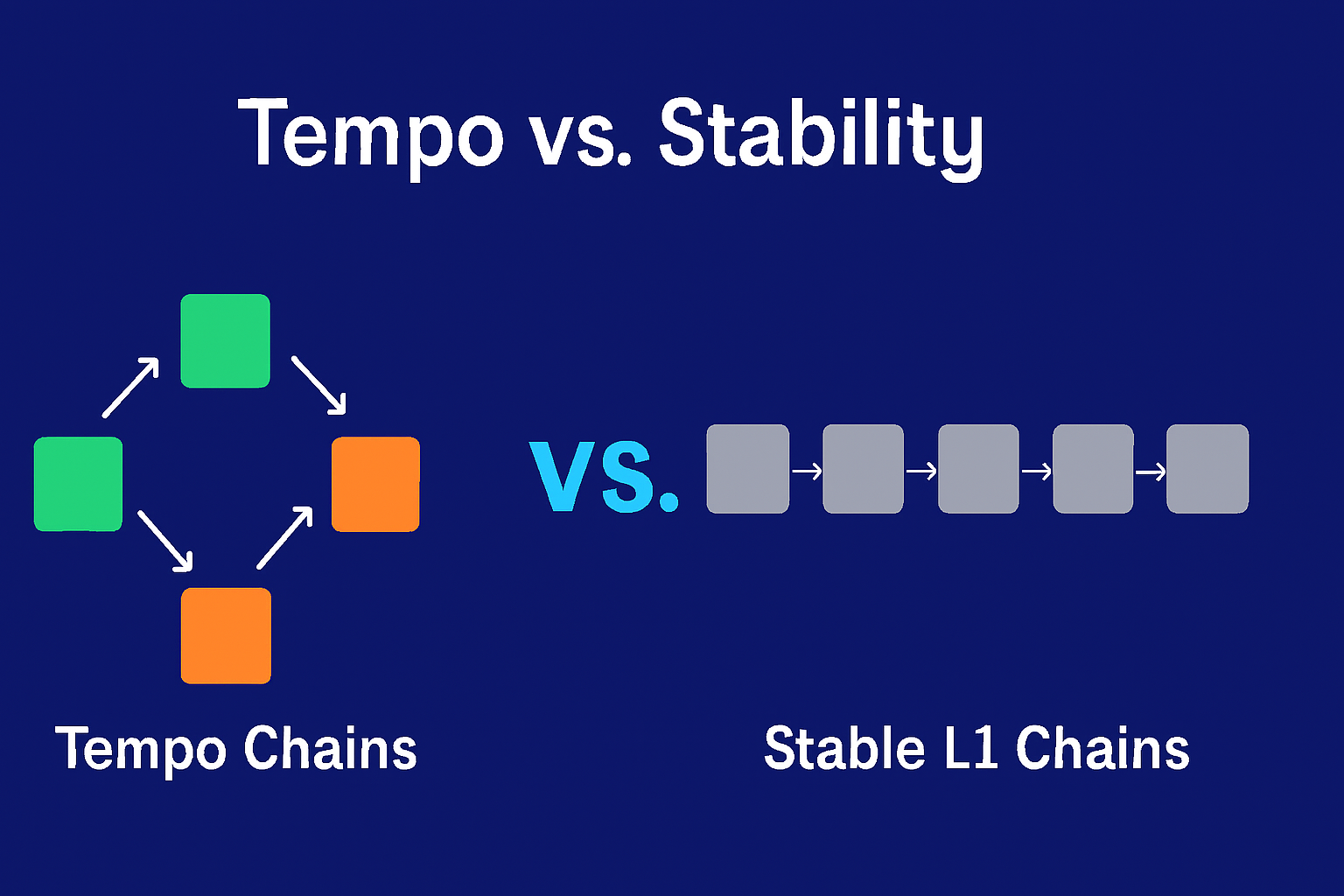
This article covers stable blockchains systems like stable L1 and Tempo. These blockchains focus on processing transactions for stablecoins and improving processing for payments, increasing their flexibility.
These two blockchains have different philosophies, performances and target markets. It is critical for investors, developers and businesses to understand the differences to properly take advantage of the stablecoin ecosystem.
What Is Tempo?
Tempo and Stable L1 are two of the many strategies in blockchain and cryptocurrency ecosystem, especially in the Layer 1 (L1) blockchain. Tempo’s approach is around ultra-fast transaction processing, emphasizing low latencies and fast confirmation times in blocks.
Subsequently, it is the most competitive in applications where finality is required almost instantly; for instance, in DeFi (Decentralized Finance) trading, gaming, and micropayments. Nonetheless, with this speed there are costs, particularly in network fees, or worse with centralization.
What Is Stable L?
Stable L1 focuses more on the stability, reliability, and security of the network rather than the transaction speeds. It’s built for mainstream adoption and focuses on stable and safe performance with strong consensus and very little chance of forking or going offline.
Transactions may take longer than with Tempo, but Stable L1 is much more suited for corporate use cases, applications where a long-term store of value is important, and consistency and security are important.
Key Differences: Tempo vs. Stable L1
Tempo and Stable L1 have different strategies and serve different blockchain networks with stablecoin Liquidation functions. Clients’ needs differ when considering products offered by Tempo, which is flexible and supported by Stripe and Paradigm, to Stable L1
Which is more robust, and has emphasis on Tether and Bitfinex’s USDT’s liquidity and ecosystem. Tempo has more extensive stablecoin coverage, and so, below, clients can see the different offerings and features.

| Feature | Tempo (Stripe/Paradigm) | Stable L1 (Tether/Bitfinex) |
|---|---|---|
| Primary Backer | Stripe and Paradigm | Tether and Bitfinex |
| Core Philosophy | Stablecoin-agnostic; aims for neutrality, allowing various stablecoins | USDT-centric; leverages the deep liquidity and market dominance of Tether (USDT) |
| Gas Payment | Any supported stablecoin (via a built-in Automated Market Maker) | Uses USDT as the native gas token, with an option for gas-free P2P transfers using USDT0 |
| Target Audience | Global e-commerce, AI-driven platforms, and businesses within the extensive Stripe ecosystem | High-volume P2P transactions, emerging markets, and businesses already heavily invested in the USDT ecosystem |
| Performance Claim | Over 100,000 transactions per second (TPS) | High-throughput, with sub-second finality and transaction fees consistently under one cent |
Backing And Strategic Vision
Tempo: A network’s sponsors usually inform its strategic choices. Tempo is sponsored by Stripe and Paradigm. Stripe signifies Tempo’s aim to interlace blockchain with worldwide trade and traditional finance, while Paradigm’s reputation adds value concerning innovations, or an ecosystem. Such support allows Tempo to be nimble and developer friendly enough to accommodate many stablecoins and different payment structures.
Stable L1, in comparison, is backed by Tether and Bitfinex. Tether provides the liquidity and market leadership of USDT, while Bitfinex facilitates easy user interface and peer to peer transaction. Thus, backing in Stable L1 offers strong net with USDT and is built for higher transaction predictability and lower costs for seamless enterprise adoption.
Performance and Scalability
Tempo: Performance is the most distinguishing attribute between the two networks. Tempo is said to be capable of processing more than 100,000 transactions per second (TPS) which is necessary for use cases like micropayments, realtime commerce, and AI use cases. Tempo’s high throughput and near instantaneous finality make it one of the most efficient stablecoin Layer-1 networks in the market.
Stable L1: Achieves high throughput with sub 1 second finality and and has transaction costs below a cent. While it is slightly slower than Tempo’s hypothetical maximum the emphasis on reliability and cost efficience suits high volume P2P transactions, remittances and enterprise use cases where consistent performance is necessary.
Target Audience
Tempo focuses on global e-commerce, AI-integrated platforms, and entities in the Stripe ecosystem, catering to developers and businesses needing custom, multi-stablecoin deployments. Its agility and cross-platform compatibility make it ideal for digital-first applications that require near real-time cross-border payment settlement.
Stable L1 targets high-volume P2P transaction customers, emerging markets, and USDT-heavy businesses. Its stable fee structure, liquidity, and rapid settlement capabilities make it particularly suitable for enterprises, along with financial institutions and other financial service providers, making it ideal for managing USDT treasury, payment, and trading services.
Why Compare Tempo vs. Stable L1?
Comparing Tempo and Stable L1 reveals core trade-offs in the design of blockchains. Tempo is more focused on serving users with needs for extreme efficiency and speedy confirmations.
This is especially useful for instant transaction and real-time interactive applications like gaming. Yet, the more focus on speed a system has, the more is long term reliability lost.
On the other hand, Stable L1 is designed for long term durability, security, and temporal consistency, hence the quiałity of trade-offs need to be made in terms of consensus immediacy, failure risks, and availability of critical application infrastructures. This is where trust in the ecosystem is built. And, the choice depends on the priorities: performance in the short term vs. long term stability.
Why Is Stability Important In an L1 for Stablecoins?
Every layer 1 network will experience congestion. Most will experience congestion disruption with high variation in throughout. This means even fast networks can become if system demand spikes. Such fee systems expose users costs spikes.
Networks with calm system demand allow users network fee calm. Stable networks allow user to depend on systems. They will settle smoothly with no disruption. Stable L1 networks are foundational to financial systems requiring trust and dependability.
This needs to be reliable. Banking and distributions have high institutional use. Disruptions can have damaging effects. Stable L1 balances system efficiency and system strength. This can support financial systems and allow the network to grow.
Pros and Cons Tempo vs. Stable L1
| Feature / Network | Tempo (Stripe/Paradigm) | Stable L1 (Tether/Bitfinex) |
|---|---|---|
| Pros | – Flexible, stablecoin-agnostic approach – Extremely high transactions per second (100,000+ TPS) – Seamless integration with Stripe ecosystem – Ideal for global commerce, AI-driven platforms, and cross-border payments | – Deep liquidity and robust USDT network – Predictable, low-cost transactions with sub-cent fees – Optimized for high-volume P2P and enterprise use cases – Sub-second finality ensures reliability and security |
| Cons | – Multi-stablecoin mechanism may increase complexity – Operational costs may vary due to AMM usage – May require more technical knowledge to optimize gas payments | – Limited to USDT, reducing flexibility for multi-stablecoin transactions – Slightly slower adoption outside the USDT ecosystem – Less ideal for businesses wanting stablecoin neutrality or diverse currency support |
Conclsuion
In the end, the Temp and Stable L1 serve different functions While Tempo is faster and more flexible, supporting multiple stables at a time, making it ideal for global commerce and AI driven systems
Stable L1 is more stable, liquid, less expensive to transfer and is valued within the USDT, making it more suitable for heavy P2P and enterprise transactions. Which to choose depends if flexibility, or stable predictability is more of a priority.
FAQ
Which stablecoins does Tempo support?
Tempo is stablecoin-agnostic and allows users to pay gas fees in any supported stablecoin via a built-in AMM.
Which stablecoin does Stable L1 use?
Stable L1 primarily uses USDT for gas payments, with an option for gas-free P2P transfers via USDT0.
What is the transaction speed of Tempo?
Tempo claims over 100,000 transactions per second (TPS), making it one of the fastest stablecoin networks.
How fast is Stable L1?
Stable L1 offers high throughput with sub-second finality and consistently low transaction fees under one cent.
Who is the target audience for Tempo?
Global e-commerce platforms, AI-driven applications, and businesses within the Stripe ecosystem.