

This paper will analyze the Decentralized Physical Infrastructure Projects To Watch beginning with innovative, blockchain-integrated, reconfigured networks for connectivity, storage, compute, and mapping.
These solutions provide communities with the tools to construct and maintain vital infrastructure and receive compensation for their efforts. They are the future of digital ecosystems that are open, resilient, and community-driven, along with offering wireless cover and decentralized cloud services.
Key Points & 10 Decentralized Physical Infrastructure Projects To Watch
| Project | Key Point |
|---|---|
| Helium | Decentralized wireless network enabling IoT and 5G coverage through community hotspots |
| Hivemapper | Blockchain-based mapping where drivers contribute dashcam footage to build global maps |
| Render Network | Distributed GPU rendering for artists and developers, monetizing unused compute power |
| io.net | Decentralized AI compute marketplace connecting GPU providers with machine learning demand |
| Grass | Crowdsourced bandwidth sharing allowing users to monetize unused internet capacity |
| Nosana | CI/CD decentralized cloud offering blockchain-powered DevOps pipelines |
| Cubik | Community-driven funding platform for projects using proof-of-contribution models |
| APhone | Web3 mobile infrastructure providing decentralized smartphone services and dApps |
| Flux | Decentralized cloud computing supporting scalable Web3 applications |
| Filecoin | Blockchain-based storage network incentivizing distributed data hosting |
DePIN Gems: 10 Decentralized Physical Infrastructure Projects To Watch
1. Helium
A community can set up and manage Helium’s decentralized wireless network hotspots, which provide IoT and 5G coverage. community members are rewarded with tokens for extending network coverage, meaning Helium doesn’t need to partner with mainstream telecom operators.
This approach cuts down on infrastructure expenses while still delivering connectivity to users all over the world. Helium enables the connection of diverse smart devices like sensors, scooters, and smart meters to provide essential infrastructure to smart cities.
Helium’s network policies foster community engagement and token rewarding democratizes participation in building wireless networks. Helium is offering an innovative approach to providing connectivity services to the consumers while minimizing costs.
Helium Features
- Community-Powered Wireless Networks – Users set up Hotspots to extend ranges for Internet of Things (IoT) networks and 5G technology.
- Token Rewards – Users receive HNT tokens as payment for their Wi-Fi contributions.
- Cost-Effective Network – Offers alternatives to traditional and expensive telecom towers.
- Smart City Compatible – Integrates with and supports the operation of various smart devices such as sensors, scooters, and smart meters.
2. Hivemapper
Hivemapper represents a new approach to decentralized mapping. Using dash cams to capture real world footage, Hivemapper allows driver to gain crypto tokens while simultaneously building a community based mapping services.
Hivemapper Builds maps using community sourced data which allows it to be up to date mapped current road closures, construction, accident, and other obstacles. Users earn rewards for their mapped data. This leads to a constantly improving data set for means of navigation, logistics, and self driving cars.
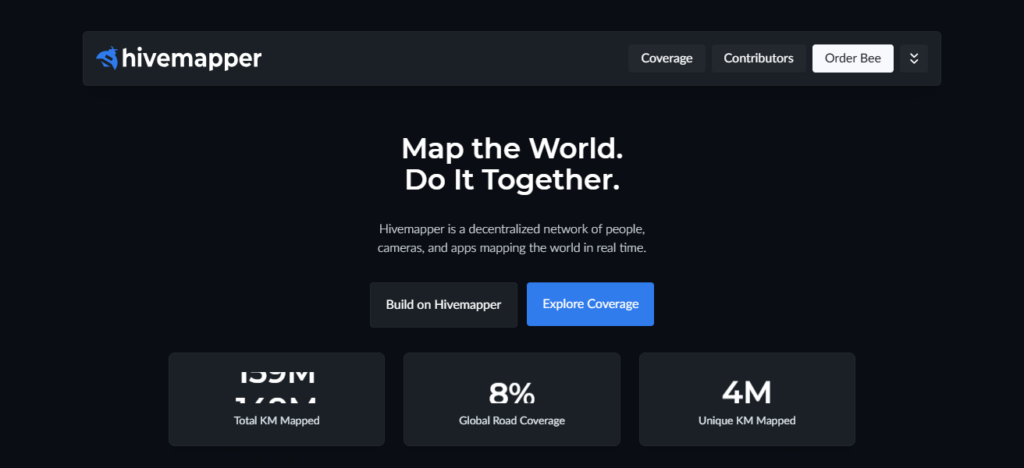
The Hivemapper concept directly competes with Google maps and other mapping monopolies for a more community driven custodial-less mapped data services. The more users drive, the better the service becomes.
Hivemapper Features
- Community Mapped Resources – Offers community features and maps for roads based on contributions from users driving with active dash cams.
- Updated and Current Features – Lists and displays road features and current events including road construction, traffic, accidents, and other delays.
- Token Rewards – Users who share their dashcam video with the company and contribute data for road maps are compensated with HONEY tokens.
- Decentralized Mapping – Competes with and offers an alternative to Google Maps.
3. Render Network
Render Network revamps the GPU rendering process by merging computing power with artists, developers, and creators globally. Users don’t have to depend on costly centralized servers anymore; they can use distributed GPUs to render intricate graphics, animations, and 3D models.
While creators get quicker rendering times at reduced prices, contributors get paid in tokens for letting others use their computing resources. Render Network is especially significant in gaming, film, and design where the demand for rendering is high and the competition is growing.
It empowers independent artists and smaller studios to be on par with the larger ones. It is also a great example of how blockchain technology is unlocking creativity.
Render Network Features
- Global Unused Computing Power – Connects global creatives with less expensive computing and render power to users’ GPUs.
- Less Expensive Availability – Service offers lower expenses to artists, designers, studios, and other users.
- Token Incentives – Users receive RNDR tokens as payment for sharing their GPUs as render power.
- Support for Creative Industries – Services the gaming, 3D design, film, and other creative industries.
4. io.net
io.net is a decentralized marketplace for AI compute, linking GPU suppliers with machine learning developers needing scalable resources. io.net builds a distributed infrastructure for training a deploying AI models by pooling idle GPUs from individuals and data centers.
It lowers costs relative to centralized cloud providers while increasing access to compute. Developers scale projects while contributors earn tokens for their hardware.
Providing a distributed and incentivized marketplace for GPUs, io.net is essential as demand for AI compute soars. It interlaces blockchain and AI to democratize access to a vital resource for innovation in machine learning.
io.net Features
- Decentralized AI Compute Marketplace – Offers pooling of inactive GPUs for artificial intelligence (AI) machine learning.
- Highly Scalable – Provides infrastructure for more efficient training and deployment of various AI models.
- Less Expensive Options – Competes with other providers of centralized cloud services.
- Token Rewards – Users receive tokens as payment for contributing their active GPUs.
5. Grass
Grass is a distributed network of bandwidth sharing it is a platform for network participants to make money by sharing their internet. Participants download software to share their network safely and earn tokens.
This software can be used to build a range of services, including VPNs, content delivery networks, and data routing services. Grass mitigates reliance on central internet service providers (ISPs) and offers a better solution at lower costs.

With its bandwidth sharing network, everyday internet users can now convert their passive internet resources into active income generating resources.
With features of decentralization, Grass also offers improved privacy, scalability, and efficiency contributing to a digital ecosystem where users can share their bandwidth and the control of their connectivity for a profit.
Grass Features
- Bandwidth sharing: Users can make money based on how much internet bandwidth they are not using.
- Privacy-focused: Uses a secure method of distributing internet bandwidth that can be used with a VPN to preserve users’ privacy.
- Incentives for users: Users who share bandwidth will receive tokens as a reward.
- Resilient infrastructure: Using Grass creates more Internet options with less reliance on traditional Internet Service Providers (ISP).
6. Nosana
Nosana provides a fully automated CI/CD pipeline from a blockchain-based DevOps as a Service. Developers build, test, and deploy from a distributed infrastructure that lowers costs and increases scalability.
Resource providers earn tokens and projects enjoy quicker and more dependable CI/CD pipelines. For Web3 projects, the resilience to downtimes and censorship of the decentralized infrastructure is a plus.
By merging DevOps and Blockchain, Nosana removes the restraints of centralized cloud infrastructure from developers, fostering a new ecosystem that uplifts innovation by providing cost-effective and collaborative cloud resources to Web3 and beyond.
Nosana Features
- Decentralized DevOps pipelines: Provides CI/CD on top of blockchains.
- Token incentives: Compute providers get NOS tokens.
- Resilient cloud: Stands against outages and censorship.
- Web3 integration: Designed for building decentralized applications.
7. Cubik
Cubik is a community funding model that supports projects via proof-of-contribution mechanisms. Instead of using venture capital or centralized grants, Cubik encourages communities to self-fund their resources.
Contributors are rewarded for backing initiatives, while projects are funded in a transparent, community-aligned manner. This model of community funding ensures accountability for all parties.

Cubik excels at grassroots innovation, supporting economically disadvantaged small teams to access funding without the conventional inhibitions. Funding decentralization adds support and clears the path for inclusiveness, transparency, and cooperation.
It crafts a funding ecosystem where projects are funded solely based on their grassroots support, shifting the paradigm from conventional centralized funding access.
Cubik Features
- Community-driven funding: Projects are funded through proof of contribution.
- Transparent resource allocation: Accountable resource allocation.
- Inclusive innovation: Small teams without venture capital are empowered.
- Tokenized recognition: Supporters of projects are rewarded.
8. APhone
APhone has its own unique initiative in the field of infrastructure development for mobile devices: a decentralized mobile infrastructure project enabling Web3 smartphone services. It integrates dApps, mobile secure communication, and blockchain-based identity services.
It also allows users to make decentralized storage, payment, and network services available through their mobile device without the restrictions of traditional app stores and telecom services.

By integrating Web3 technologies in mobile infrastructure, APhone helps users regain control of their digital lives, preserving the privacy and ownership of their data.
APhone aims to bridge the divide between blockchain technologies and mobile ecosystems, facilitating the mainstream adoption of mobile decentralized services. It also aims to provide users with a mobile ecosystem free of centralized control.
APhone Features
- Web3 mobile infrastructure: Blends decentralized apps with mobile devices.
- Data ownership: Control, identity, storage, and communication are in users’ hands.
- App stores bypass: Centralized gatekeepers like Google or Apple are avoided.
- Mainstream adoption: Blockchain services are mobile-friendly.
9. Flux
Flux is a decentralized cloud computing network providing infrastructure for scalable Web3 applications. It supports websites, services, and decentralized apps, utilizing distributed computing resources volunteered by the community.
While community contributors earn tokens for sharing their computing resources, developers enjoy low-cost and highly resilient services. With all the necessary deployment, monitoring, and scaling tools, the Flux ecosystem serves as a complete alternative to centralized cloud providers.
Thanks to its decentralized censorship resistant model, global accessibility is assured. Flux is powering Web3 infrastructure, therefore enabling innovations in all industries, including finance and gaming, while offering a community-driven and equitable model to cloud computing.
Flux Features
- Decentralized cloud computing: Distributed hardware hosts Web3 apps and services.
- Scalable ecosystem: Provisioning, monitoring, and scaling services.
- Token rewards: Resource contributors get FLUX tokens.
- Censorship resistance: Freedom of access and robust services are provided globally
10. Filecoin
Filecoin has built a fully decentralized network for data storage with the monetary incentive for people to lend their secure data storage. The network’s users pay in tokens to have their data stored, while the data space sellers receive tokens by keeping their space reliable.
Differently from the centralized data storages, Filecoin keeps the data stored on impenetrable nodes, which increases the network’s security, reliability, data redundancy, and censorship resistance.
The network is also very useful for web 3.0 technologies which need decentralized data storage, content distributions, and archiving. With low tokens, sellers of data storage commit to keeping their sold storage space reliable, thus, empowering buyers to give data control to themselves.
Filecoin is among the first and largest decentralized physical infrastructure networks (DePIN) to show how blockchains can impact the world on a large scale.
Filecoin Features
- Blockchain-based storage – Filecoin uses blockchain to motivate users to host data on a distributed network.
- Redundant storage – Files are kept on multiple nodes to ensure reliability.
- Tokenized economy – Storage providers receive FIL tokens as a reward.
- Web3 Backbone – Storage provides support for decentralized applications, decentralized archives, and content distribution.
Cocnsluion
In conclusion, Decentralized Physical Infrastructure Networks are redefining how we construct and maintain systems on a global scale. With the use of blockchain, these projects enable communities to acquire, manage, and profit from connectivity, storage, computing, and mapping.
Helium, Hivemapper, and Render showcase a decentralized and community oriented future for infrastructure, making DePIN a vital element of Web3 innovation.
FAQ
What are DePIN projects?
Decentralized Physical Infrastructure Networks (DePIN) use blockchain to build and manage real-world infrastructure like connectivity, storage, and compute.
Why are DePIN projects important?
They democratize infrastructure ownership, reduce costs, and reward communities for participation.
Which project focuses on wireless connectivity?
Helium builds decentralized IoT and 5G networks powered by community hotspots.
Which project is building decentralized maps?
Hivemapper crowdsources dashcam footage to create real-time global maps.