


In this article, I will discuss the top corporate treasury management tools. These tools help businesses manage their cash, liquidity, payments, financial risks, forecasting, and banking operations efficiently.
We will review the top corporate treasury platforms, key features, advantages, challenges, and best practices to help finance professionals determine the best solutions for their company’s treasury, operations, and strategic financial goals.
Key Points & Top Corporate Treasury Management Tools
- Kyriba: Best for global enterprises managing complex FX risks and banking relationships.
- Ripple Treasury: Best for fast cash visibility, AI insights, and digital assets.
- HighRadius: Best for automated cash forecasting and AI-powered receivables management.
- Trovata: Best for cloud-based, API-first, transparent multi-bank cash visibility.
- SAP Treasury: Best for SAP users needing integrated treasury and accounting.
- Oracle Treasury: Best for Oracle users wanting seamless financial data integration.
- ION Treasury: Best for complex trading, capital markets, and derivatives management.
- Coupa Treasury: Best for procurement-focused organizations needing spend and cash visibility.
- Nomentia: Best for flexible treasury workflows, cash positions, and bank connectivity.
- FIS Treasury: Best for large corporations managing global payments and liquidity.
- TIS: Best for standardized multi-bank payment controls, security, and automation.
- Cobase: Best for centralized multi-bank operations and corporate payment management.
- CAPIX: Best for secure investment tracking and centralized corporate treasury operations.
- Tijori: Best for credit facilities, letters of credit, and ERP accounting automation.
14 Top Corporate Treasury Management Tools
1. Kyriba
Created in 2000, Kyriba was designed to manage cash, liquidity, payments, and financial risks in large multinational corporations. Kyriba was originally developed as a SaaS product in a time where cloud technology was still emerging.
Kyriba began with cash management and forecasting and has since expanded its offerings to include the full range of treasury and risk management.
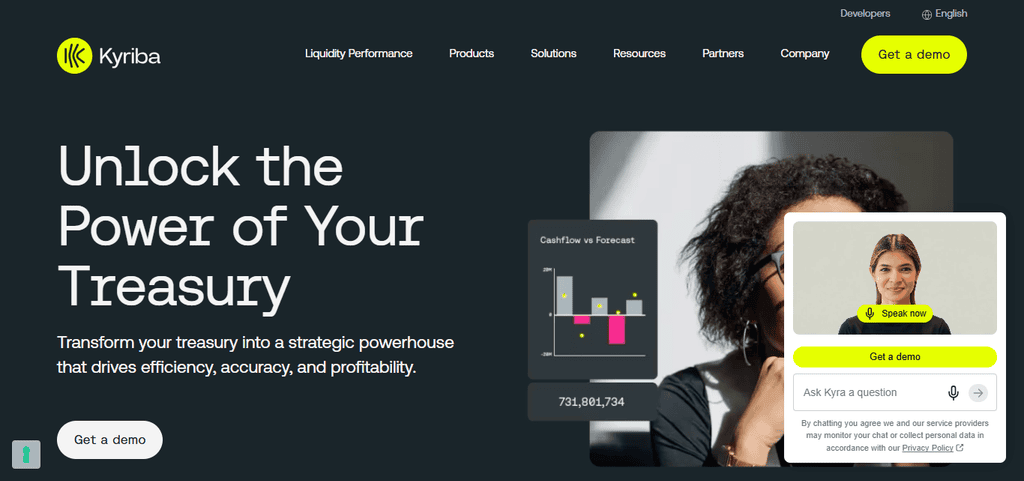
Kyriba is particularly strong in analysis and management of foreign exchange exposure, hedging and FX trade, liquidity planning, and banking connectivity. Kyriba is designed to meet the needs of global entities with sophisticated treasury needs.
Kyriba Pros & Cons
Pros
- Strong FX Risk Management: Kyriba has advanced capabilities for foreign-exchange exposure, hedging, and financial risk management.
- Global Bank Connectivity: Kyriba has the capability to manage complex multinational banking relationships with extensive banking connectivity.
- Comprehensive Treasury Platform: Kyriba has offerings for cash management and liquidity along with payments and cash forecasting and risk management.
- Scalable for Enterprises: Kyriba’s solutions are well suited for large corporations with sophisticated treasury operations.
Cons
- Higher Cost: Kyriba’s solutions have higher implementation and licensing costs associated with enterprise-level solutions.
- Complex Implementation: Kyriba’s solutions require integration and IT and treasury functionality.
- Overkill for Smaller Companies: Kyriba’s offerings may be extensive for smaller companies to the point of not being used.
- Training Requirements: Kyriba’s solutions require advanced training to learn how to fully use its offerings.
2. Ripple Treasury
Ripple Treasury was created using the GTreasury system. GTreasury was acquired by Ripple in October 2025 for $1 billion and offers several decades of experience with corporate treasury.
The Ripple Treasury system is designed to support the traditional needs of corporate treasury, including cash management, AI, payments, and liquidity while adding support for digital assets.

Ripple Systems launched native digital assets within the platform in April 2026. Ripple Treasury is designed to provide cash visibility, provide AI-driven insights, payments, liquidity and digital asset management.
Ripple Treasury Pros & Cons
Pros
- Real-Time Cash Visibility: Ripple Treasury helps treasury teams achieve real-time visibility of cash and liquidity positions.
- Digital Asset Support: Ripple Treasury assists treasury teams with digital assets and blockchain finance.
- Enterprise Treasury Heritage: GTreasury has decades of experience in treasury management.
Cons
- Relatively New Combination: Ripple Treasury has a newer integration structure compared to other established treasury management solutions.
- Digital Asset Complexity: Digital assets may introduce added complexities to operations and regulations.
- Integration Challenges: Ripple Treasury’s solutions may require careful integration with existing systems.
3. HighRadius
HighRadius specializes in enterprise systems for accounts receivable, cash forecasting, working capital, and treasury. Its founder and CEO, Sashi Narahari, developed HighRadius in 2006 with on-site software designed to streamline accounts receivable.
HighRadius began its shift to the cloud in 2010, and in 2014 HighRadius introduced AI. In addition to its earlier AI initiatives, HighRadius developed Autonomous Finance and expanded its AI offerings.

Currently, HighRadius is well suited to businesses for automation of cash forecasting, receivables, collections and AI based finance operations.
HighRadius Pros & Cons
Pros
- Improved Cash Forecasting: Predictability is increased with automation and sophisticated analysis.
- Strong AR Management: Highly effective in collections, receivables and working capital management.
- AI/Automation: Finance activities are reduced through intelligent automation and autonomous process engines.
- Working Capital Improvement: Organizations are better positioned to speed up cash collections and enhance overall cash conversion.
Cons
- Significant Installation Work: Connect users to multiple finance functions.
- Pricing: Advanced automation will be expensive for smaller firms.
- Substantial User Training: Complex functionality.
- Accounts Receivable Focus: AR centric organizations will find less relevance for Traditional Treasury.
4. Trovata
Trovata is a cloud based cash management and financial data normalization platform with automated real time visibility. The company was founded in 2016 beening based on the principle of treasury teams not having to rely on spreadsheets and cumbersome financial processes to access banking data.

Organization’s banking data is consolidated and connected via APIs to financial systems and cash positions can be monitored and automated cash flow processes and workflows can be improved and forecasting can be achieved.
It’s ideal for technology based finance teams seeking modern cloud based treasury infrastructures and multi bank connections with easy access to data and automated cash management.
Trovata Pros & Cons
Pros
- Cloud-Native: A modern architecture provides flexibility and scalability for Treasury workflows.
- API Connectivity: Bank, ERP and financial applications connection is simpler with APIs.
- Real-Time Cash Visibility: Provides a consolidated view of cash across different banking relationships.
- Automation: Data based workflows and hauls eradicate manual processes that rely on spreadsheets.
Cons
- More Traditional/Legacy Depth: Some mega-enterprises drag a preference for legacy treasury platforms.
- Complex Environment Integration: Will still require a lot of integrations.
- High Level Treasury Needs: Specialized treasury requirements may necessitate additional solutions.
- Organizational Change: Departure from Legacy and spreadsheets requires a change in organizational processes.
5. SAP Treasury and Risk Management
SAP Treasury and Risk Management is suitable for companies integrated deeply with SAP’s ERP. The development of this product began in the early nineties, and SAP integrated various modules and components for financial management, which included treasury, financial assets, and the management of market risk.

The component integration evolved and was extended to provide broader functionality for the management of risk and treasury. The solution address corporate liquidity, financial transactions, market risk, investments, debt, and accounting. It is appropriate for corporations that want integrated SAP ERP treasury functions and financial processes.
SAP Treasury and Risk Management Pros & Cons
Pros
- Integration with SAP ERP: best at integrating with related SAP financial modules.
- Deep domain expertise and strong finance operations consulting skills: strong domain expertise and complemented by strong finance operations consulting skills from deep Finance practitioner bench strength.
- Accounting Integration: Treasury transactions are closely related to accounting and financial reporting.
- Extensive Functionality: Includes liquidity, investments, debt, financial instruments, and risk management.
- Enterprise Scalability: Designed for large multi-national organizations with complex SAP environments.
Cons
- Complex Implementation: Planning and expertise for SAP treasury implementations can be substantial.
- Total Cost: Licensing, consulting, customization and maintenance can be substantial.
- Dependency: Organizations outside the SAP ecosystem will have fewer integration opportunities.
- Steep Learning Curve: For inexperience treasury users, the advanced functionality can be too complicated.
6. Oracle Treasury
Oracle Treasury is one of Oracle’s financial management applications designed for companies that use Oracle Financials. This application was developed with Oracle’s enterprise financial applications, allowing the treasury activities to communicate with accounting and other necessary corporate finance functions.
During the development of Oracle’s enterprise finance software in the 1990s, Oracle Treasury was established, and over the years as Oracle Financials grew, so did Oracle’s Treasury. The strongest advantage is the integration.

Treasury departments are able to manage cash, investments, debt, financial instruments, and exposure to risk, and at the same time, keep a strong relationship with accounting and the general ledger. This is ideal for corporations that rely on Oracle for their financial data.
Oracle Treasury Pros & Cons
Pros
- Strong Oracle Integration: Naturally integrates with Oracle Financials and other Oracle applications.
- Efficient Accounting Process: Treasury transactions can easily flow into accounting.
- Integrated Financial Data: Helps organizations to integrate their treasury information.
- Large Enterprise Capability: Suitable for large organizations with complex Oracle financial systems.
Cons
- Oracle Centric: Organizations that do not use Oracle Financials will receive less benefits.
- Complex Integration: Integrations and configurations require specialized Oracle knowledge.
- High Cost: Enterprise level deployments can be expensive in terms of software and consulting.
- Customization, Complex treasury processes may require customization.
7. ION Treasury
Advanced solutions for complex organizations such as corporates, banks, central banks, and public institutions for treasury and risk management are offered by ION Treasury. Ion’s heritage includes advanced treasury and capital markets software developed through the company’s growth and various acquisitions.

ION launched its Wallstreet Suite on September 12, 2023. It is an enterprise level treasury management and payment hub solution that automates processes for payments, cash visibility, liquidity, exposures, risk management, bank connectivity, and automation.
The advanced solutions offered by ION Treasury are appropriate for organizations with significant requirements for complex derivatives, trading and capital markets exposures, and multinational treasury operations.
ION Treasury Pros & Cons
Pros
- Leading Cap-Market Support: Strong support for trading, derivatives and other complex instruments.
- High Level Risk Management: Support for exposure management, liquidity, and financial risk management.
- High Volume: Designed for high volume, fast payment and transaction processing.
- Extensive Treasury Management: Treasury management functions, payments and cash liquidity and financial markets integrations.
Cons
- Limited to Oracle Financials: Additional benefits are not offered to organizations that do not use Oracle Financials.
- Complex System Integration: Involves Oracle Financials and other systems to a high degree.
- High Overall Cost: Expensive to implement enterprise solutions.
- Customizations: Complex processes will increase the need for customization.
8. Coupa Treasury
Coupa Treasury combines treasury management with Coupa’s larger business spend and procurement ecosystem. The BELLIN acquisition by Coupa in 2020 vastly improved Coupa Treasury’s offerings, including a treasury management solution.

The combination of the practices and technologies facilitated the integration of treasury and payments, cash management, and business spending.
Coupa Treasury helps organizations enhance cash visibility and liquidity and financial risk and payment operations. This integration also facilitates visibility across procurement and spend activities.
Coupa Treasury Pros & Cons
Pros
- Integration with Procurement: Integrates treasury functions within Coupa’s overall procurement and spending integration.
- Cash Visibility: Helps organizations better understand their cash position and liquidity.
- Enhanced Spend Management: Increases the interconnection of corporate spend and treasury operations.
- Enterprise Functionality: Suitable for large organizations with significant procurement and treasury activities.
Cons
- Coupa Ecosystem: Organizations not utilizing Coupa may have fewer integration capabilities.
- Complex Integration: Joining procurement and treasury may involve an extensive implementation.
- Additional Cost: Optimization for large enterprises may involve higher licensing costs.
- Integration Requirements: Results may be impacted by the overall optimization of the ERP and procurement systems.
- Multiple Modules: Robust functionality may also make product deployment and configuration complicated.
- Training Needs: Complex functionality may necessitate considerable specialized training.
9. Nomentia
Based in Europe, Nomentia offers treasury and finance technologies. These include treasury and cash management, payment automation, and risk management systems. It offers enterprise bank connectivity services.
It uniquely combines established treasury and financial technologies and platforms. Nomentia was founded in 2020 with the combination of treasury technologies that built on decades of regional business experience.

This company reduces technology barriers as each module can work with and integrate with other modules. This approach is ideal for teams with flexible operational workflows and the need to manage cash position, payments, forecast, and center banking connectivity. The modules allow for assembly and adjustment based on the functions finance teams require.
Nomentia Pros & Cons
Pros
- Module Choice: Organizations can choose specific treasury offerings.
- Extensive Banking Connectivity: Relationships with multiple banks and other financial services.
- Flexible Workflows: Operational workflows can be defined by treasury teams.
- Strong European Focus: Extensive experience in European treasury environments.
Cons
- Implementation: Building connectivity to multiple banks and financial systems is challenging.
- Client Support: Organizations outside its primary markets will consider the level of support offered.
- Multiple Modules: Customization is often necessary when dealing with modular applications.
- Complex Learning Curve: Advanced functionalities may require users to develop platform specific skills.
10. FIS Treasury
FIS Treasury is designed for large organizations requiring the management of complex global payments, liquidity, treasury, and finance processes. FIS can trace its corporate history back to 1968 with the founding of Systematics.
A major event in the history of treasury was the completion of the FIS acquisition of SunGard on November 30, 2015. SunGard added extensive technology for trading, investments, risk, accounting and treasury to FIS.

This history facilitated the development of a large enterprise platform for control of complex payments, liquidity and risk within large corporations.
FIS Treasury Pros & Cons
Pros
- Global Enterprise Scale: Built to tackle the extensive treasury requirements of large multinationals.
- Strong Payment Capabilities: Aids large firms in the international transaction of payments and other financial operations.
- Liquidity Management: Supports cash and liquidity management as well as financial risk management.
- Strong Heritage in Technology and Finance: Decades of experience with financial technology and treasury services allows FIS a strong foundation.
Cons
- Complex Platform: Extensive functionality for large corporations can be difficult to implement and can be difficult to administer.
- Cost: The deployment of the solution may include large costs associated with the license and implementation.
- Complex Legacy Technology: Long standing technology can include a complex framework and integration.
- Specialized Knowledge: Requires deep technical and treasury knowledge.
11. TIS — Treasury Intelligence Solutions
TIS, short for Treasury Intelligence Solutions, uses cloud technology for global payments, cash management, and financial controls. Incorporated in 2010, TIS was created to facilitate the corporate back-office systems’ corporate banking relationships from a global perspective.

Its cloud technology integrates banking and ERP systems and enables payment, cash forecasting and cash management, working capital optimization, fraud mitigation, financial messaging, and payment compliance.
TIS is designed for multi-national corporate clients seeking secure control over payment processes, banking connectivity, and standardization across corporate units.
TIS Pros & Cons
Pros
- Payment Standardization: Helps standardize payment framework in multinational firms.
- Payment Security: Provides centralized payment security and governance framework.
- Multiple Bank Connectivity: Joins corporate systems with many banks and financial organizations.
- Integration with ERP: Bridges the gap between banking and ERP systems.
Cons
- Complex Implementation: Can be time consuming to implement in a large multi-bank environment.
- Focused on Enterprises: May be more functionality than smaller firms would need.
- Payment Controls: Payment controls and governance framework designs can be complex and require configuration.
- Extensive Organization Scope: Can mean Organization wide endeavors cause significant process standardization across multiple countries.
12. Cobase
Cobase is a cloud-based banking operations multi-bank treasury and payments platform. Cobase was started in 2016 and launched their Payment Hub in 2018 after being developed and nurtured by ING. Cobase aims to solve companies having numerous banking relationships spanning multiple portals and systems.

Cobase accommodates real-time cash visibility, payments, cash management, FX, forecasting, and ERP integration. Cobase’s offerings make them a strong fit for organizations looking for a corporate payments hub integrating multiple banks, accounts, currencies, and treasury management.
Cobase Pros & Cons
Pros
- Centralized Banking: Focuses all your banking relationships in one single platform.
- Payment Hub: Helps simplify corporate payment processing across various banks.
- Cash Visibility: Has one single source of information for all accounts and cash positions.
- ERP Connectivity: Connects your treasury operations with your corporate financial systems.
Cons
- Integration Requires Work: Integrating with multiple banks and ERP systems will need some work.
- Banking Complexity: Possible varying banking capabilities can lead to different configuration challenges.
- Advanced Treasury Needs: Value-added services can mean you need additional technology for your treasury operations.
- Change Management: Staff will have to get used to working with a single, centralized system as opposed to several different banking portals.
13. CAPIX
A Melbourne based company, CAPIX, provides treasury softwares and services for financial markets and manages corporate treasuries and treasury operations integrated with ERPs. Established in 1991, CAPIX started as financial markets software company.

The first major client of CAPIX was ANZ Bank. CAPIX developed FX – options based risk management software for ANZ Bank. Throughout the next several decades, CAPIX added services for treasury management, money markets, derivatives, hedge accounting, risk management, and corporate treasury solutions.
Their solutions now integrate with Microsoft Dynamics and SAP, making them fit for centralized treasury and other numerous management requirements.
CAPIX Pros & Cons
Pros
- Treasury Expertise: Long history in financial markets and corporate treasury technology.
- Risk Management: Supports FX, derivatives, investments, and financial-risk management.
- ERP Integration: Can integrate treasury processes with major enterprise systems.
- Specialized Functionality: Useful for organizations requiring detailed treasury and financial-market capabilities.
Cons
- Specialist Platform: Advanced treasury functions may be unnecessary for simpler organizations.
- Implementation Complexity: Financial-market integrations can require specialized technical knowledge.
- Learning Curve: Users may need treasury expertise to fully utilize advanced functionality.
- Smaller Market Profile: It may have less global market visibility than major enterprise vendors.
14. Tijori
Tijori offers corporate treasury technology focused on banking facilities, cash, and investment management as well as FX risk and automation of payments and treasury processes and workflows. With over 200 bank and ERP system connections, Tijori provides real time visibility,,” and automated data integration.

Companies requiring self-service management of credit facilities, letters of credit, investments, liquidity, and treasury process accounting will find Tijori most useful.
Tijori Pros & Cons
Pros
- Has the capability to help manage organization loans, credit facilities and related documentation.
- Helps in the centralized control of letters of credit, guarantees, etc.
- Can help automate financial information with the ERP system.
Cons
- Newer Platform: Has a more limited market history in comparison to legacy treasury vendors.
- Enterprise Validation: Very large corporations may prefer solutions with a more established deployment history on a global scale.
- Integration Requirements: Still requires appropriate planning to link with an ERP and bank.
- Specialized Focus: Companies with very sophisticated needs related to advanced capital markets may require additional tools.
- Centralized Treasury: Brings together various treasury workflows into a single cloud based service.
How We Choose Top Corporate Treasury Management Tools
- Integration: We consider integration with ERP, banking, accounting, and financial systems.
- Automation: We determine how far tool automation covers manual treasury work.
- Security: We assess protection of data, control of payments, and compliance.
- Scalability: We consider extensibility of the platform to match an advanced stage of the business.
- Usability: We consider how much ease of use and accessibility the platform provides to the users.
- Bank Connectivity: We consider the extent of financial institutions that the platform connects to.
- Pricing: We look at how favorable the pricing relates to the features, scalability, and overall business value.
Conclsuion
In Conclusion The selection of the Best Corporate Treasury Management Tools depends on the size of the company, the extent of financial complexity, banking relationships, and treasury objectives.
Companies have several options, such as Kyriba, Ripple Treasury, HighRadius, Trovata, SAP, Oracle, ION, Coupa, Nomentia, FIS, TIS, Cobase, CAPIX, and Tijori.
Companies need to review a tool’s features, integrations, workflows, security, flexibility, cost, and service levels to identify the solution that strengthens cash visibility, liquidity, financial control and efficiency of the business operations.
FAQ
What are corporate treasury management tools?
They help businesses manage cash, liquidity, payments, risks, forecasting, and banking.
Why do companies use treasury management software?
It improves visibility, automates processes, reduces risks, and strengthens financial decision-making.
Which treasury tool is best for global enterprises?
Kyriba is strong for multinational organizations managing complex FX and banking operations.
Which tool is best for cash forecasting?
HighRadius provides strong automated forecasting and accounts-receivable management capabilities.
