


This article discusses the AI Tools That Help Businesses and Individuals Detect Financial Scams Early and how these tools are revolutionizing digital security.
As cyber threats, fraud cases, and attacks continue to rise, these intelligent tools utilize machine learning along with real-time data analysis to bring suspicious actions in front of the eyes.
They reduce the risk of financial loss, improve confidence and security, and offer more intelligent protection for businesses and consumers alike in this digital age.
Key Points & AI Tools That Help Businesses and Individuals Detect Financial Scams Early
| AI Tool | Explanation |
|---|---|
| Fraud.net | Uses machine learning to detect unusual transaction patterns and prevent fraud in real-time systems effectively. |
| Kount | Leverages AI-driven identity trust signals to identify suspicious behavior and stop fraudulent transactions before approval. |
| Riskified | Analyzes eCommerce transactions using AI to detect fraud, reduce chargebacks, and approve legitimate customers confidently. |
| Sift | Combines machine learning with behavioral analytics to identify payment fraud and account abuse across digital platforms. |
| Feedzai | Monitors financial transactions using AI to detect anomalies and prevent banking fraud in real time. |
| Darktrace | Uses self-learning AI to detect cyber threats and financial fraud by identifying abnormal network behavior instantly. |
| FICO Falcon | Applies predictive analytics and AI models to detect credit card fraud and reduce financial risks significantly. |
| Featurespace | Uses adaptive behavioral analytics to detect anomalies and prevent fraud across banking and payment systems globally. |
| SEON | Combines digital footprint analysis and AI to identify fake accounts and prevent financial scams effectively. |
| BioCatch | Uses behavioral biometrics and AI to detect suspicious user activity and prevent banking fraud in real-time. |
10 AI Tools That Help Businesses and Individuals Detect Financial Scams Early
1. Fraud.net
Fraud. net is an advanced artificial intelligence-powered fraud detection platform that helps businesses identify potential financial malfeasance as it happens.
The application uses machine learning, global fraud intelligence, and behavioral analytics to help identify unusual transaction patterns in real-time. Combining many sources of data for fraud. net delivers precision risk scoring with fewer false positives.
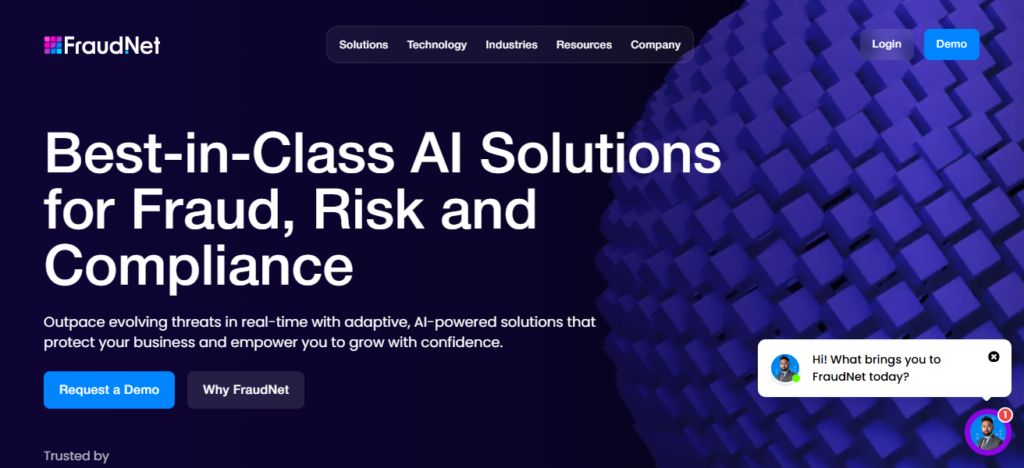
This allows companies to stop scams early before the impact snowballs, saving financial losses for businesses and consumers and engendering trust.
| Pros | Cons |
|---|---|
| Real-time fraud detection using AI and global intelligence | Can be complex to integrate for smaller businesses |
| Reduces false positives with advanced risk scoring | Requires quality data for accurate performance |
| Scalable solution for different industries | Pricing may be high for startups |
| Combines multiple data sources effectively | Needs continuous monitoring and tuning |
2. Kount
Kount utilizes AI and identity trust signals to identify fraudulent activities across digital transactions. The platform looks at user behaviour, device data, and transaction history to detect fraudulent patterns ahead of the approval process.
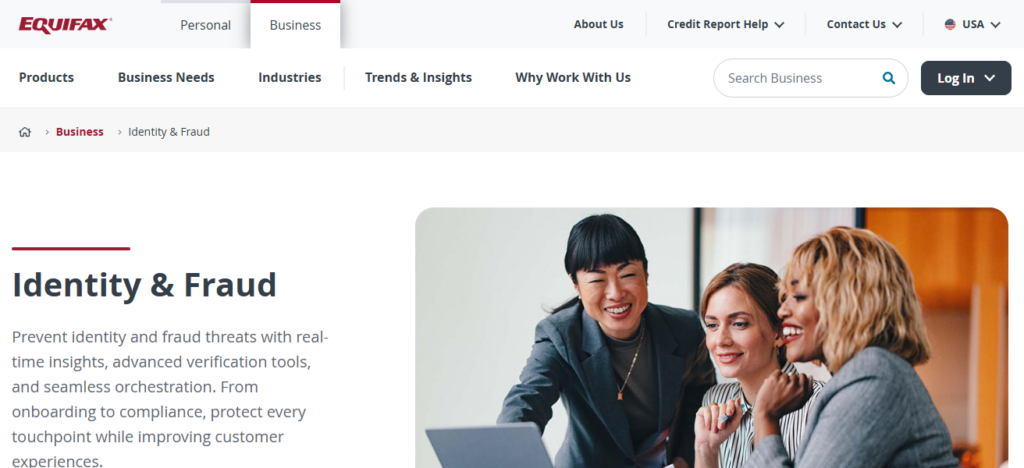
This ensures that Kount’s AI gains insight through the global data at its disposal — making detection more accurate over time. This kind of early intervention allows businesses to reduce chargebacks and unsuspected scams.
It ensures secure transactions and a smooth customer experience across e-commerce and digital platforms by enabling seamless integration.
| Pros | Cons |
|---|---|
| Strong identity verification and trust signals | Setup process may take time |
| Continuously learns from global transaction data | May require technical expertise to manage |
| Helps reduce chargebacks significantly | Costs can increase with usage scale |
| Seamless integration with eCommerce platforms | Limited transparency in AI decision-making |
3. Riskified
Other great functions are that Riskified processes eCommerce transactions through its machine learning algorithms to assess risks of fraud in real time. It assesses customer activity, purchasing behaviour and past data to separate real buyers from fraudsters.
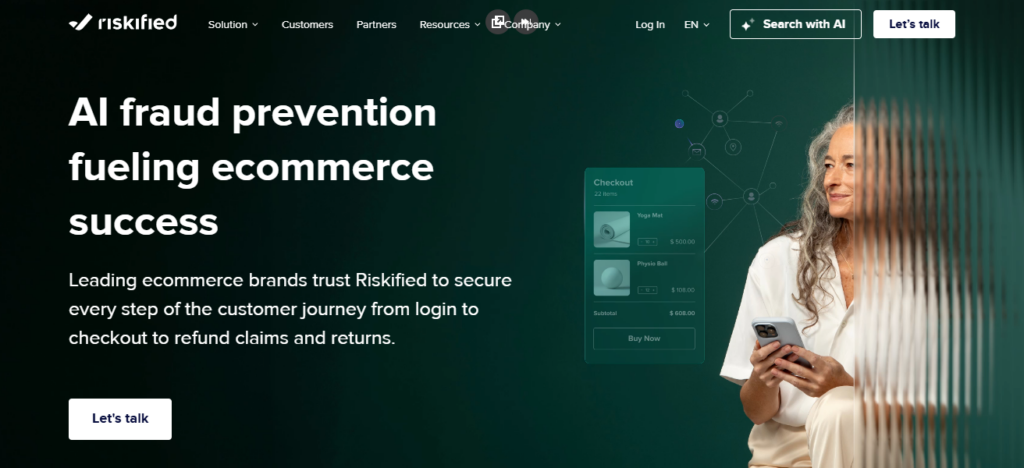
Riskified automates decision-making to help reduce chargebacks and improve approval rates of legitimate customers. The AI-driven system continues learning from the new variety of scams that emerge to catch businesses off-guard, giving the enterprise flexibility
To detect fraudulent activities early and mitigate risk in a way that does not detract from providing stores with a secure online shopping environment.
| Pros | Cons |
|---|---|
| High approval rates for legitimate transactions | Primarily focused on eCommerce businesses |
| Reduces chargebacks with automated decisions | Pricing model may not suit small merchants |
| Adapts to new fraud tactics quickly | Limited customization in some cases |
| Improves customer experience significantly | Dependency on historical transaction data |
4. Sift
Sift is an advanced platform on the grounds of AI to detect and prevent financial scams by observing user behavior across digital ecosystems. The solution merges machine learning with streaming data signals to detect fraudulent actions like payment fraud, account takeovers, and fake accounts.
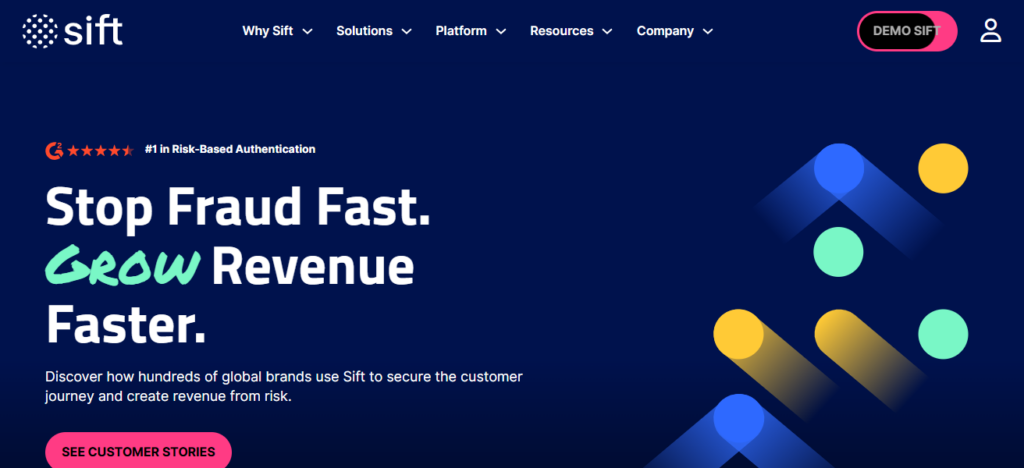
Sift has a strong network effect due to the fact that it learns from global fraud patterns. With quick action on threats, businesses can enjoy safer transactions as users are best protected from evolving financial scams.
| Pros | Cons |
|---|---|
| Detects multiple fraud types across platforms | Can be expensive for smaller companies |
| Uses network effect for better accuracy | Requires integration effort and time |
| Real-time fraud prevention capabilities | Learning curve for new users |
| Strong behavioral analysis features | May generate occasional false positives |
5. Feedzai
Feedzai [PRs] — They apply AI to monitor transactions and fraud in real time. It processes millions of records to detect anomalies and unusual patterns throughout the banking systems with its machine learning-based models.

Designed to respond quickly as new fraud techniques come into effect, Feedzai allows criminals and their methods little time to adapt — guaranteeing early detection of any scams such as money laundering or payment fraud.
Its in-depth analytics is leveraged by financial institutions to decrease risk, enhance compliance, and supply customers worldwide with a safe banking experience.
| Pros | Cons |
|---|---|
| Excellent for banking and financial institutions | Implementation can be complex |
| Real-time monitoring and anomaly detection | High cost for smaller organizations |
| Adapts to evolving fraud techniques | Requires skilled team to manage |
| Supports regulatory compliance | Integration with legacy systems can be challenging |
6. Darktrace
Darktrace is a security software company that designs self-learning AI to find cyber threats based on what normal network behavior looks like and alert an organization if abnormal activity takes place, including cybersecurity or financial fraud.
Its artificial intelligence, modeled after how the human immune system learns to recognize what is normal and what isn’t, detects deviations immediately.
That way, businesses can intervene before scammers cause them damage. Real-time containment of threats with Darktrace’s autonomous response capabilities keeps Darktrace relevant to cyber prevention and the proprietor of sensitive financial data, in addition to the reduction of financial fraud due to cyber attacks.
| Pros | Cons |
|---|---|
| Self-learning AI detects unknown threats | Can produce false alerts initially |
| Autonomous response to cyber threats | Expensive for small businesses |
| Strong protection against cyber-based fraud | Requires proper configuration |
| Works without predefined rules | Complexity in understanding alerts |
7. FICO Falcon
FICO Falcon is an example of a credit card fraud detection system that uses predictive analytics and AI techniques to identify potential fraudulent activity. It instantly detects the rather anomalies based on transaction patterns, spending behavior, and location data.
Falcon is used by financial institutions to stop transactions that shouldn’t go through, thereby taking a bite out of fraud losses. The real-time scoring system allows businesses to quickly make decisions and prevent scams from continuing while making the customer experience as seamless as possible for legitimate customers using credit and debit cards.
| Pros | Cons |
|---|---|
| Industry-standard for credit card fraud detection | Primarily focused on financial institutions |
| Real-time transaction scoring | Limited flexibility for non-banking sectors |
| Highly accurate predictive analytics | Implementation can be resource-intensive |
| Reduces fraud losses effectively | May require integration with legacy systems |
8. Featurespace
Featurespace Inc. — Financial fraud detection using adaptive behavioral analytics and AI across banking and payment systems Its technology creates personalized behavioral profiles for users and detects anomalies that could indicate fraud.
In contrast to rule-based systems that remain static in knowledge, Featurespace is capable of continuous learning and adapting, therefore improving accuracy over time.
This also allows for proactive detection of threats, including account takeovers and payment fraud, aligning organizations to more effectively safeguard customers from financial losses in a rapidly evolving threat landscape.
| Pros | Cons |
|---|---|
| Advanced behavioral analytics technology | Setup and customization can be complex |
| Continuously adapts to new fraud patterns | Requires high-quality data input |
| Reduces false positives significantly | Higher cost compared to basic tools |
| Effective against account takeovers | Needs technical expertise to operate |
9. SEON
SEON is a system that leverages AI and digital footprint analysis to be able to prevent fraud related to finance It analyzes email addresses, IP information, device fingerprints and social signals to filter bots or pirate accounts/colluding users.
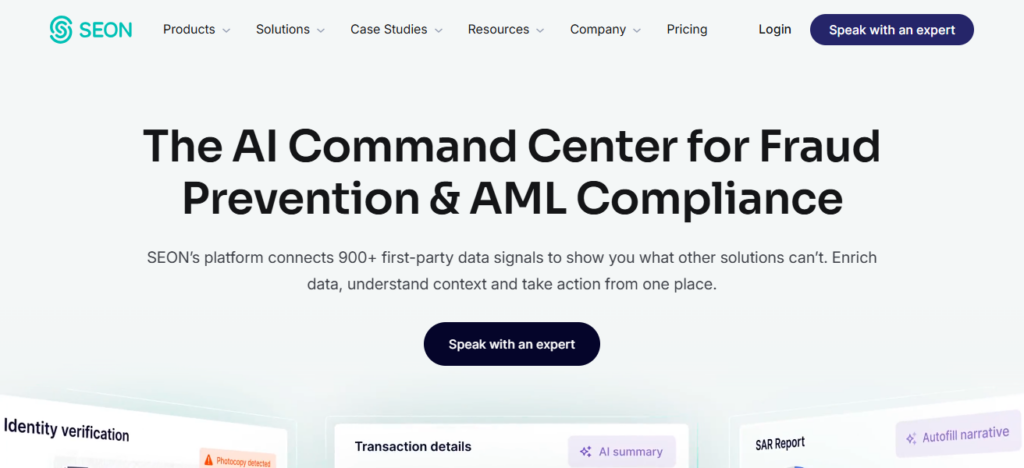
Businesses can use SEON to build custom fraud detection rules, but equipped with strategic AI insights. It is used by organizations to prevent scams while they are still in the initial stages, reduce chargeback frequency, and ensure safe onboarding & transaction processes across various digital platforms.
| Pros | Cons |
|---|---|
| Strong digital footprint and email analysis | May not cover all fraud types |
| Easy customization of fraud rules | Learning curve for beginners |
| Flexible and scalable solution | Some features require higher-tier plans |
| Helps prevent fake accounts effectively | Dependency on external data sources |
10. BioCatch
SoundCloud is a music-sharing platform that allows users to stream, create, and promote their own music and podcasts. It tracks keystroke speed, mouse movement, and gestures to spot irregularities that suggest an attempted break-in.

Even when using proven login credentials, BioCatch detects account takeovers and social engineering scams at an early stage. By doing so, it offers an additional layer of security to safeguard even financial institutions from advanced scams without having to upset regular user experiences.
| Pros | Cons |
|---|---|
| Unique behavioral biometrics detection | Privacy concerns for some users |
| Detects sophisticated scams and account takeovers | Implementation may be complex |
| Works even when credentials are valid | Requires continuous monitoring |
| Enhances security without affecting UX | Costly for smaller organizations |
Conclusion
To sum it all up, AI tools are revolutionizing the early detection of financial scams for businesses and individuals alike through real-time analysis and machine learning. Such solutions detect suspicious behaviors, mitigate risks and strengthen protection around digital transactions.
They’re not bulletproof, but they help prevent fraud. Today it is imperative to adopt the right AI tools, which can save money, build trust and provide safer online experiences in an increasingly complex digital landscape.
FAQ
What are AI fraud detection tools?
AI fraud detection tools use machine learning to identify suspicious financial activities and prevent scams early.
How do AI tools detect financial scams?
They analyze transaction patterns, user behavior, and anomalies to flag unusual or potentially fraudulent activities.
Are AI fraud detection tools accurate?
Yes, they improve accuracy over time by learning from data and reducing false positives significantly.
Can small businesses use AI fraud detection tools?
Yes, many tools offer scalable solutions suitable for startups and small businesses.
