


In this guide, I will provide insights into the Best Crypto Exchanges With Lower Fees Than Binance that you can check out to get lower trading fees, better Discounts on helping users find cost-effective exchanges.
This guide gives you insights on some of the best exchanges that help in minimizing trading costs, while providing powerful features for strong market liquidity and security to casual buyers and professional crypto investors in the market.
Key Points & Best Crypto Exchanges with Lower Fees Than Binance
MEXC Offers zero maker fees, competitive taker rates, and supports diverse coins for global traders efficiently.
Bitget Low spot and futures fees, strong copy-trading features, and transparent withdrawal costs attract frequent traders.
Gate.io Provides discounted fees via native tokens, wide coin selection, and advanced trading tools for professionals.
KuCoin Charges minimal trading fees, offers token-based discounts, and supports futures contracts with strong liquidity worldwide.
HTX (formerly Huobi) Low trading charges, zero withdrawal fees, and robust security make HTX appealing for cost-conscious investors.
Kraken Transparent fee structure, low maker-taker costs, and strong regulatory compliance ensure safe, affordable crypto trading.
Bybit Competitive futures fees, zero hidden charges, and advanced trading interface attract derivatives-focused crypto traders globally.
OKX Offers tiered fee discounts, strong DeFi integration, and reliable liquidity for both spot and futures markets.
Weex Emerging exchange with ultra-low fees, simple interface, and growing reputation among budget-conscious crypto enthusiasts worldwide.
CoinEx Flat low fees, transparent policies, and wide coin support make CoinEx ideal for everyday traders.
10 Best Crypto Exchanges With Lower Fees Than Binance
1. MEXC
MEXC Now considered one of the lowest-fee crypto exchanges on market, with often 0% maker fees and very low taker fees (~0.05%) which makes it cheaper than binance for many spot traders.
It is particularly favored for altcoin trading as it quickly lists thousands of new tokens. Competitive futures fees and frequent zero-fee promotions. Cost efficiency, early listings, or high liquidity for Emerging Tokens traders prefer MEXC!
But users will need to tread carefully as newer listings can be more volatile. MEXC is best for traders that want super low fees, with access to tons of altcoins.
| Pros | Cons |
|---|---|
| Extremely low trading fees (0% maker, very low taker fees) | Higher risk due to frequent new/low-cap listings |
| Excellent for altcoin discovery and early listings | Liquidity can be inconsistent for some tokens |
| Frequent zero-fee promotions | Not as regulated as top-tier exchanges |
| Strong futures trading options | Interface can feel complex for beginners |
2. Bitget
Bitget is a rapidly growing exchange with low and stable trading fees of roughly 0.10% for spot, comparable to Binance, but usually better for futures coworking fee discounts on top of competition prices! It also rewards token-based fee waivers with BGB which helps active traders to minimize cost even further.
Bitget is popular in copy and derivatives, with tight spreads and strong liquidity. For both newcomers and professionals, its fee structure is clear and competitive. In terms of fees, Bitget can become more cost-efficient than Binance; especially if users use promotions or when taking advantage of futures trading fee tiers.
| Pros | Cons |
|---|---|
| Low and competitive spot/futures fees | Not the absolute lowest in spot trading |
| Copy trading features for beginners | Limited fiat support in some regions |
| Strong liquidity in derivatives | Still growing brand compared to Binance |
| Token-based fee discounts (BGB) | Some features require learning curve |
3. Gate.io
Gate. io guarantees minimal fees (0.2% average base fee, with lower costs for active traders using VIP levels and discounts for GT token users) They are not cheaper than Binance at a base level but it still becomes very competitive for the high-volume user. Gate.
One notable exchange for the above is io which is notorious for having a huge amount of alt coins listed ranging from low-cap to more nascent projects. That makes it appealing to speculative traders, who value access over low fees.
Though fees are marginally elevated, the platform makes up for it with a deep token variety and regular new listings. For the long term or high-frequency trading, fees optimization strategies needed for minimizing overall transaction costs at Gate. io.
| Pros | Cons |
|---|---|
| Huge selection of altcoins and new tokens | Higher base trading fees (~0.2%) |
| Good for early-stage crypto investments | Interface may feel complex for beginners |
| VIP tiers reduce trading costs | Lower liquidity on some small coins |
| Strong global user base | Not ideal for low-fee focused traders |
4. KuCoin
KuCoin has about 0.10% maker and taker fees, yet users can lower this using KCS token discounts. That often makes it a little less expensive than Binance for active traders.
KuCoin has a vast number of supported cryptocurrencies and powerful trading bot ecosystem that significantly simplifies the strategy automation. The exchange has gained significant popularity among retail traders due to its user-friendly interface and low entry barriers.

Base fees are on par with Binance, but discounts and promotions can lead to costs that are a fraction of this. KuCoin combines affordable trading fees and automation tools, making it a great option for traders looking to accomplish both through one in platform.
| Pros | Cons |
|---|---|
| Around 0.10% fees with discounts via KCS | Withdrawals can be expensive sometimes |
| Large crypto selection | Regulatory concerns in some regions |
| Trading bots and automation tools | Not fully licensed in major markets |
| Beginner-friendly interface | Customer support can be slow |
5. HTX (formerly Huobi)
HTX usually has a spot trading fee of roughly 0.2%, more than the normal tier on Binance. Traders can, however, reduce them through HT token discounts and VIP tiers.
One of the oldest in the crypto industry, the exchange has an excellent liquidity on major trading pairs. HTX is an Asian trending exchange that offers futures trading with reasonable fees.
While not base-wise the cheapest, its worldwide presence and discounts put through effective trading costs down. Over time, HTX can be quite cost-effective for users who actively trade and take advantage of token benefits.
| Pros | Cons |
|---|---|
| Huge selection of altcoins and new tokens | Higher base trading fees (~0.2%) |
| Good for early-stage crypto investments | Interface may feel complex for beginners |
| VIP tiers reduce trading costs | Lower liquidity on some small coins |
| Strong global user base | Not ideal for low-fee focused traders |
6. Kraken
Kraken has strong security, and tiered trading fees of 0%–0.16% maker or up to 0.26% taker (for small traders this can be more than Binance). It does, however, use a tier system based on usage volume to give discounts in fees.
Kraken is known for its compliance and institutional-grade security. Although not an overall low-cost exchange, it does provide transparency by not hiding spreads and allowing you to predict costs.
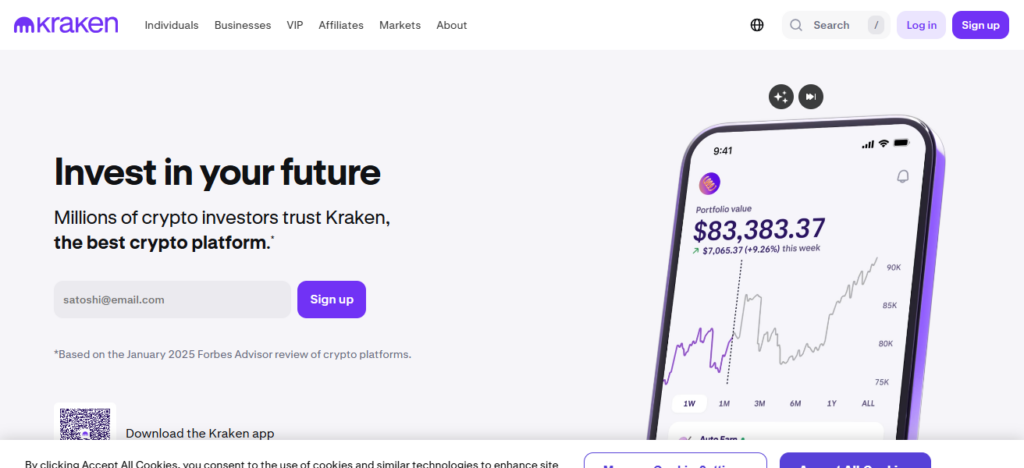
Its fees are competitive among advanced traders who care more about safety and regulation than ultra-low cost trading, especially in USD and EUR markets.
| Pros | Cons |
|---|---|
| Very strong security and reputation | Higher fees for small traders |
| Transparent fee structure | Limited altcoin selection compared to others |
| Great for fiat (USD/EUR) trading | Not ideal for low-fee trading strategy |
| Regulated and trusted globally | Interface less beginner-friendly |
7. Bybit
As we can see Bybit has about 0.10% spot trading fees, just as Binance, but its biggest advantage is an incredibly low cost of futures trading (as low as 0.02% maker and 0.055% taker).
This makes it more affordable than Binance for derivatives traders. Bybit is one of the most popular exchanges i.e which provides deep liquidity, as well as fast execution and professional trading tools.
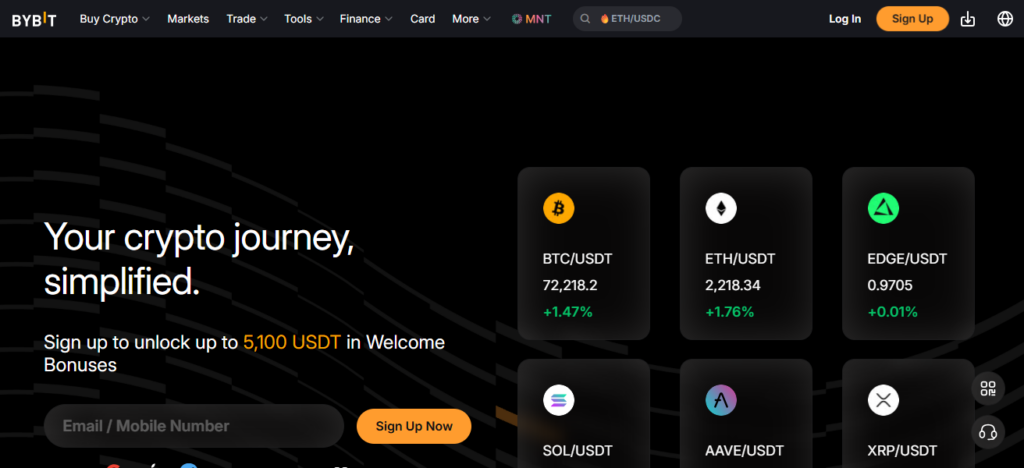
Fee reductions are also available to active traders through VIP tiers. In summary, when trading futures or using high-volume strategies, Bybit is more cost-effective compared to Binance.
Scalpers and leveraged traders looking to take advantage of high sits particularly well known; the exchange has extremely low fees and it brings a lot of liquidity to the market.
| Pros | Cons |
|---|---|
| Very low futures trading fees | Spot fees similar to Binance |
| High liquidity in derivatives | Not as strong in altcoin variety |
| Fast execution and trading tools | Some regions face restrictions |
| VIP discounts available | Focus more on derivatives than spot |
8. OKX
OKX does have a slightly lower base spot fee (about 0.08% maker & 0.10% taker), which can be cheaper than Binance for more market-making traders. It also provides further discounts via OKB token holdings and VIP tiers.
OKX is very advanced, they have great derivatives markets and institutions liquidity. Its fee structure is favourable to professional traders that put frequent limit orders.
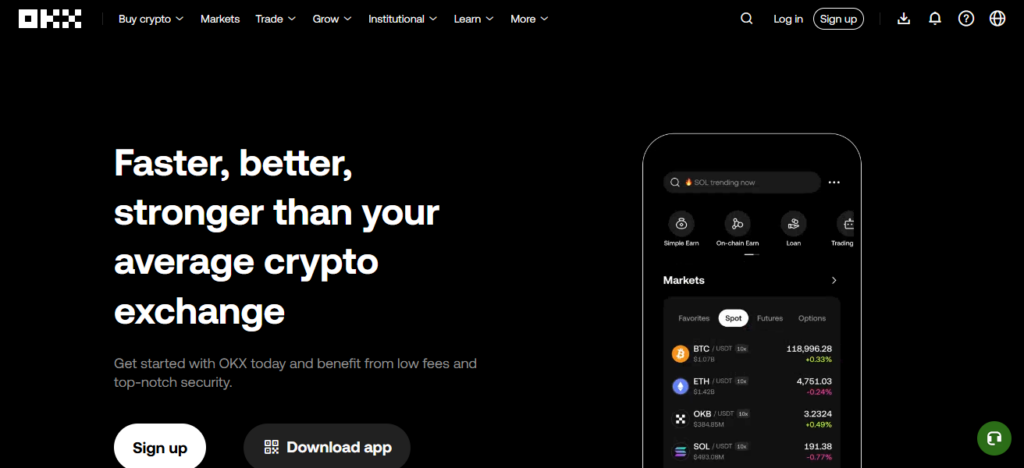
Since taker fees are similar to Binance, the lower maker fee gives it a cost advantage in many trading strategies. Lastly, OKX is excellent for high-volume and professional trading environment.
| Pros | Cons |
|---|---|
| Lower maker fees (0.08%) than Binance | Slightly complex fee structure |
| Strong derivatives and liquidity | Not beginner-focused |
| OKB token fee discounts | Some features locked behind tiers |
| Professional trading tools | Verification can take time |
9. Weex
WEEX | A new exchange which is highly competitive with low trading fees and promotion zero-fees on some pairs. It serves below or equal to Binance-level pricing on its standard spot and futures fees, strategically for cost-sensitive traders.
WEEX emphasizes heavily on derivatives trading and copy trading features. It also offers referral and bonus systems, which significantly decrease trading cost.

Although not on the same scale as Binance and OKX, its low-fee promotions and simpler structure offer attractive options for beginner and mid-level traders searching for efficiencies trading several instruments.
| Pros | Cons |
|---|---|
| Low trading fees and promotions | Smaller exchange with lower trust history |
| Copy trading features | Limited global recognition |
| Bonus/referral incentives reduce cost | Lower liquidity than top exchanges |
| Futures-focused platform | Still building reputation |
10. CoinEx
Usually matching or slightly under, depending on promotions for Binance, CoinEx also offers flat and transparent fees for spot trading around 0.10% as well. It has a CET token under its umbrella which backs fee discounts for users and can lower the cost of trading even further.
It is highly recommended to use CoinEx as most suitable option for all traders must know that is simple, easy to use, has very stable fee structure without any complex tiers. It has a strong reputation for price predictability, and supports a wide variety of altcoins.
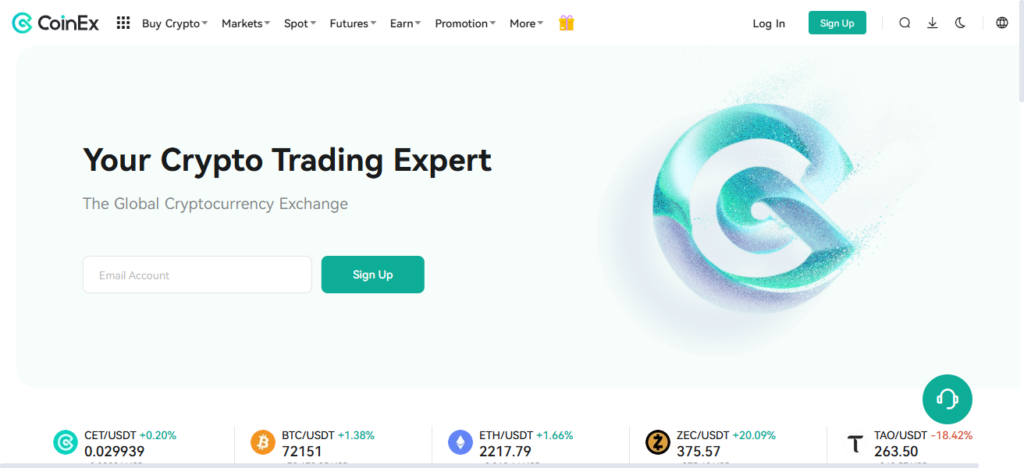
Although it is not the most cost-effective exchange on every level, it has a consistent fee model and works with token-based discounts that ultimately mean lower-free trading than its competitors for retail traders who want easy shipping and low banks compared to Binance.
| Pros | Cons |
|---|---|
| Stable ~0.10% trading fees | Not the cheapest in all cases |
| CET token reduces fees further | Smaller ecosystem than Binance/OKX |
| Simple and beginner-friendly | Lower liquidity on some pairs |
| Wide altcoin support | Less advanced trading tools |
Conclusion
Finally, for a lower fee or similar to the Binance one there are several other exchanges like MEXC, Bitget, Bybit, OKX, KuCoin, CoinEx and many more. Such platforms offer cost benefits by avoiding trading fees, discounts on tokens, and other promotions.
While Binance is still one of the king exchanges, those looking to reduce costs in spot or futures trading should check out these alternative platforms based on their individual trading needs and strategy.
FAQ
Is OKX cheaper than Binance?
Yes, in many cases OKX is slightly cheaper because it offers 0.08% maker fees, which is lower than Binance’s standard rate.
Is Gate.io cheaper than Binance?
Not usually. Gate.io has higher base fees (~0.2%), but large traders can reduce costs using VIP levels and GT token discounts.
Is MEXC cheaper than Binance?
Yes, MEXC can be cheaper because it offers 0% maker fees and very low taker fees (~0.05%), making it ideal for low-cost spot trading.
Is Bybit better for trading fees?
Yes, especially for futures trading. Bybit offers very low derivatives fees (as low as 0.02%), often cheaper than Binance.
